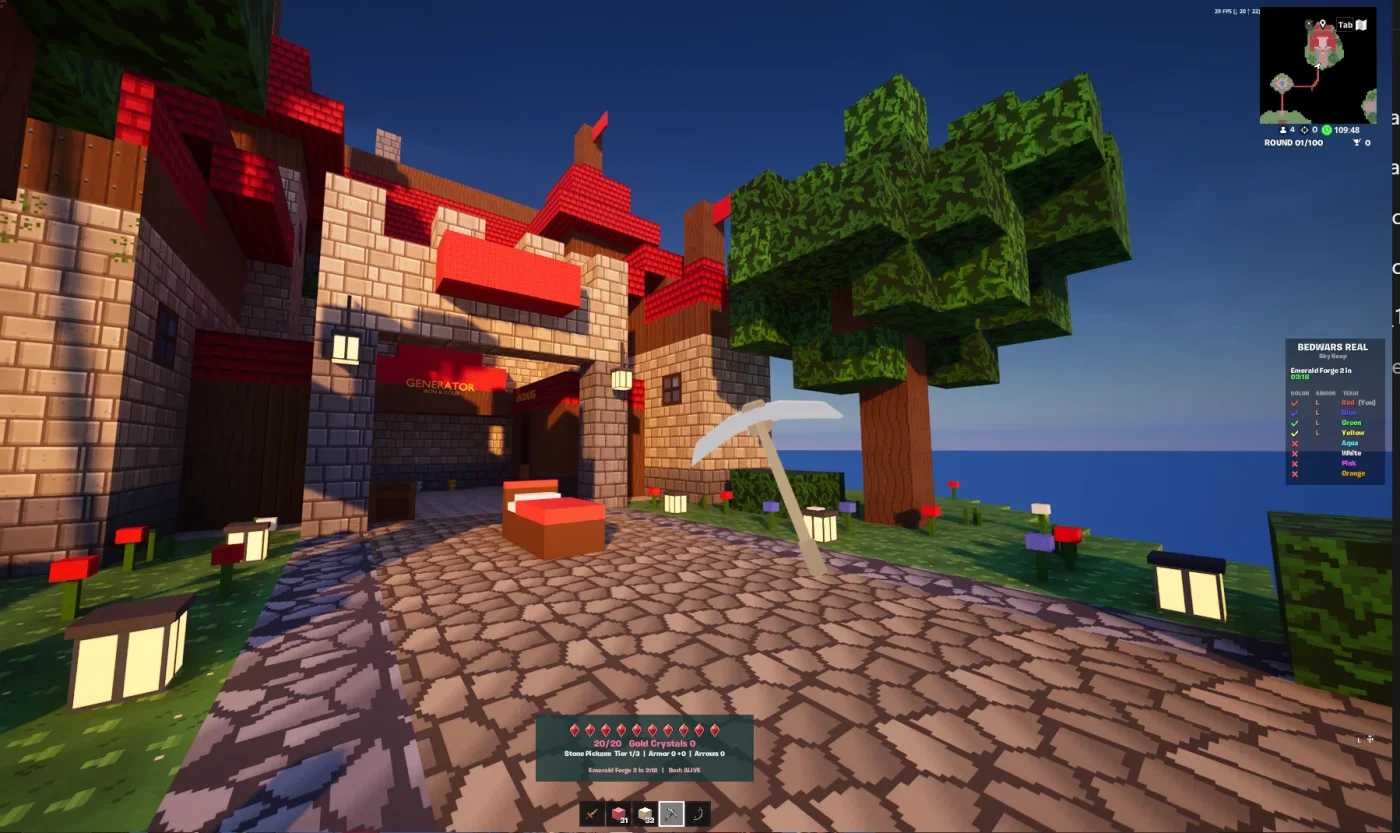
Bedwars: The Origin FI

Fortnite UEFN · Verse · Claude Code + MCP · 2026

Bed Wars in Fortnite, down to the feel

A development story of how the Minecraft Bed Wars game mode was rebuilt in Fortnite's UEFN editor so that movement, building and combat feel like the original. The game was made in six weeks by a human and an AI agent working together: the agent drove the editor over an MCP connection, wrote the Verse code and produced the models with Blender scripts, while the human playtested and made the decisions.

The finished map in the editor

Bedwars: The Origin is a re-implementation of Bed Wars, the game mode familiar from Minecraft, in Fortnite's UEFN editor. It was built between 27 Sep and 8 Nov 2026 over 47 Claude Code sessions and released on 6–7 Nov 2026 under island code 4189-7888-9164. This chapter explains what the project set out to solve, which Fortnite limitations shaped the solutions, how the finished game is split across 34 Verse files and what was done in each development phase. It is a map that places the later chapters, each focused on a single mechanic, into the whole.

Goal: a Bed Wars that feels like the original

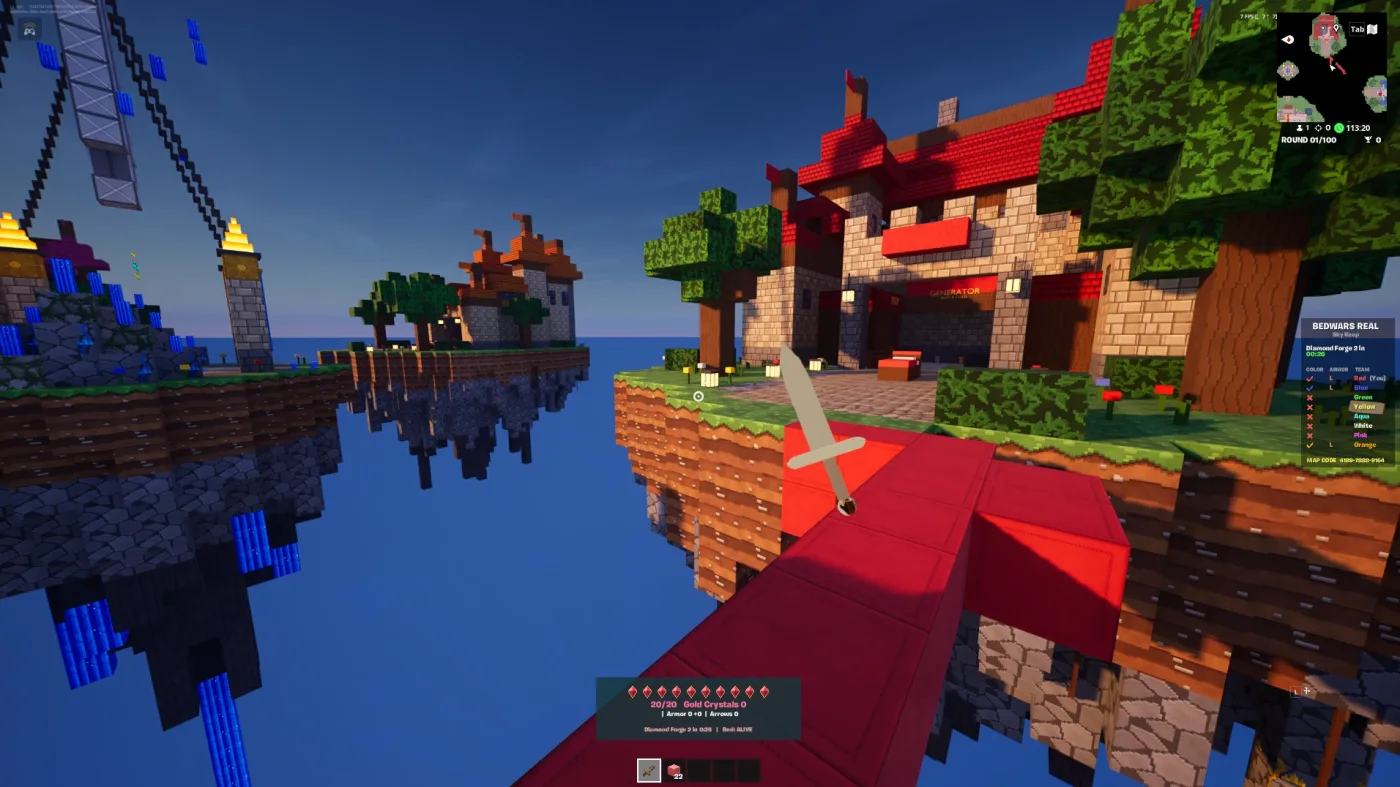
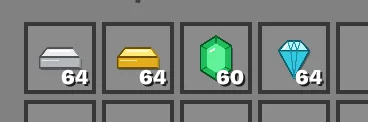
Bed Wars is a team game popular on Minecraft multiplayer servers (Hypixel being the best known). Each team has its own island with a bed on it. As long as the bed is intact, a player who dies respawns; once an enemy breaks the bed, the next death is permanent (a final kill). The islands have generators that produce iron, gold, diamonds and emeralds, which are spent in a shop on blocks, weapons, armour and special items. Players build bridges of blocks between the islands, and the last team still in the game wins.

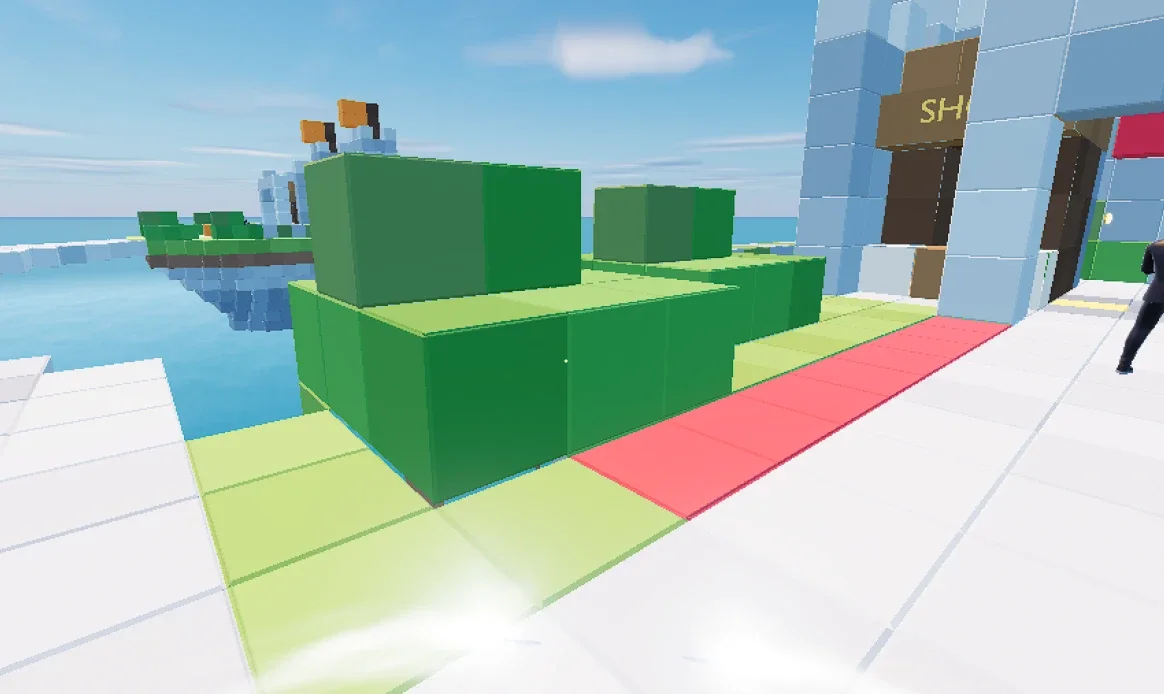
The goal of the project was to bring this game mode to Fortnite so that it feels like the original, specifically like Minecraft 1.8.9: a jump of about 1.25 metres and one block high, a sprint jump across a three-block gap, a two-block wall impassable, a block appearing under your feet instantly on click, shift, i.e. sneaking (a crouch in which you cannot fall off an edge), enabling speed bridging, i.e. fast bridge building while walking backwards, pillaring (jumping and placing a block under your own feet) raising a tower smoothly, and PvP (player-versus-player combat) knockback (the backwards flight caused by a hit) matching the distances of the original.

UEFN (Unreal Editor for Fortnite) is Epic's editor for building custom islands inside Fortnite. Game logic is written in the Verse language, and ready-made functionality is provided by devices, such as the movement modulator, input trigger, conditional button or item granter. The work was done with the Claude Code agent through MCP (Model Context Protocol): Epic's own MCP server on port 8000 gave the agent access to the editor, so it could compile Verse, place and configure devices, import meshes and textures, start a test session and read the server log. Before the first session, the project had been worked on with another AI service whose credits ran out; that left behind backups in the Blocks folder dated 25–26 Sep.

Limits set by Fortnite

The biggest limitation is that Verse runs on the server and has no client prediction. Only Fortnite's own movements, such as walking, sprinting and jumping, are predicted on the player's machine. Everything done in Verse, for example placing a block, the sneak edge guard or knockback, becomes visible to the player only after a network round trip. For this reason many mechanics are built so that the server makes its decision in advance: blocks are taken from a ready-made pool, pillaring has a 0.25-second cut-off before landing, and the invisible sneak walls are raised before the player is at the edge. According to a reply from Epic on the forums, client-side Verse (Predicts) is on the roadmap for Q2 2027, so some of the solutions are intentionally temporary.

Fortnite has no voxel engine. The map consists of static meshes made in Blender, with collision built from boxes, and the blocks players place are Verse-created entities or props on a 1-metre grid. The grid is 193 × 193 × 73 cells (X and Y −96…96, Z −24…48), and Verse tracks every cell in a map. The map's own solid cells were generated into a bitmap in the file bedwars_grid_support.verse, so that both building and sneaking know where there is ground.

Other limits came up during development: Fortnite's sprint cannot be turned off by any setting, the island's movement settings override some devices, speed changes reach the player about 0.25 s late, ending a Verse game with the End Game device crashed the server, the server only sees player names as anonymous, and after every push of changes the first life could be broken because the server wrote to the pawn before the client had taken control of it. Minecraft-style water was abandoned entirely on 30 Sep because the float band of Fortnite's water device could not be bent into voxel water.

Architecture of the finished game

The game's Verse code is in 34 files in the folder MyProjectF\Content, 16,767 lines in total. Four Verse devices (creative_device) are placed in the level: bedwars_building is the host of the whole game, shift_sneak owns movement and cameras, bw_pvp_manager is the combat hit gate, and bedwars_fps handles the first-person camera and the starting sword. The other systems are ordinary Verse classes that the host creates and gives a reference to itself (field Host or Game). bedwars_building has 111 editable fields to which the level's devices are wired.

When the game starts, the host bedwars_building creates the combat system bw_combat, the lobby bw_lobby, dropped items bw_pickups, chests bw_chests, the sidebar bw_sidebar, the global leaderboard, the practice and test players and the bots, and itself contains the voxel world, the inventory, the block catalog and the break effects. bw_combat in turn owns the beds, the timeline, the world border, the bow, the Rift Orb (a throwable teleport item) and the old water system. Combat rules go through interfaces: bw_pvp_manager knows the game only through the interfaces pvp_combat_host (bw_combat reports terrain and equipment), pvp_movement_hooks (shift_sneak reports movement state) and pvp_knockback_driver (bw_practice launches practice targets), so the hit logic is not tied to the rest of the Bed Wars code.

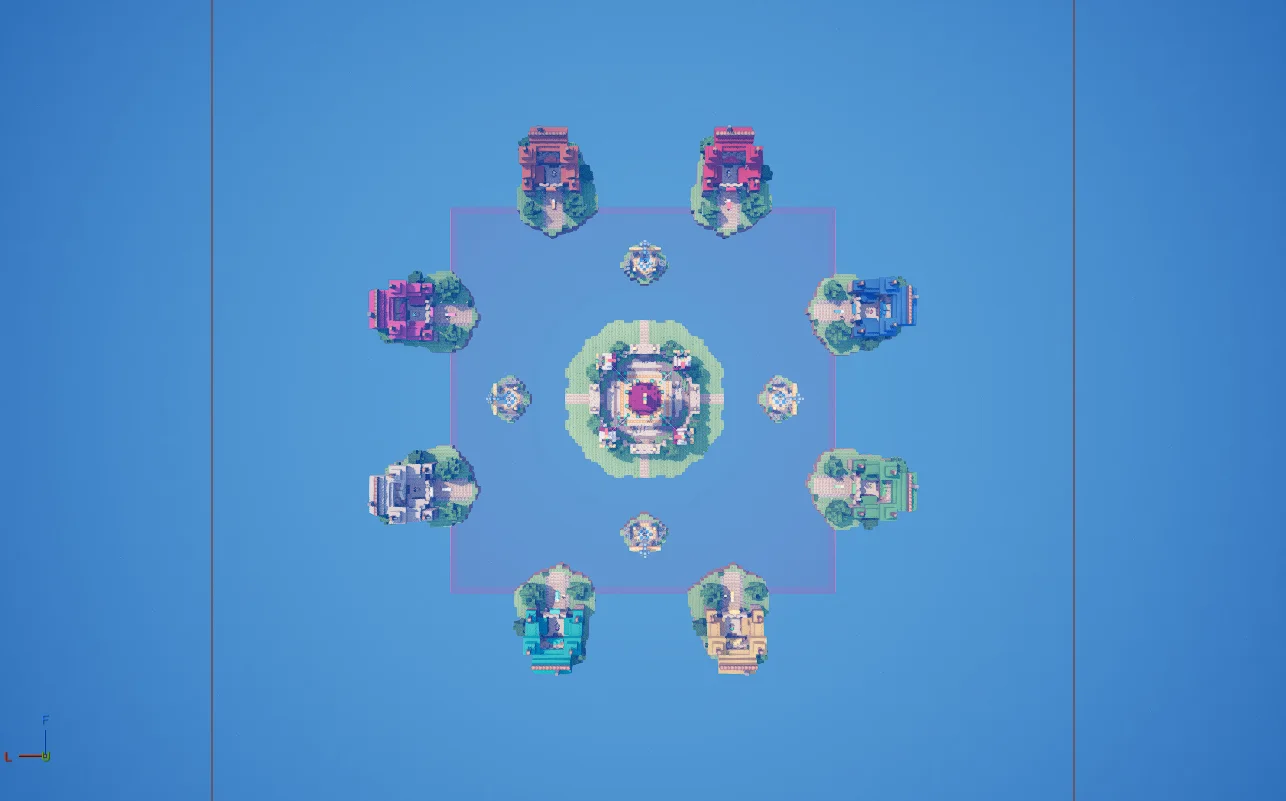
The finished map seen straight from above in the editor: eight team castle bases in a ring, four small diamond islands and, in the middle, the Coronation Court emerald island. The pale square is the initial size of the world border, which covers all buildable cells.

Systems by file

Movement and shift (shift_sneak.verse, 1,886 lines). Jumping and walking are Fortnite's own, client-predicted movements; their shape comes from the island gravity of −1950 cm/s² and the speed multiplier of 1.26 (walking about 4.4 m/s, sprinting about 6.9 m/s), which shift_sneak adjusts with movement modulators. Sneaking is implemented with invisible barrier devices reserved for each player: while the sneak key (crouch) is held, walls are raised on the edges of the block under the player, read from the bedwars_grid_support and voxel data. The same file manages the camera stack (base, sprint and sneak cameras), the speed cap for jumping against a wall, and the first-life wait until the client is driving the new pawn. It implements the pvp_movement_hooks interface, through which combat knows whether the attacker is sprinting.

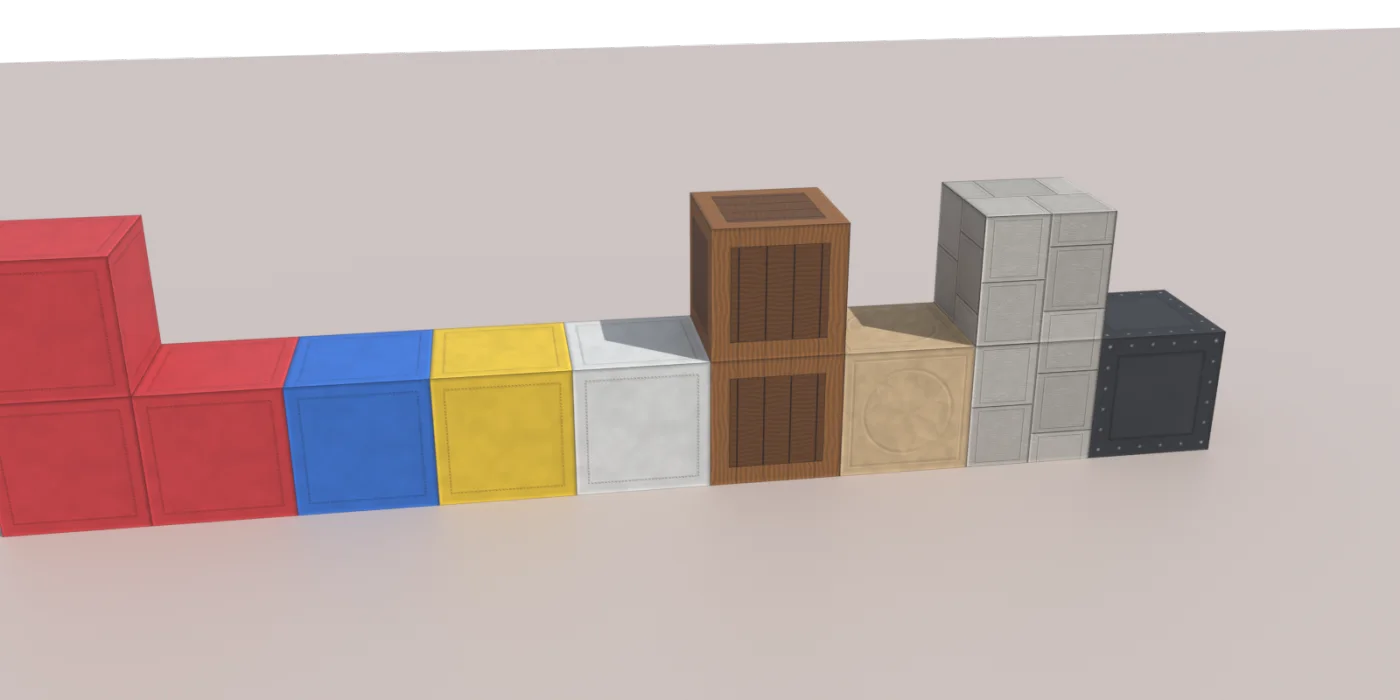
Building and voxels (bedwars_building.verse 2,697, bedwars_voxels.verse 96, bedwars_grid_support.verse 169, bedwars_block_catalog.verse 91, bedwars_break_fx.verse 75, bedwars_water.verse 1,028, bedwars_water_motion.verse 90). bw_voxels stores placed blocks under a key computed from the cell coordinates and knows the map's own solid cells. bedwars_building reads clicks from input triggers, computes which cell the view ray hits and places a block from the ready-made pool (4 per type, at most 4,096 blocks); pillaring uses faster prop blocks. The block catalog defines six blocks (Banner Felt, Carved Sandstone, Blast Glass, Keep Stone, Crate Wood, Bastion Plate) with their prices, mining times and blast resistances, and break_fx shows a ten-stage cracking animation. The water files are still in the project, but the water bucket was removed from the shop.

Combat (bw_pvp_manager.verse 401, pvp_rules.verse 386, bedwars_combat.verse 2,730, bedwars_rules.verse 67, bedwars_bow.verse 432, bedwars_pearl.verse 287). Every damage source (melee hit, arrow, explosion, summoned creature, fall, void, Rift Orb, border) builds a single pvp_hit record and calls bw_pvp_manager's Resolve function, which is the only gate: it checks the hurt window (0.39 s, i.e. 12 server frames), the team and the combat tag, and writes the knockback as the pawn's velocity. pvp_rules contains Minecraft's formulas in the project's units; a plain hit launches the victim about 1.99 blocks and a sprint hit about 4.94 blocks. bedwars_combat is the hub joining combat and economy: purchase events, equipment, fireballs, TNT, summoned creatures, generator piles and the building ban in bases. The bow and the Rift Orb simulate their own trajectories in Verse using Minecraft's 20 Hz formulas.

Economy, shop and inventory (bedwars_shop_catalog.verse 116, bedwars_inventory.verse 1,741, bedwars_chests.verse 149, bedwars_pickups.verse 212, bedwars_ui_keys.verse 80). The shop consists of shopkeeper characters and a UI drawn by Verse, whose items, prices and icons come from shop_catalog in nine categories. Payment works as a purchase ticket: the price is checked, a conditional button charges the currency, and only the button's confirmation grants the item. The inventory is Minecraft-like, 5 hotbar slots + 27 storage slots, and it mirrors Fortnite's own hotbar with invisible filler items. Chests (the team chest and the personal vault), dropped stacks and currency pickup use the same slots, and ui_keys binds the close and tab keys of the shop and inventory so that they also work on a controller.

Match cycle, timeline and border (bedwars_beds.verse 353, bedwars_timeline.verse 211, bedwars_border.verse 240, bedwars_keyframes.verse 15). bw_beds tracks the beds and team members and decides final deaths and the winner. bw_timeline runs a Hypixel-style timeline at six-minute intervals (Diamond II, Emerald II, Diamond III, Emerald III, bed destruction) and drives the islands' Verse generators: diamond 30/23/12 s and emerald 65/50/35 s per tier, at most 8 or 3 waiting. Finally, bw_border draws a red border at the 40-minute mark about 97 metres from the centre and closes it completely in 480 seconds; the panels move on linear keyframes from the keyframes file, which the client plays back smoothly. At the 50-minute mark, a game still in progress ends in a draw.

Lobby and stats (bedwars_lobby.verse 955, bedwars_stats.verse 169, bedwars_global_board.verse 155, bedwars_sidebar.verse 298, bedwars_lobby_art.verse 33). bw_lobby runs the phases waiting, countdown, match and end, places players in a castle-style waiting lobby above the map and draws the wall boards. bedwars_stats saves permanent lifetime stats (kills, final kills, beds broken, wins, games, deaths) and computes ten ranks; the save format must never be changed, only extended. global_board carries a worldwide top 10 list in the players' own saves and merges the lists whenever players meet on the same server. bedwars_sidebar shows the team status and armour codes (e.g. P IV) and the island code during a match.

Visuals and hand models (bedwars_viewmodel.verse 193, bedwars_item_models.verse 41, bedwars_fps.verse 265). The player does not see their own character; the camera hides it, and the held item is drawn as a separate first-person model (viewmodel) whose sway, swing and bow draw are computed attached to the camera. item_models maps item identifiers to the 3D models shown on the ground and in third person. bedwars_fps defines the Bedwars module through which Verse refers to content, and manages the starting sword as well as the building and spectator cameras.

Test players and bots (bedwars_practice.verse 602, bedwars_test_players.verse 263, bedwars_bots.verse 241). bw_practice runs the practice targets: guard bots do not react to Fortnite's physics, so their knockback flight is computed in Verse as a copy of the movement measured from a player pawn. bw_test_players includes UEFN's test players as real participants who wait in the lobby, spawn at a base and count towards the bed and win rules. bw_bots is a solo mode added after release: if a player has waited alone in the lobby for 60 seconds, two defender bots appear on the neighbouring islands; they use the same hit gate and the test player rules and do not accumulate stats.
Content pipeline: from Blender to Verse

All of the game's own graphics were produced by scripts rather than by hand modelling. The folder Documents\ChatGPT\Blocks contains 380 Python scripts, of which 44 build_*.py scripts produce the actual assets when run in Blender 5.1 in background mode: the voxel meshes and palette (build_assets.py), the castle bases, diamond islands and centre island (build_keep_v3.py, build_diamond_v3.py, build_center_v3.py), the lobby, beds, shop booths, coins, 3D items and hand models, break effects, and textures such as block set v2 (build_block_textures_v2.py), the map atlas's 32-pixel tiles (build_keep_tiles_v4.py) and the shop icons (build_shop_icons_v2.py). The output is FBX meshes and PNG textures.

Import into UEFN was done through MCP (StaticMeshTools.import_file and TextureTools.import_file). Several rules were learned along the way: the importer rotates FBX meshes by 90 degrees, so the models are rotated in advance; automatic LODs are removed from every import and the Nanite fallback is set to full precision, because otherwise blocks looked melted on machines without Nanite support; a texture cannot be replaced under the same name, so the map atlas progressed through the names V4–V8; the old FBX importer ignored vertex colours until the setting was changed; and assets must be saved before the Verse build, because otherwise the editor opens a save dialog that requires the user to confirm. Collision shapes were built as box lists, and gaps in them were found by tracing every grid column.

Verse refers to imported assets by path, for example Bedwars.Building.SM_BW_Item2_SwordIron or Bedwars.Lobby.T_BW_Rank2_1, and the map's solid cells were generated from the file grid_v2_solid_cells.json into a Verse bitmap that must be kept in sync with the level. Finally, changes were compiled (VerseToolset.BuildAll), the test session was stopped and the changes were pushed, and the result was checked from the server log and from editor shots that mcp_capture.py took from saved camera angles.

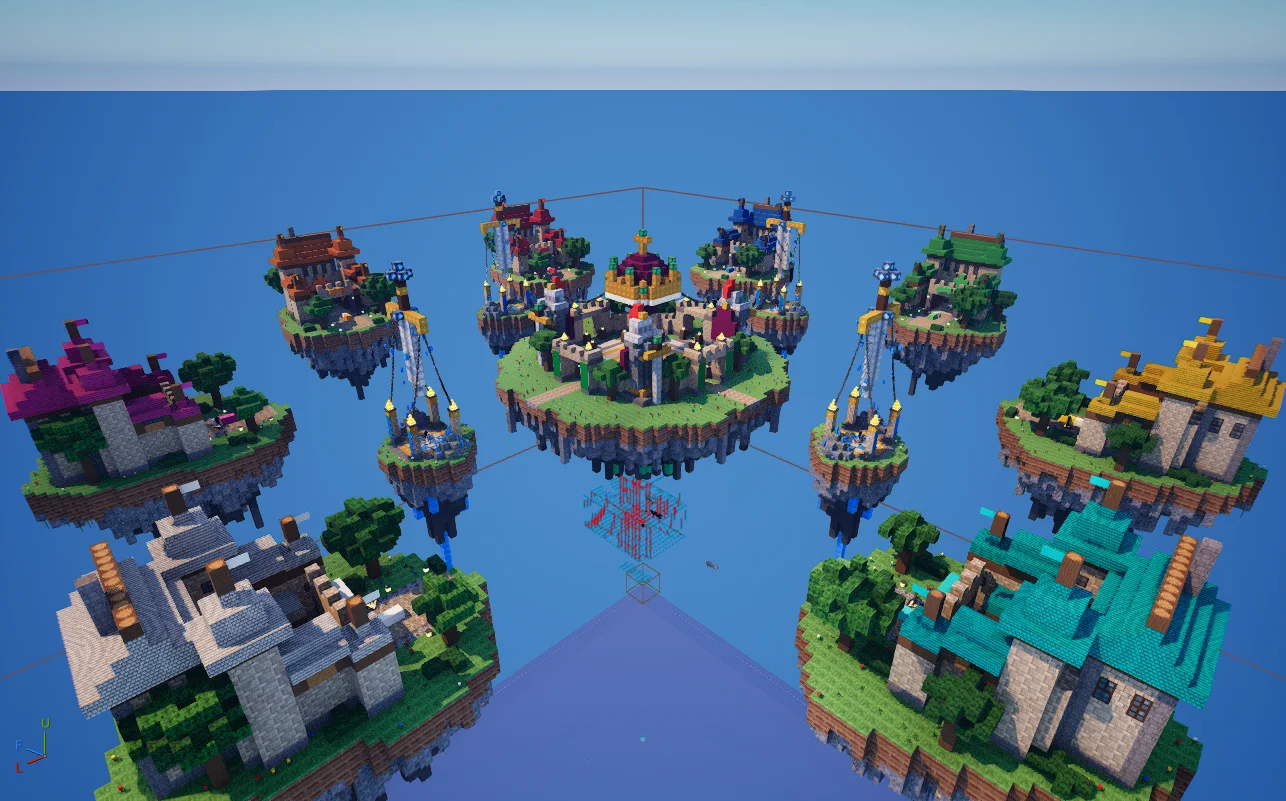
The map at an angle from above: castle bases imported from Blender scripts in their team colours, diamond islands with their chained swords and, in the middle, the crown-topped Coronation Court. All surfaces use a single custom tile atlas, and below the islands the device scaffolding under the map floor is visible.

Development phases 27 Sep – 8 Nov 2026

Movement and building (27–28 Sep). On the first day the Epic UEFN MCP connection was set up and work began on the Minecraft jump: gravity, the speed multiplier of 1.26, the two-block wall and the map's collision shapes. The next day speed bridging was made faster, the sprint-jump boost over a block was removed with a speed cap against walls, gravity was locked at −1950, and a double block produced by a single click was fixed.

Combat and the overall game (28–30 Sep). A Minecraft-style combat architecture was built whose knockback distances matched the original to within a few percent when measured. After that came the shop gadgets, team upgrades, the Hypixel timeline, the shrinking zone and spectator mode, the waiting lobby with permanent stats and ranks, a crash-free game cycle (8 consecutive game ends), the sidebar, a custom inventory, chests and Verse generators, and the building ban in a base's inner court. Water was removed from the game.

Launch plan (1–7 Oct). Based on a release analysis, plan v2 was drawn up: bridges removed, a deeper void, the lobby hidden when viewed from below, and the world border closing completely. The first two steps were implemented and tested the same evening. The same week, planning of the bachelor's thesis began, and no changes were made to the game for a few days.

Look and usability (11–12 Oct). The whole map was redesigned in a castle style (Sky Keep bases, Chained Sword diamond islands, Coronation Court), the lobby was converted to the same style and got a global top 10 board. Block placement got a ready-made block pool, sneaking a 0.15 s lead, the inventory its own screen and controller support, final-killed players a SPECTATE button, and the sky the Storm Keep fog.

Pillaring and custom graphics (14–19 Oct). The suction and jerks in pillaring were removed with prop blocks and a 0.25 s landing cut-off, and the broken first life after a push and the hotbar order were fixed. The shop icons, 3D items, hand models and a custom block set were made in the new style. A Fortnite update briefly broke the editor, and a sneak leak at the corner of diagonal blocks was fixed.

Polish and copyright (19–21 Oct). All eight team upgrade and trap cards passed an automated live test (50/50). Minecraft-style textures, names, hearts and the bed were replaced with custom ones (atlas V8, life crystals, sapphire and jade), Minecraft and Hypixel names were scrubbed from all files, and 0.4 s was chosen as the PvP hurt window. The world border was made visible and closing all the way, joining players were made to spawn directly in the lobby, sneaking was moved to the crouch key and sprint was consumed. At the same time it was decided to carry the mechanics over to a new Pillars project as well.

Thesis and release preparation (25 Oct – 2 Nov). Bed Wars was used as a pilot for the bachelor's thesis, but the case was later switched to the smaller Paint Wars. On 2 Nov, Verse builds broken by a UEFN update were fixed, test currency was cleared from the starting inventory, Party Choice matchmaking was selected, the test bots were removed and the starting spawn was fixed.

Release and documentation (6–8 Nov). The game was released as Bedwars: The Origin: the Creator Portal forms, age rating and promotional images were done, bugs found in the live version were fixed (a 64-currency test wallet left over from an old level setting, the island code and the portal), and defender bots were added for solo players. The thumbnail and logo were redone for Release 2, and finally the project was documented in the Docs folder (README, 387 images, a gallery and this development story).

Key values

WhatValueWhat it affects
Development time27 Sep – 8 Nov 2026 (43 days)From the first MCP connection to the completion of the documentation
Claude Code sessions47Sessions ranged from questions of a couple of minutes to work stretches of several days
Developer prompts1,029All developer messages across 47 sessions (sessiot.json)
Developer image attachments185 (136 files)Playtest screenshots and references, folder kuvat_kayttajalta
Verse files34MyProjectF\Content\*.verse, four of which are devices placed in the level
Verse lines16,767wc -l; about 2,193 comment lines and 950 blank lines, total size about 889 KB
Largest filesbedwars_combat 2,730, bedwars_building 2,697, shift_sneak 1,886, bedwars_inventory 1,741 linesCombat and economy, building, movement and inventory
Host device wiring111 @editable fieldsLevel devices and settings wired to bedwars_building
Blender scripts380 .py, of which 44 build_*.pyDocuments\ChatGPT\Blocks: production of models, textures and icons, plus MCP helper scripts
Documentation images387Docs\kuvat: icons, 3D renders, blocks, atlas tiles, editor shots, UEFN exports
Build grid193 × 193 × 73 cells of 1 m eachX and Y −96…96, Z −24…48; at most 4,096 placed blocks
Teams and islands8 bases, 4 diamond islands, 1 centre islandKeep v3 castle map
Gravity−1950 cm/s²Island setting; jump apex about 1.25 m as in Minecraft
Match timelineevery 6 min, border at 40 min, closed at 48 min, draw at 50 minGenerator tiers and bed destruction, then the closing world border
Release6–7 Nov 2026, island code 4189-7888-9164Bedwars: The Origin; Release 2 was prepared for review on 7 Nov.

Final state

In the released game the whole Bed Wars cycle works from the lobby to the winner: Minecraft-feel movement, instant building, speed bridging and pillaring, 1.8.9-style knockback, the shop, inventory, chests, team upgrades, generators, timeline, closing border, permanent stats, ranks, global top 10 and solo bots. Left open were the things that require client prediction (late pillaring clicks are left without a block until Verse Predicts arrives), the smoothness gap compared with Pillars was never measured, and several late fixes (for example the global board names, spectator mode, controller inventory moves and bot combat) were not confirmed in full playtests in time. The water system code is still in the project, unused.

Chapters

Movement: Minecraft jumping and running on Fortnite's physics pawnBed Wars is a game mode familiar from Minecraft in which teams defend a bed on their island and build bridges out of blocks to the other islands. The mode only works if m…Shift sneaking and speed bridging: stopping at the edge in FortniteIn Bed Wars, bridges are built over the void, and the whole rhythm of building relies on being able to stop at the edge of a block by sneaking without falling. Fortnite h…Placing and breaking blocksBed Wars is a team game in which each team protects its own bed and builds bridges and defences out of blocks from island to island. Fortnite has no built-in Minecraft-st…Combat: classic PvP on Fortnite's physics character, bows, explosives and botsIn Bed Wars, combat decides who gets to break a bed and who falls off the island into the void. The goal was therefore for hits, knockback, bows and explosives to feel th…Economy: currencies, generators, shop, team upgrades and a custom inventoryIn Bed Wars (a team game in which every team defends its own bed and tries to break the others' beds), all gear is bought with currencies produced by generators in the ba…Game flow: beds, timeline, shrinking border, waiting lobby and persistent statsThis chapter explains how a Bed Wars match works from start to finish: beds, respawning, final death, the winner, the match timeline and a border that closes all the way.…Visuals: map, blocks, icons, sky and an original visual identityThis chapter describes how the map and graphics of Bedwars: The Origin went from flat-coloured cubes to an original castle style in which every model and texture is gener…Workflow, performance and release: driving the editor over MCP and the road from Creator Portal to liveThe whole of Bed Wars was built with the Claude agent driving Epic's UEFN editor directly over an MCP connection while the developer tested the changes in game. The first…

Next chapter: Movement →