Bedwars: The Origin FI

Chapter

Game flow: beds, timeline, shrinking border, waiting lobby and persistent stats

This chapter explains how a Bed Wars match works from start to finish: beds, respawning, final death, the winner, the match timeline and a border that closes all the way. The same whole includes the waiting lobby floating above the map, permanently saved stats, a ten-rank system and a worldwide top 10 board. Without a working game loop the game could not have been released: the first round changes crashed the server, and joining, round transitions and waiting had to feel as smooth as on any Fortnite map.

Starting point: the rules of Bed Wars and what the map was missing

Bed Wars is a team game familiar from Minecraft. Every team has its own island with a bed in its courtyard. As long as the bed stands, a player who dies respawns on their own island. Once an opponent has broken the bed, the team's next death is final, a final kill, and the player is out of the match. The last team that still has a player in the game wins. Resources (iron, gold, diamonds and emeralds) are collected from generators and used to buy blocks, weapons and team upgrades.

Bedwars: The Origin was built with Fortnite's UEFN editor (Unreal Editor for Fortnite). The game logic is written in the Verse programming language, and ready-made Fortnite devices are placed on the map, such as spawn pads, the End Game device and the Island Settings device. Development was done with the Claude Code agent, which drove the editor over an MCP connection (Model Context Protocol): it could place devices, change settings, compile Verse and take screenshots in the editor.

As of late September the map had eight coloured bases, but no actual bed mechanic at all: the beds were decorative three-block models inside the base structures. The endgame had dragons that got stuck in the castle walls. When work on the game loop started, the developer's direction was clear: use a normal Fortnite game session like other maps do, and when a new game starts, everything resets except the stats.

Beds, respawn, final kill and the winner

On 29 September the beds were rebuilt in Verse (bedwars_beds.verse). Each bed now takes two block cells (head and foot), and the third cell of the old three-cell model was freed up for building. The bed parts belong to the same block grid as the blocks players build, so an enemy mines a bed in about 0.3 seconds, like a block. You cannot break your own bed, and TNT or a fireball does not break a bed. The old bed models were hidden, and the protection points around the beds were removed so that a bed can be defended with your own blocks.

When a bed is broken, all players get a notice in the form "Red broke the Blue bed!", and the players of the team that lost its bed get a big BED BROKEN! title and a reminder that their next death is the last. The breaker gets one bed in their stats, but only if the bed's team actually had a player. A death without a bed is a final kill: the player is marked as eliminated, everyone is shown a KNOCKED OUT notice and the winner check (CheckWinner) runs. If only one team has played in the match, a death is never final, because there would be no winner.

The winner is decided when only one team is left standing with a player alive or a player with a bed waiting to respawn. The win is recorded in the stats immediately, because the winner may leave before the round ends. The winning team sees a large golden VICTORY! text, the others the notice "<team> TEAM WINS!", and after 6 seconds (FinishDelay) the match is ended. If the time limit runs out first, the match ends in a draw (DRAW!) and no win is recorded for anyone.

At the start of a match the beds of teams with no player are removed silently, without a notice or stats (for example "7 beds of empty teams removed" in the log). This was decided on 1 October so that empty bases do not have to be broken for nothing.

The bed model was changed once more on 20 October for copyright reasons, because the silhouette of a white pillow and a team-coloured blanket resembled Minecraft. The new custom bed still fills exactly a 2 × 1 × 1 block space so that players can build around it. In game the model first appeared distorted and flickered; the causes were LOD levels (simplified meshes) added automatically by the importer, overlapping faces and faces flipped inside out by mirroring. After the fixes the final bed is a box bed assembled from five thick parts.

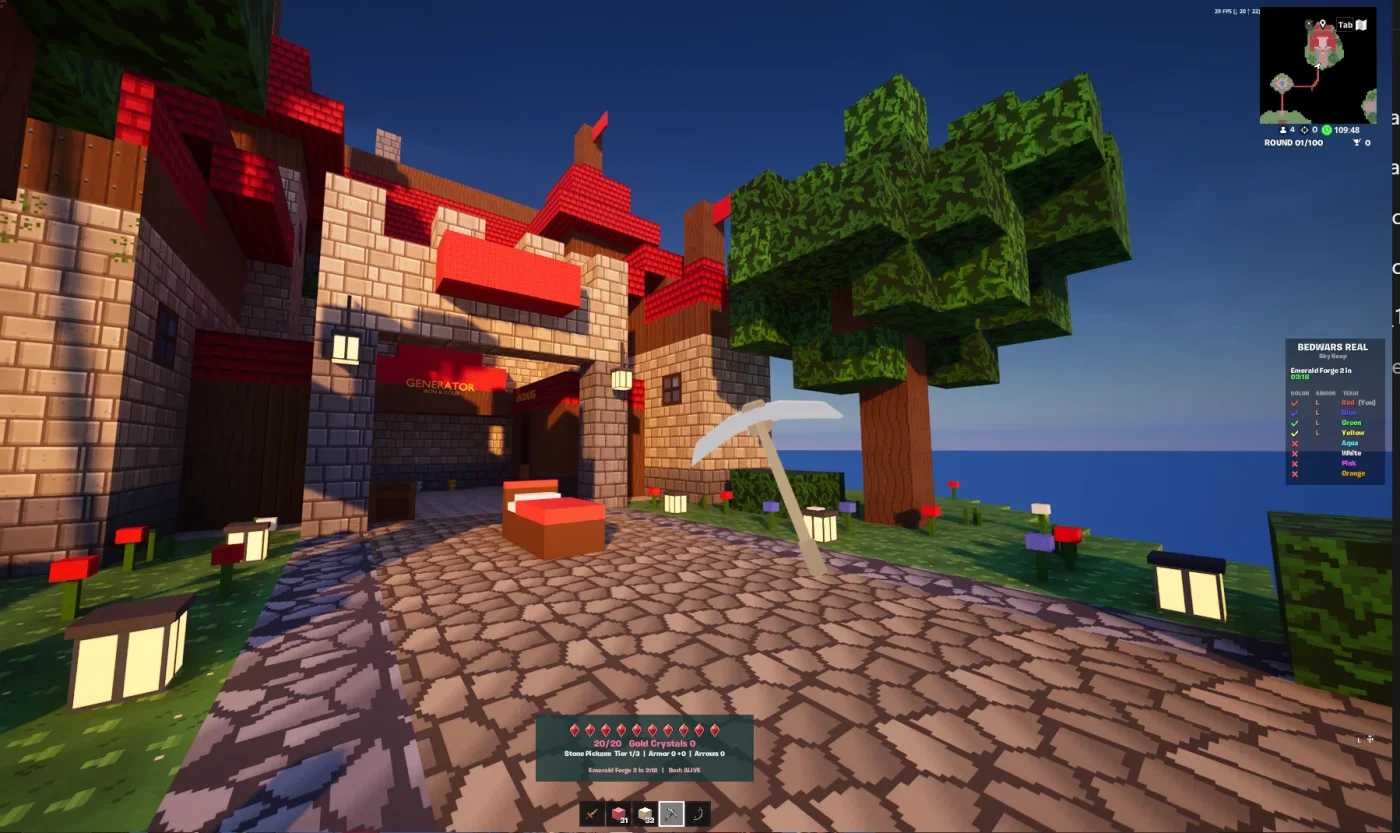
The red base's courtyard in a pre-release test: the custom two-block bed on paving in front of the castle's GENERATOR gate. On the right edge the sidebar shows the next timeline event (Emerald Forge 2) and the team states, the panel at the bottom of the screen reads Bed: ALIVE, and the round counter ROUND 01/100 is visible in the top-right corner.

The end-of-game crash: End Game must not be triggered from Verse

On 29 September a full round was tested for the first time so that the game actually ends and a new one begins. The round change crashed the server: the player dropped to the Fortnite main menu with a connection error message. According to the logs this was the first round change in the island's history, because earlier games had always been stopped with the editor's StopGame command.

The cause was isolated by comparison: when the same lobby situation was ended with the editor's StopGame, the game always returned to the pregame phase in 6 seconds. When Verse called the End Game device directly (EndGame.Activate), the server died in the reset phase (PostGameReset) every time, four times out of four, in both EndRound and EndGame mode. The game's own cleanup code ran to completion, so the fault was not in the lobby, the stat saving or the cleanup, but in the fact that the game was ended inside a Verse call.

The fix: Verse never calls the End Game device itself. The EndTheGame function fires the Trigger device BW_EndGame_Trigger, which has a 0.5-second delay and is wired in the level to the End Game device's activation. This way the game ends outside Verse. The instigator is passed along, so the "Activating Team wins" setting still works. After the fix eight game endings in a row went through without a crash (three developer wins and three games decided by the border), and the log recorded for example Games +1, Kills +2, Final kills +3, Beds +3 and Wins +1.

At the same time the ClearGame function was written (bedwars_building.verse). It is called both at the end of a round (OnEnd) and at the start (OnBegin), and it removes everything the game has created: device event subscriptions, HUDs, items, built blocks, beds, lobby state, the combat and practice systems, bots and the sidebar. Behind this was also the finding that some device event listeners were being subscribed again every round, so that, for example, a purchase could have registered twice from the second round on. ClearGame does not touch the persistent stats. For testing, the settings TestEndGameSeconds (the game ends after N seconds) and EventTimeScale (the whole timeline at, for example, one tenth of the time) were added.

Timeline: generator tiers and the destruction of the beds

The dragons were removed on 29 September and replaced with the traditional Bed Wars timeline (bedwars_timeline.verse). An event comes every six minutes: 6:00 diamond generators to tier 2, 12:00 emeralds to tier 2, 18:00 diamonds to tier 3, 24:00 emeralds to tier 3 and at 30:00 all remaining beds are destroyed. When the beds are destroyed, everyone gets the title THE BEDS CRUMBLE!, and from then on every death is final.

The island generators do not use Fortnite's own item spawner devices, because those flung items around and lost count. Verse times them itself: when the hologram's counter reaches zero, exactly one gem appears on the generator, and the player collects everything by walking over it. The diamond interval at tiers I–III is 30, 23 and 12 seconds and the emerald interval 65, 50 and 35 seconds. At most 8 diamonds or 3 emeralds can wait on a generator; when it is full the counter keeps running, but nothing spawns. When the tier rises, the next gem arrives no later than one new interval later. The four emerald generators are in a square around the centre so that the distance is the same for every team.

The announcements were rewritten in our own words on 20 October, because the originals were verbatim quotes from a well-known Minecraft server. The current texts are for example "The Diamond Forges burn hotter: Forge 2!" and "The Emerald Forges blaze at full heat: Forge 3!", and the holograms read Forge level and Next gem in N s. The bases' own iron and gold piles run for the whole match in all eight bases (iron 2 s, gold 8 s, caps 48 and 16); they are covered in more detail in the generators chapter.

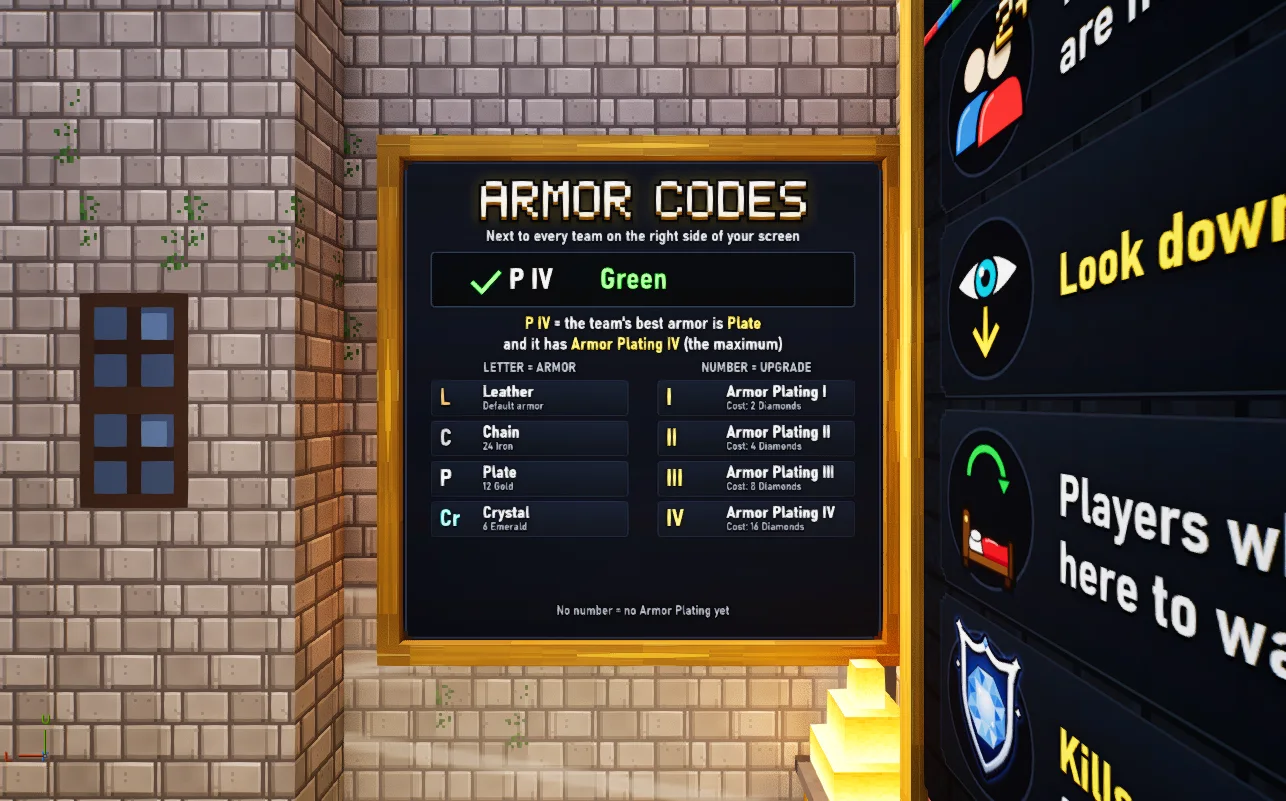
At the end of September a sidebar was added to the right edge of the match screen (bedwars_sidebar.verse): a title, the next event and its timer in MM:SS format, and one row for each of the eight teams. A row has a team-coloured check mark while the bed stands, the number of remaining players after the bed is gone, or a red cross when the team is out; your own team is marked (You). On 30 September an armour code was added to the rows, for example P IV = the team's best armour is Plate and it has the Armor Plating IV upgrade, and the island code was added at the bottom. After the timeline the sidebar shows the border timer and width.

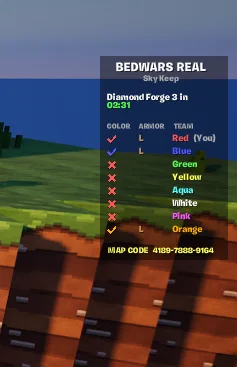
The match sidebar in a release-day test: the next event Diamond Forge 3 with the timer at 02:31, the columns COLOR, ARMOR and TEAM, check marks for teams still standing and red crosses for eliminated ones, and MAP CODE 4189-7888-9164 at the bottom. The title still reads BEDWARS REAL / Sky Keep, which was changed after release to BEDWARS / The Origin.

A shrinking border that closes completely

The dragons were replaced with a border in the style of Minecraft's world border (bedwars_border.verse): a square centred on the map that shrinks, and a player outside it takes damage. The damage follows Minecraft's formula: when the whole character is outside the border, a hit is max(1, floor(blocks outside the border × 0.2)), so at least one heart per second; armour does not protect. Near the border the screen turns red from five blocks away. The first version lagged, because the wall was sent from the server 10 times per second and the damage-effect device was moved to the player's position twice per second; the wall was changed into an animation played by the player's own machine, and the damage was kept without moving the effect device around.

Originally the border shrank to a 16 × 16 block area and stopped. On 1 October the developer decided that the border must close completely so that two players cannot stall the game for hours, and a hard time limit was added after which the match ends in a draw. On 21 October the logic was rewritten: the border stays hidden until its start time and then shrinks at a single constant speed to zero in 480 seconds. A closed border damages everyone.

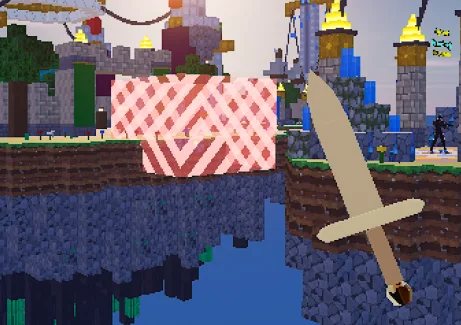
The wall, however, did not show up in game even though the border worked. First the material was strengthened (opacity from 8–36 % to 30–70 %, visibility out to about 160 metres, more glow and no fog on the wall), but the wall stayed invisible. For debugging, two small test boxes using the same wall mesh were placed on the centre island, and they showed up correctly in game. The conclusion was that a single box stretched to an enormous size (about 194 × 194 × 260 m) never rendered. The wall was rebuilt from panels: each side is split into panels at most 20 metres wide in three rows of about 30 metres (heights Z 7000–16000 cm), 120 panels in total at the start, decreasing as the border shrinks.

The movement was jerky at first, because the server moved the panels in 20 cm jumps. This was replaced with 10-second sliding animations (keyframed movement) that the player's machine plays itself; the server sets the panels to their exact position every 10 seconds. The wall still jumped every 10 seconds, because the animation's scale change is added to the scale rather than multiplied by it, as had been assumed. Once the animation was fixed to reduce the panel width by exactly the amount of shrinkage, the wall slid smoothly, and the developer confirmed in game that it works.

On the same day the schedule was tightened: the border starts at 35:00, i.e. five minutes after the beds are destroyed, is fully closed at 43:00, and the match time limit to a draw is 45:00 (previously 40:00, 48:00 and 50:00).

The debugging test box on the centre island: the red-and-white crosshatch-striped, translucent border material shows up correctly in game. The image showed that the fault lay in the size of a single huge stretched wall mesh, not in the material, after which the wall was assembled from small panels.

The waiting lobby above the map

On 29 September a waiting lobby was built into the game about 250 metres above the centre of the map (top of the floor at Z 35000 cm). The first version was a 25 × 25 block space made of invisible glass: you can see down to the map through the floor, but the vertical boards are seen only edge-on when looking up from the map. The lobby has eight spawn pads, and the lobby state machine (bedwars_lobby.verse) goes through the phases Waiting, Countdown, Match and Ending. Players waiting in the lobby are marked as dead to the game systems, so no combat system affects them.

A player who has been final-killed returns to the lobby to wait for the next match. For that, a spectator mode was tried first in which the player could fly or teleport to others, but Fortnite does not allow teleporting a frozen character and Verse cannot read movement keys, so it was replaced with a fixed overview camera in a corner of the map. The final solution was made on 12 October: the lobby's SPECTATE button (a Button device that uses Fortnite's own interact key and therefore shows the correct key on every platform). Pressing it turns off the player's team spawn pad and eliminates the lobby character; because respawning needs a pad, the player stays in Fortnite's own spectator mode and can switch the player being watched with the normal buttons. The solution works because the teams are one-player teams. On 21 October the button was also opened to players who joined mid-match.

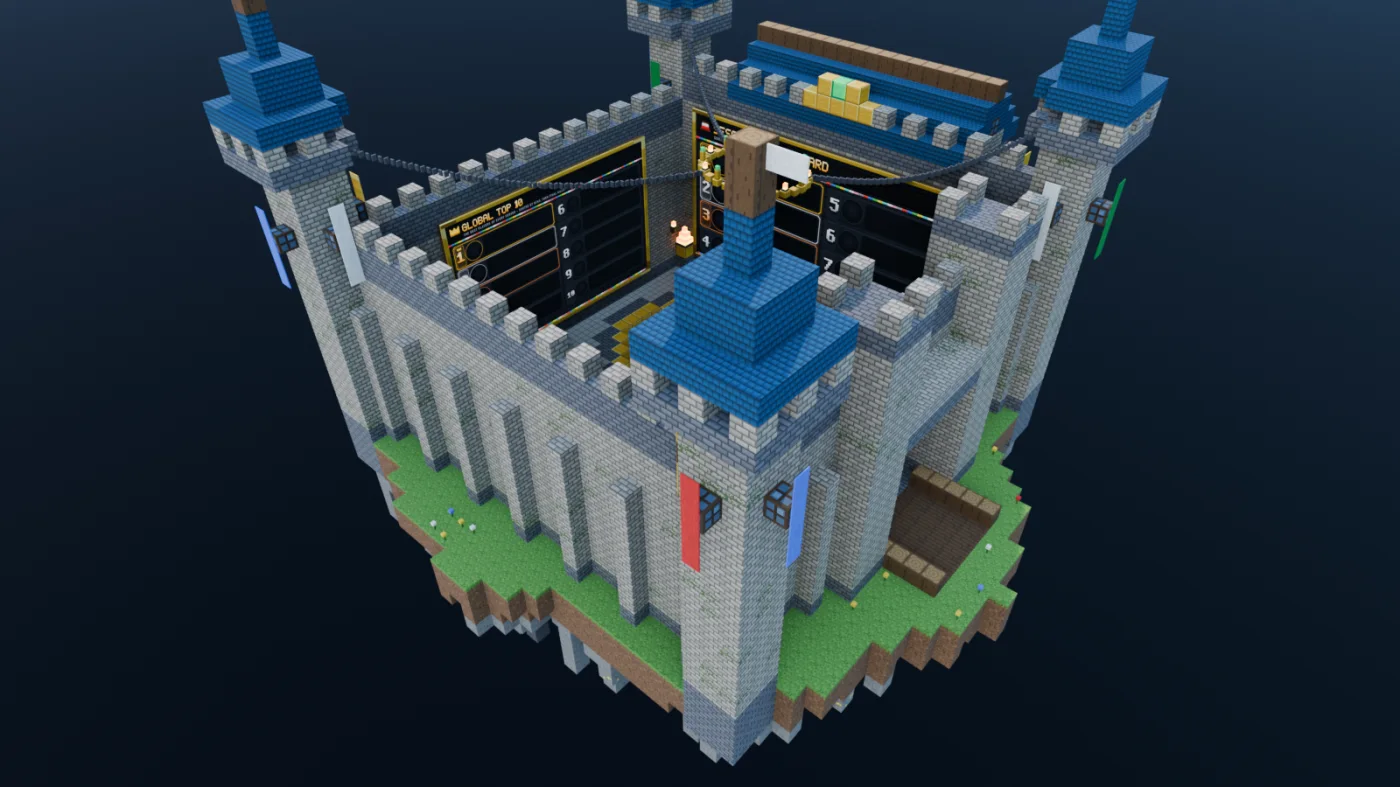
In early October the map was redesigned in a castle style, and on 12 October the lobby was rebuilt in the same style (Sky Keep Courtyard, Blender script build_lobby_v3.py, the same texture atlas as the map). The castle courtyard has high walls, four corner towers, eight spawn spots on a gold-edged dais and an opening in the middle of the floor for watching the map; the walking surface is still an invisible glass floor. The lobby mesh was given a draw distance of about 150 metres so that those playing 250 m below do not see it, and the mesh got 829 collision boxes.

All shared information was moved onto wall boards: the session leaderboard on the south, GLOBAL TOP 10 on the west, the rank board and Waiting Lobby instructions on the north, and the armour code legend, the island code and a portal to a new game on the east. Only the lobby state (for example WAITING FOR PLAYERS 1/2 or MATCH STARTS IN 30), a personal notice and your own rank card with progress bars remained on screen. A Discord stand planned for the lobby was removed, because Epic's rules forbid prompts to act outside Fortnite.

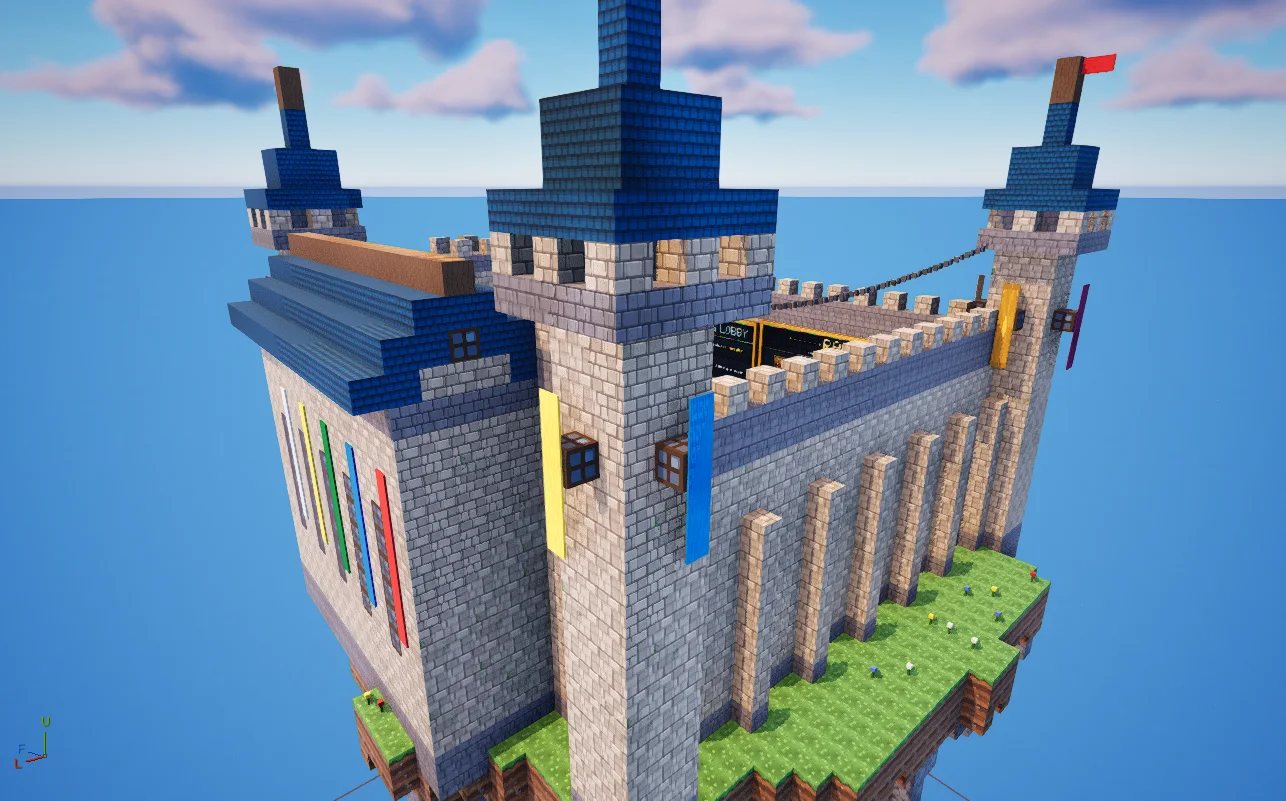
Preview render of the v3 lobby castle from Blender: walls, corner towers with blue-grey roofs, chains and the GLOBAL TOP 10 and session boards on the courtyard walls. The preview was made before the mesh was exported to UEFN.
The lobby castle in the UEFN editor from outside: stone walls, team-coloured pennants and a grass base. In game the 150-metre draw distance keeps the castle invisible to those playing on the map.
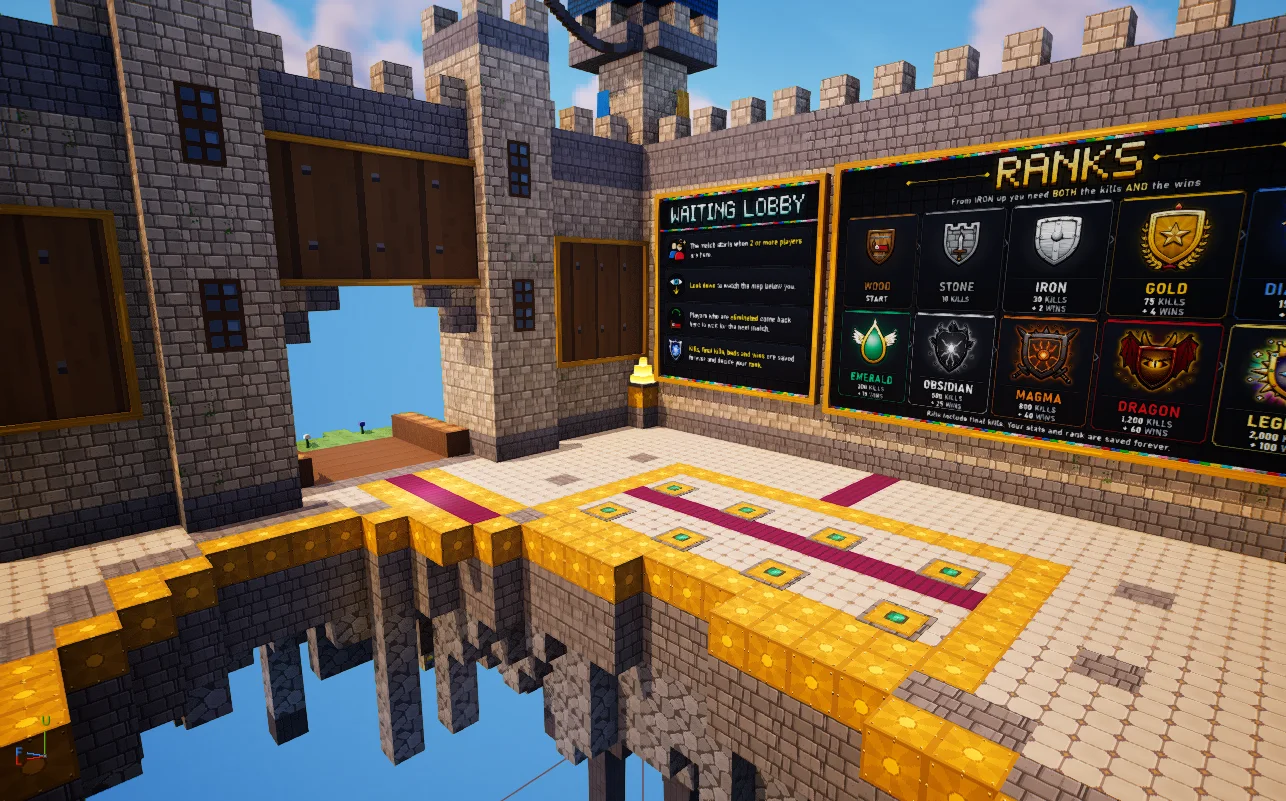
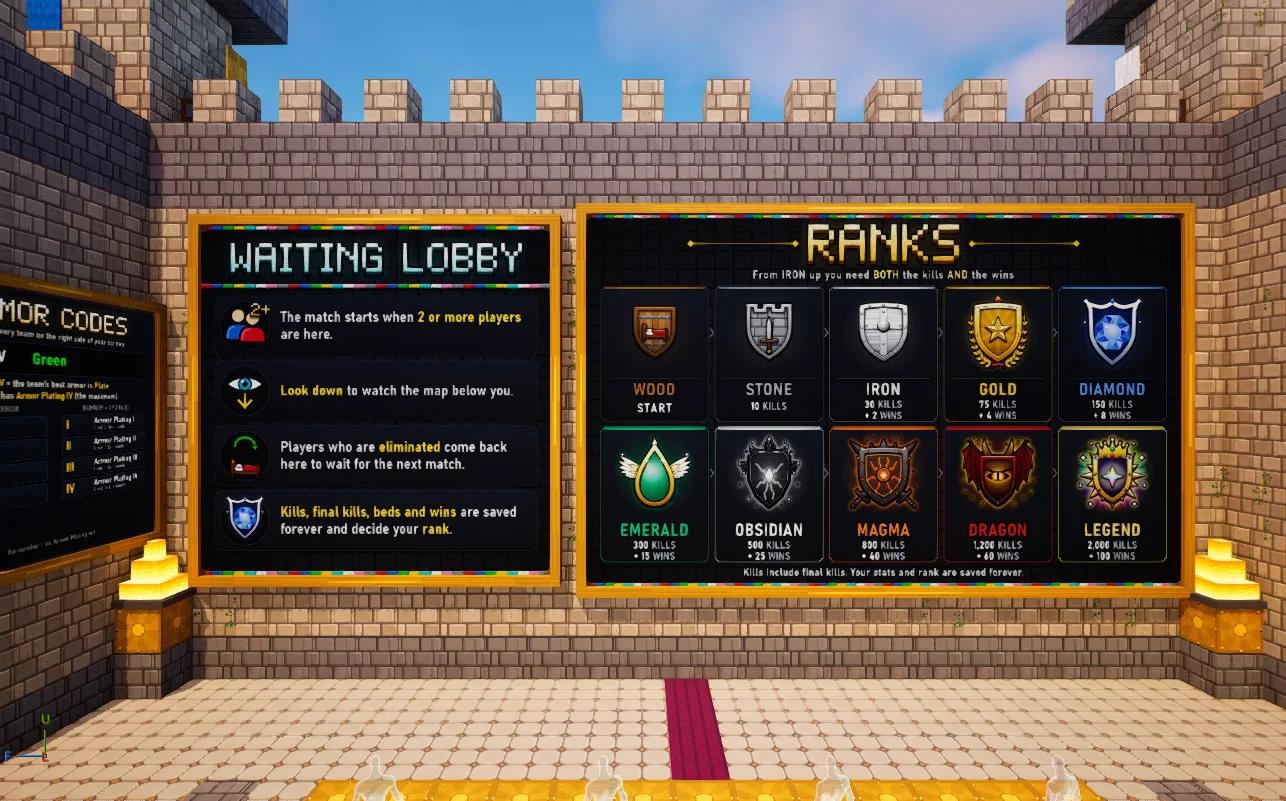
The lobby courtyard in the editor: eight green-centred spawn pads on a golden dais, the WAITING LOBBY instruction board and the RANKS board on the north wall, and the opening in the middle of the floor through which the map is visible below.
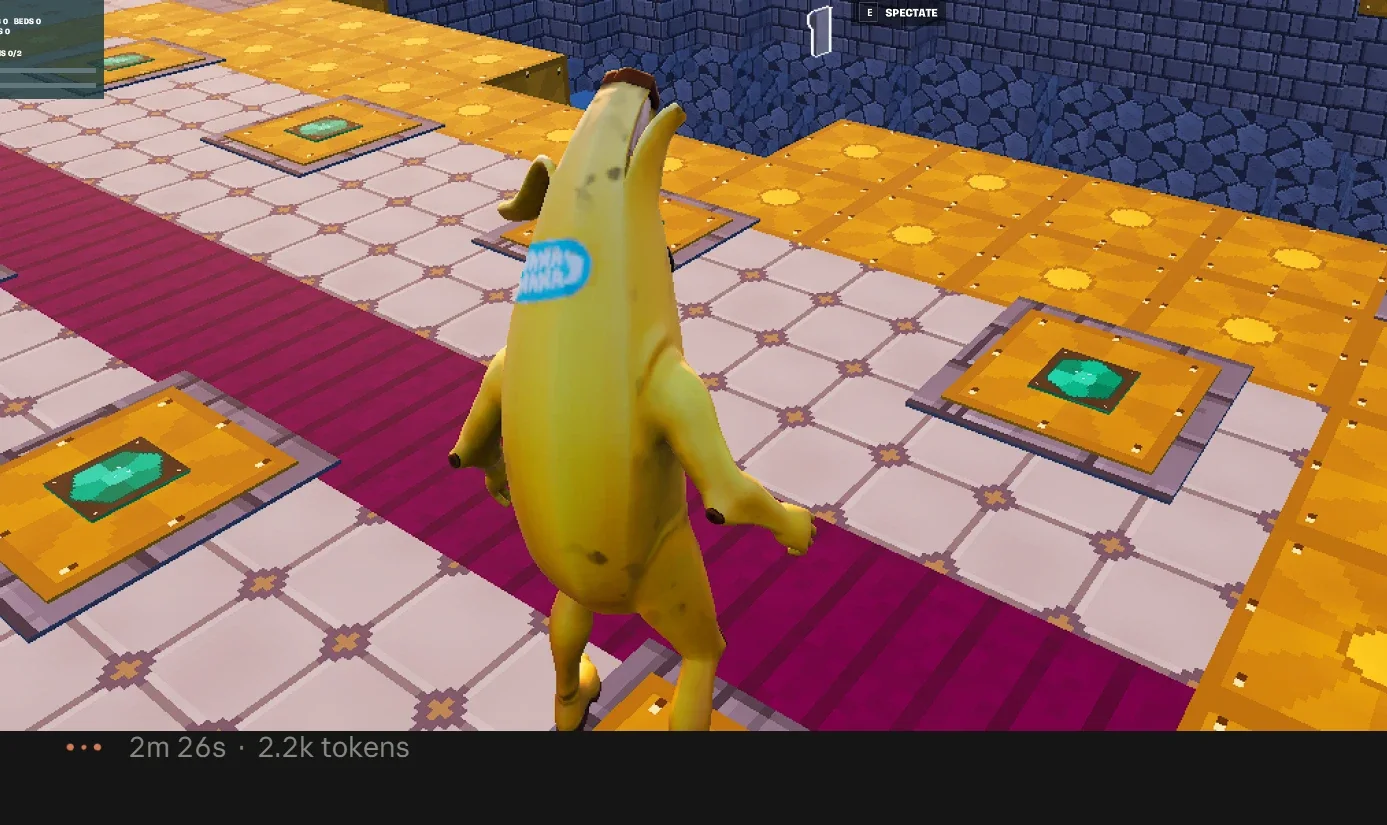
The player character among the lobby spawn pads in a test session, with the SPECTATE button at the top. The image relates to the observation that at the start of a session it took about 5 seconds before the first-person view switched on and the character could be moved.

Joining and match start without stutter

In October, joining and the start of the match repeatedly produced the same kind of fault. The Fortnite character is physics-based, and when the server changes or teleports the character before the player's own machine has taken control of it, the server's and the client's views of the character diverge for the whole life (desynchronisation). The symptoms were sliding, ten-centimetre jumps that snapped back, or movement that did not happen at all.

On 14 October it was found that the lobby code teleported a freshly spawned character straight into the lobby and the rescue logic did it again every half second, even though after a push the player's machine took control of the character only 5–21 seconds later. The solution was a PawnReady check: the character is not touched until it has actually moved more than 2 cm (time limit 60 s). Merely being on the ground was not accepted as a signal, because a frozen character reported being on the ground. On 20 October the move from the lobby to the base at match start was changed from a teleport into a new character from the team spawn pad, as in a respawn; the developer confirmed that the first life then moved normally.

On 21 October a joining player still spawned on the game island first, died and came up to the lobby. There were several causes: in the island settings the spawn pad was chosen at random from all enabled pads, so the lobby pads' priority had no effect, the base pads were enabled during the wait as well, and Fortnite favours the player's own team pad at game start. The final setting is that the eight base pads are in Create Only mode, meaning they are off in game until Verse enables them at match start, and on 2 November Use as Island Start was also removed from them. Game start keeps the player in place (spawnLocation CurrentLocation), and a player joining mid-match gets a new character from a lobby pad that is briefly opened just for them.

At the start of a session there was a wait of about 5 seconds during which the character bounced in third-person view. It was caused by the island setting autoStart = 5, since Verse does not run at all in the pregame phase. The value was lowered to one second, because a value of 0 would have meant a 90-second wait on a public server; according to the log, getting from arriving in the lobby to the first-person view then took 0.3 seconds. A text was added to the lobby that counts down "You can move in 6, 5, 4…" and disappears once the character is under the player's control. The character was not frozen from the server, because it was precisely server changes before the handover of control that caused the desync.

Round model and matchmaking

At the time of the crash fix the island was set up as a single-round game. In the editor's test session the next game always started on the same server, but on 21 October the private version revealed that on a real server End Game ended the whole game and Fortnite showed its own Requeue / Return to lobby screen, which felt broken. A round model was built in its place: 100 rounds in Island Settings, a round time limit of 120 minutes, end-of-round slow motion off and the End Game device ending only the round. Verse did not need to change, because OnBegin and OnEnd run every round. In an editor test three 80-second rounds went through in a row, and the next one started in about 14 seconds directly from the lobby.

The round model was reverted the same evening, because the character seemed to lag on the island again, but the actual cause turned out to be the spawn pads (the Create Only fix). After that the round model was put back into use. In the released version the round counter is shown as ROUND 01/100, and after a match the map resets and players return to the lobby on the same server.

The lobby rules were refined several times. The countdown starts when at least two players are present; at first it shortened as the player count grew (30 s, 15 s with four and 5 s with eight), but on 21 October it was changed to always be exactly 30 seconds. The test mode PracticeMode, which let the game start with one player, was switched off. The early-October plan was to close the server to matchmaking for the duration of the match with a Round Settings device, but on 2 November the developer's model became a normal Fortnite mode: 8 slots, a leaver's slot is filled at any time, and a player joining mid-match waits in the lobby, watches the match with the SPECTATE button or finds a new game through the portal. Matchmaking is therefore always open, join in progress stayed on, and nobody can enter a match already in progress, not even in practice mode.

The matchmaking setting became Party Choice (value Unrestricted), which lets a group of friends choose a private or a public game. The portal to a new game needs the published island's code, so it and the island code board stay hidden as long as the constant BWMapCode is the placeholder 0000-0000-0000. After release, on 7 November, the code was set to 4189-7888-9164, after which the portal showed the island's name and the text Matchmaking Enabled.

A watchdog in the lobby makes sure nobody gets stuck: if nobody is playing any more, if the match has only one team and players are waiting in the lobby, or if the ending did not go through, the game is ended via EndTheGame after a 12-second wait (30 seconds in the ending phase). After release, on 7 November, solo bots were added as well: when a player has been alone in the lobby for 60 seconds, two defender bots appear on the neighbouring islands, and they are cancelled if another player joins before the match starts. Bot matches do not accumulate stats.
Persistent stats and ten ranks

The stats had to survive even if a player came back a year later. They are saved with Verse persistence in the class bw_lifetime_stats and the variable BWLifetimeStats (bedwars_stats.verse): kills, final kills, beds broken, wins, games played, deaths and final deaths. Persistent data can only be written while the player is in the game, so the stats are written at the moment of the event. The only writer is BWAddStats, and merging takes the larger value of each field, so a stale or empty record can never reduce the numbers. After release the names must not be changed or the data is lost; new fields can only be added with a default value. The developer confirmed on 21 October in the private version that the stats carried over from one session to the next.

Stats only accumulate in a real match: the lobby phase is Match, at least two teams have played in the match, and it is not a practice, test or bot match. A kill is credited to whoever hit the victim during the preceding 10 seconds, so deaths to the void, falling or the border also count. A game played is recorded at the start of the match and a win as soon as the winner is decided.

The rank system has ten tiers, and each got its own shield logo whose ornaments and glow grow from tier to tier. The original requirements were very steep (for example Legend 10,000 kills and 1,000 wins). The rank name NETHERITE was changed to MAGMA as early as 29 September, because it is a proper name invented by Minecraft, and on 20 October the OBSIDIAN rank was recoloured from purple to black glass and DRAGON to crimson so that they do not reference Minecraft. On 21 October the ranks were made easier: STONE needs only 10 kills and the higher ones also wins, because in an eight-player game on average only one game in eight is a win.

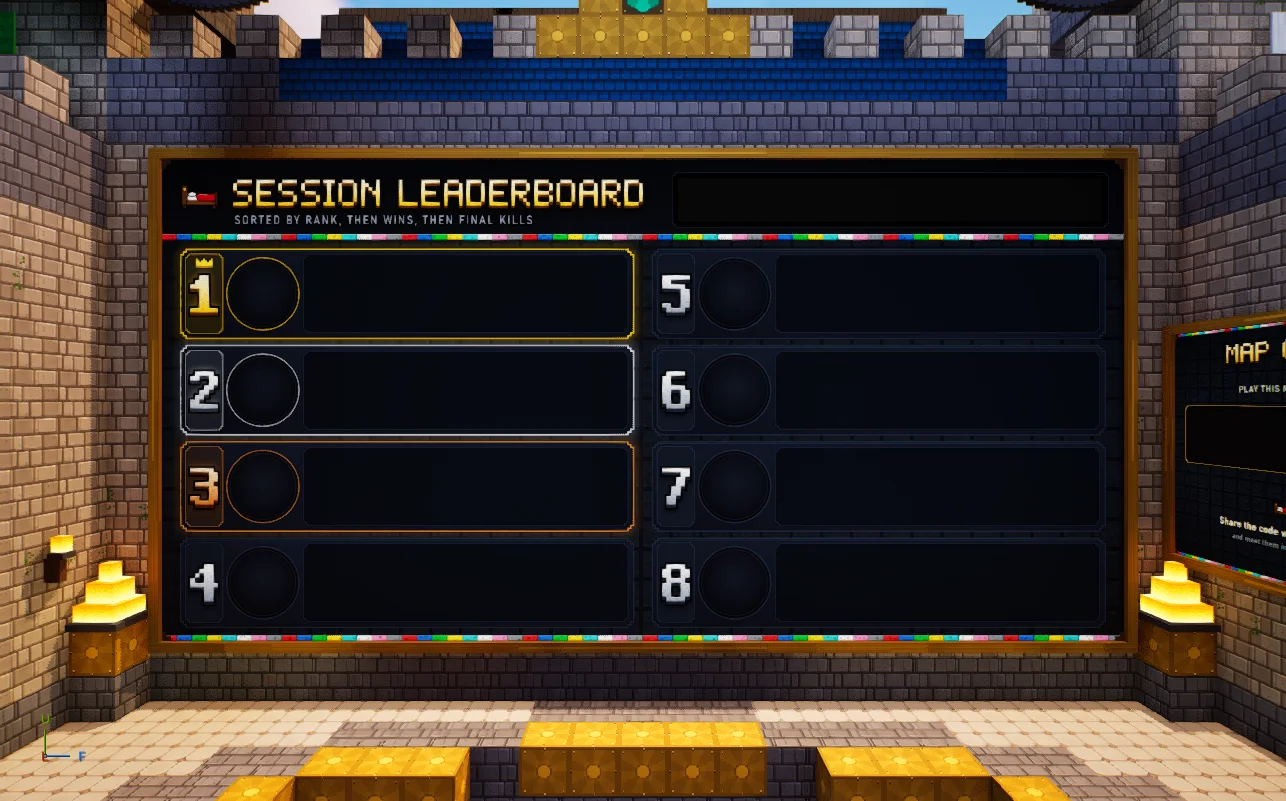
In the lobby your own rank logo is shown above your head, and your own rank card shows kills, final kills, beds, wins, games and progress bars toward the next rank. The session leaderboard sorts the players present by rank, wins, final kills, total kills and beds.

The lobby's north wall in the editor: the WAITING LOBBY instruction board and the RANKS board with ten shield logos from Wood to Legend and their final requirements (for example STONE 10 kills, GOLD 75 kills + 4 wins, LEGEND 2 000 kills + 100 wins). Part of the armour code board is visible on the left.
The ARMOR CODES board, which explains the armour codes in the sidebar: the letter gives the team's best armour (Leather, Chain, Plate, Crystal) and the Roman numeral the Armor Plating upgrade level, for example P IV.
The SESSION LEADERBOARD on the lobby's south wall in the editor: eight rows for the players in the session, ordered by rank, wins and final kills. Names and stats are drawn onto the rows during the game, so the board is empty in the editor.

Global top 10 and the anonymous names problem

On 30 September a worldwide top 10 list was requested. At first the agent judged it impossible, because Epic offers no ready-made global list and persistent data is per player, but when the developer pointed out that other Bed Wars maps do it, it admitted it had been wrong. The solution (bedwars_global_board.verse) carries the list in the players' own saves: every player has a copy of the best ten they know of. When players are on the same server, their copies and their own stats are merged every 15 seconds and whenever stats change, and each one takes the merged list with them. This way the list spreads from server to server with the players, but not instantly. The order is wins, final kills, total kills and beds.

On 12 October it was noticed that the board showed all players as anonymous. Because of Epic's privacy protection, the server gets other players' names only in the form Anonymous[N], and the number changes from server to server, so the real name can neither be saved nor used as a key. Rows are now keyed by a random permanent identifier that a player gets once and that is saved in their own record. The row of a player who is present is drawn as a message that each viewer's own game turns into the real name, and an absent player is shown in the form Player #4821. The old rows keyed by name were removed; the change was safe because the island was not yet public.

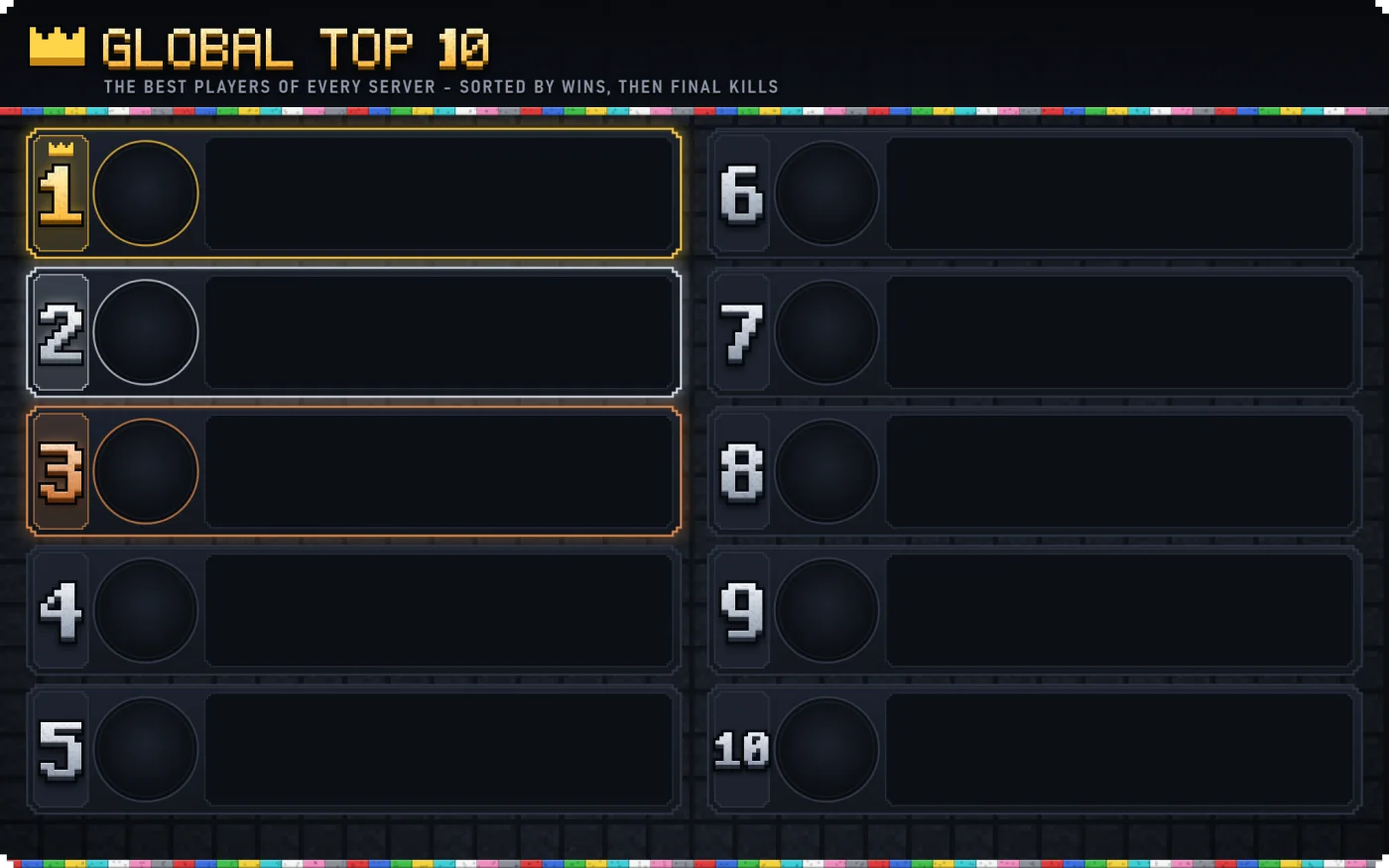
In the same lobby overhaul the global top 10 was moved from a HUD panel to the lobby's west wall, which has 20 billboard texts and rank icons. Bot matches do not accumulate stats precisely so that the top 10 list cannot be farmed alone.

The base texture of the GLOBAL TOP 10 board: ten rows, gold, silver and bronze frames for the top three, and a subtitle giving the order (wins, then final kills). Names, stats and rank icons are drawn on top of the texture with Verse.

Final implementation

The game loop code is split across several Verse files. bedwars_building.verse is the main controller: it holds the schedule settings (DiamondTwoSeconds 360, EmeraldTwoSeconds 720, DiamondThreeSeconds 1080, EmeraldThreeSeconds 1440, BedsGoneSeconds 1800, BorderStartSeconds 2100, BorderShrinkSeconds 480, MatchTimeLimitSeconds 2700, EventTimeScale 1.0), the lobby settings (LobbyMinPlayers 2, LobbyCountdownSeconds 30), the void kill height VoidKillZ −10000 cm, EndTheGame and ClearGame. bedwars_lobby.verse handles the lobby phases, spawn spots, mid-match joiners, the SPECTATE button, rank cards, the overhead logos, drawing the session board and the global board, and the watchdog. bedwars_beds.verse contains the beds, the final kill rules, the winner and the draw, bedwars_timeline.verse the timeline and the island generators, bedwars_border.verse the border, bedwars_stats.verse the persistent stats and rank thresholds, bedwars_global_board.verse the worldwide list and bedwars_sidebar.verse the match sidebar, the VICTORY text and the island code. The solo bots are in the file bedwars_bots.verse.

In the released game a match runs like this: the player spawns directly in the lobby, two players start the 30-second countdown (when waiting alone, the match starts against bots after 60 seconds), at match start everyone gets a new character from their own base's pad and the beds of empty teams are removed. The generators rise in tier at 6, 12, 18 and 24 minutes, the beds crumble at 30:00, the border starts at 35:00 and closes fully at 43:00, and at 45:00 the match ends in a draw at the latest. The last team wins, and after 6 seconds the Trigger device ends the round through the End Game device. A new round (up to 100) starts from the lobby on the same server, and ClearGame has reset everything except the stats, ranks and the top 10 list.

The lobby's matchmaking portal in a test session after the island code was set: the portal shows the published island's thumbnail and the text BEDWARS: THE ORIGIN / Matchmaking Enabled. The portal switches on automatically once BWMapCode is no longer the placeholder.

Key values

WhatValueWhat it affects
Bed size2 × 1 × 1 blocksThe bed is a two-cell part of the block grid; an enemy mines it in about 0.3 seconds, your own bed cannot be broken, and TNT or a fireball does not break it.
FinishDelay6 sTime from declaring the winner to ending the round.
BW_EndGame_Trigger delay0.5 sThe Trigger device activates the End Game device through a level binding outside Verse; a direct EndGame.Activate crashed the server 4/4 times.
Timeline6:00 / 12:00 / 18:00 / 24:00 / 30:00Diamonds II, emeralds II, diamonds III, emeralds III and the destruction of all beds.
Diamond generator interval30 / 23 / 12 s, max 8Island generator tiers I–III and the cap on waiting diamonds.
Emerald generator interval65 / 50 / 35 s, max 3Four emerald generators in a square around the centre.
BorderStartSeconds2100 s (35:00)The border starts shrinking five minutes after the beds are destroyed.
BorderShrinkSeconds480 sThe border shrinks steadily to zero; fully closed at 43:00.
MatchTimeLimitSeconds2700 s (45:00)The match ends in a draw with no win at this point at the latest.
Initial border widthhalf-width 9700 cm (about 194 m)Covers all buildable cells; the wall consists of panels at most 20 m wide and about 30 m tall in three rows (Z 7000–16000 cm), 120 panels at the start.
Border damagemax(1, floor(blocks × 0.2))At least one heart per second when the whole character is outside the border; a closed border damages everyone.
Lobby heightfloor Z 35000 cm, about 250 m above the mapThe lobby mesh's draw distance is about 150 m, so it cannot be seen from the map.
Countdown30 s, at least 2 playersDoes not shorten as the player count grows; 5 s in a bot match.
BotSoloWaitSeconds60 sA player waiting alone then gets two defender bots; bot matches do not accumulate stats.
autoStart1 sFortnite's pregame phase, in which Verse does not run; a value of 0 would mean a 90 s wait on a public server.
Rounds100 rounds, round time limit 120 minEnd Game ends only the round, and the next one starts on the same server without a Requeue screen.
Kill credit window10 sA death to the void, falling or the border is credited to whoever hit the victim during the preceding 10 seconds.
Rank thresholds (kills/wins)WOOD 0/0, STONE 10/0, IRON 30/2, GOLD 75/4, DIAMOND 150/8, EMERALD 300/15, OBSIDIAN 500/25, MAGMA 800/40, DRAGON 1200/60, LEGEND 2000/100Kills also include final kills; both conditions are required. Eased on 21 October from the originals (e.g. LEGEND 10,000/1,000).
Global top 10 syncevery 15 s and when stats changeThe present players' copies of the list are merged and saved back to each of them.
Island code4189-7888-9164The constant BWMapCode; shows the code in the sidebar and on the lobby board and switches the portal on.

Final state

In the released game the whole loop works: spawning in the lobby, the 30-second countdown, the match with beds, the timeline, a visible border that closes all the way, the winner and the next round on the same server (up to 100 rounds) without the server crashing. Stats carrying over from one session to the next has been confirmed in the private version, and the developer tested a bot match as working. Not verified live: the global top 10 and the display of names, the portal's matchmaking, the SPECTATE button and the native spectator mode, a match with several human players from start to finish, and the start of a session's first round and the absence of the Requeue screen on a real server. According to the log, characters standing in the bases at the end of a round fall into the void because the blocks are removed before the reset; this has not been reported as a problem. The orientation of the rank icons on the global board and the lobby's invisibility from the map had been noted for checking.

Next chapter: Art & assets →