Bedwars: The Origin FI

Chapter

Movement: Minecraft jumping and running on Fortnite's physics pawn

Bed Wars is a game mode familiar from Minecraft in which teams defend a bed on their island and build bridges out of blocks to the other islands. The mode only works if movement feels like Minecraft: a jump rises a little over one block but not two, a sprint jump clears a gap of a certain length, and you can jump onto a block without flying over it. This chapter describes how Fortnite's own movement was bent into that shape, why almost all of the usual controls turned out to have no effect, and how the pawn's stuttering movement after respawns and pushes was finally fixed.

Goal: Minecraft 1.8.9 movement in Fortnite

The game was built with Fortnite's UEFN editor (Unreal Editor for Fortnite), where game logic is written in the Verse language and the game's building blocks are ready-made devices that are placed in the level and wired to each other. The developer directed the work through a Claude Code agent, which drove the editor over an MCP connection (Model Context Protocol, an interface through which an AI can read and change the editor's state, compile code and start test sessions).

The reference was Minecraft version 1.8.9, which Bed Wars players treat as the benchmark. In the first session on 27.9.2026 the jump rose almost three blocks high (a block is 100 cm in the game) and felt like a steep, stiff parabola. The goals set were a soft jump that cannot get you on top of two stacked blocks, a sprint jump that clears a gap, a working last-moment jump right off the edge, walls that behave like ordinary walls without sliding or stuttering, and a first-person camera in which your own body is never visible.

Later the goals were refined: a sprint jump should not carry you over a single block (important, for example, in a game mode played on top of pillars), and Fortnite's own extra sprint was to be removed. The implementation of sneaking (Minecraft's crouch-walk on the Shift key, which prevents falling off the edge of a block) and speed bridging (fast bridge building while walking backwards and sneaking at the edge) is covered in its own chapter; here they are touched on only where they affected movement in general.

The physics pawn and the measurement tool

Physics was enabled on the island because knockback (being thrown backwards by a hit), explosion jumps, water and the bow need Verse's impulse and velocity calls (ApplyLinearImpulse, SetLinearVelocity), which do not work without physics. With physics enabled the player's character is a Chaos Mover physics pawn (PlayerPawn_Newton), whose movement is predicted by the player's own machine and corrected by the server when needed (rollback and resimulation).

To study movement, Claude added a measurement tool to the movement code in shift_sneak.verse (RunMovementProbe, initially RunJumpProbe) that writes the pawn's height, velocity, movement mode and grounded state to the server log about 30 times per second as PVP MOVEMENT lines. Almost every decision in this chapter is based on these logs; for analysing jumps a separate script was also written that computed the speed state, peak speed, height and distance of each jump.

The measurements revealed a key limitation: the Player Movement Settings device, normally used in Fortnite to adjust walk speed and jump velocity, has no effect on the physics pawn with any movement preset. All 21 test jumps rose about 200 cm regardless of the device's jump value. Fortnite's native values are walk 3.5 m/s, sprint 5.5 m/s and backwards 3.0 m/s, and the jump's launch velocity is locked at about 11.2 m/s. The Leap potion that raised the jump, which used the same device, also stopped working. Movement Modulator devices' speed effects do have an effect, but every time an effect is applied or swapped the physics pawn resimulates its movement, which shows up as a jerk.

Turning physics off was tried on 27.9. with a backup in place (gravity −1168, jump 889 cm/s). The experiment failed: the pawn was still a Chaos Mover, the movement settings device still did not work, and Fortnite's extra lift from holding the jump button took the jump to about 3.9 metres, which gravity could not bring down. Physics was turned back on, and that became the permanent solution.

Fixing the jump: from double jump to native jump

The first finding was that the movement code's own jump impulse and Fortnite's native jump fired on top of each other and added up: in an old log the vertical velocity was 21 m/s and the jump about six blocks. Claude lowered the native jump to the minimum and measured the scripted jump at 124 cm, but the jump still felt weak and stuttered while moving.

The stutter was caused by the player's machine not predicting a jump made by the server, so the server corrected the pawn's position mid-flight. In addition, during a sprint jump the speed multiplier changed from 1.0 to 1.35 mid-jump, and each change caused its own correction. The jump was moved entirely to Fortnite's own native jump, which the player's machine predicts itself, and all speed changes during the jump were removed. After this the jump was judged good in a playtest, but you could still get on top of two blocks.

This became the basic movement rule for the whole project: the server must not apply impulses, velocity writes or effect swaps to the player's pawn, or move collision surfaces near it, because all of these show up as stutter. The only allowed controls are the island's gravity and one permanent speed effect.

Gravity as the only jump control, and the two-block wall

Because the launch velocity is locked, jump height can only be adjusted with the island's gravity (Island Settings, gravityValue). According to the measurements the physics pawn feels gravity as 2.7 percent of its cm/s² value in metres, so a value of −1950 gives about 52.65 m/s², and the jump peak is given by v0² / (2 · 0.027 · |g|). On 27.9. gravity was tried at −1562, −1940, −911 and −1330, and at the end of the day it was left at about −1655 (peak about 1.45–1.47 m). Jump length was adjusted with a permanent speed effect, BaseSpeedMod, raised to 1.26 (walk about 4.4 m/s, sprint about 6.9 m/s). At the same time the swap of the backwards-movement speed effect (between 1.0 and 1.12) was removed; it toggled back and forth when bouncing off a wall and caused stutter.

Two causes were found for getting over a two-block wall. The island's movement preset was Current BR, i.e. Battle Royale movement, which brought along ledge grabbing, wall climbing and sliding; it was switched to Custom, and sliding, sprint energy and glider deployment were turned off. The second cause is the pawn's shape: Fortnite's character is a capsule (a cylinder with hemispherical ends), whereas Minecraft's character is a box. When the feet are about 40–55 cm below the top edge of a wall, the capsule's rounded bottom rides up the corner. In measurements, a 1.70 m peak climbed on top of two blocks and a 1.60 m peak got hung on the corner and jerked forward. The peak therefore has to stay at least about 50 cm below the height of two blocks.

To stop the capsule from riding up, per-player invisible lips were made: barrier plates (invisible collision walls) that extend the surface of a two-block wall from 30 cm below the edge to 70 cm above it and cover a 5 × 5 cell area around the pawn. In the first version a 5 cm thick plate sat in front of the wall surface and pushed a pawn jumping against the wall about 4.9 cm back; the plate was moved inside the wall and narrowed to exactly one block's width.

The movement code's invisible floor plates, which give a Minecraft-like ability to step about 30 cm over an edge, were originally flush with the block surface. Barrier plates are almost frictionless, and when the pawn stood on them, starting to move felt slow and the pawn bounced off walls. The plates were lowered 1.5 cm below the block surface (PadDrop), so the pawn stands on the real block and only touches the plate when stepping over the edge. Restricting the plates to sneaking only broke last-moment edge jumps, so they were restored for walking too and stay in place for the whole jump.

The wall stutter still continued, but only in the map's prebuilt structures, not in blocks placed by players. The map structures were large merged meshes (SM_BWG_* in the GridV2 folder) with triangle-mesh collision, and the physics capsule caught on the seams between triangles. From the map's block data (bedwars_grid_support) Claude computed about 1,360 merged box collisions, with floors as large slabs, and applied them to all the meshes, making sure the surface height stayed the same at every point. After this the walls were confirmed to work in a playtest.

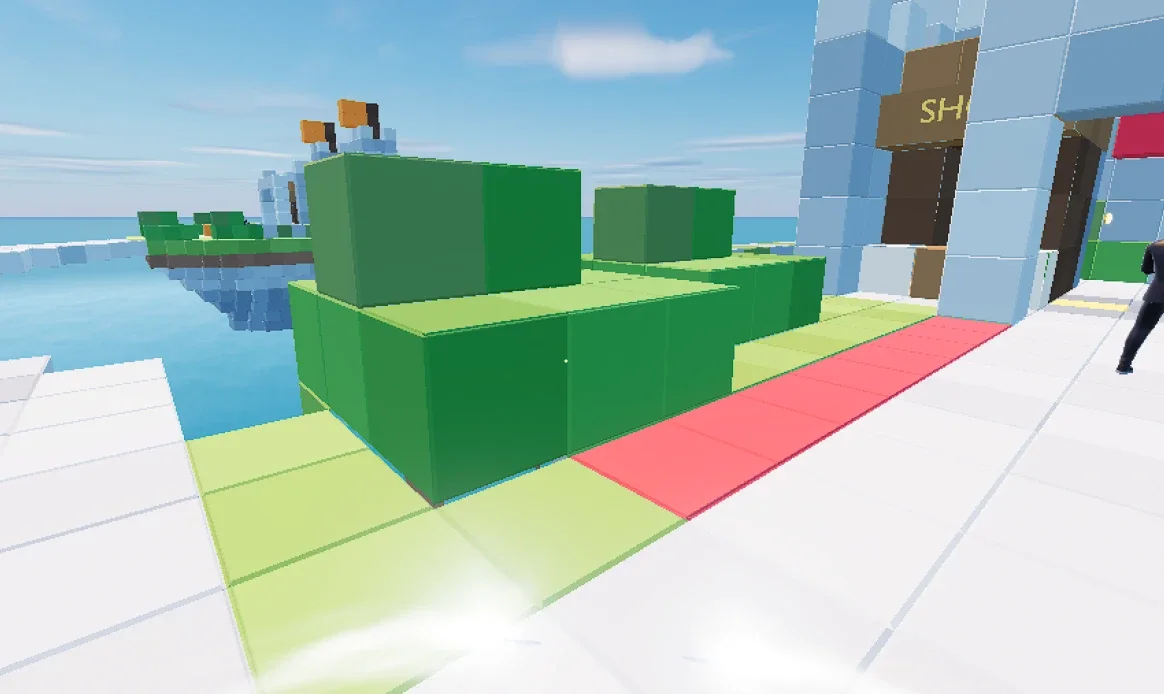
Green stair-like block structures of the early map next to the shop, at the edge of a red path and a white tile floor. It was exactly in prebuilt map structures like these that the wall stuttered and pushed the pawn, because their collision was a triangle mesh; the problem was solved with box collisions.
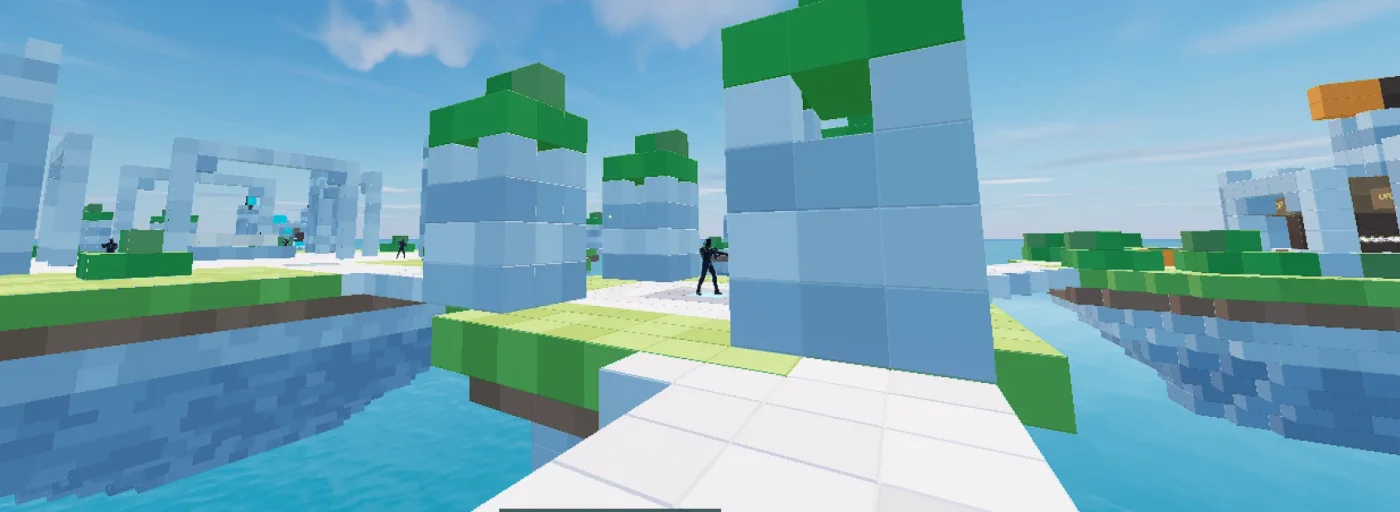
Light blue pillars with green tops and a white bridge on the centre island in an early version of the map. Another example of the map structures where the wall problem appeared, whereas blocks placed by the player worked normally.

The sprint-jump boost over a block, and gravity −1950

The next day, 28.9., a phenomenon was investigated where, when running at a block and jumping, the pawn seemed to boost forward and fly over a single block instead of landing on top of it. According to the measurement log there was no forward impulse in the code: a pawn pressing against a block has a speed of 0, but when the capsule rises over the corner about 0.07 s after take-off, it accelerates in the air with Fortnite's own acceleration. When walking the acceleration is 7 m/s² and the pawn lands on top of the block; when sprinting it is 28.5 m/s², the speed rose in the air from 0 to 6.9 m/s and the pawn landed 1.3 m behind the block. In Minecraft the sprint is cancelled on hitting a wall, so the equivalent air acceleration there is about 8 m/s².

Neither the air acceleration nor sprint cancelling could be adjusted from Verse or the island settings. The movement preset Ch 4 Movement instead of Ch 5 did not change any measured value, and disabling sprinting in the island settings (bAllowSprinting) together with raising the speed effect (1.98) only produced far too high a speed, about 10.9 m/s, because the physics pawn did not obey the sprint setting. Sprinting also stayed on in a fully restarted session, and Fortnite's Toggle Sprint setting on the player's side had no effect. Building a custom sprint with a speed effect was not recommended, because reaching full speed would have taken about 1 s instead of the current 0.24 s and there would have been a jerk at the end of the sprint. A custom physics world in Verse was not possible either, because Verse runs only on the server and prediction on the player's machine (Verse.org/Predicts) was at the time an Epic-internal feature.

As a partial fix, a speed cap against walls was made (UpdateWallSlow and TouchingStep in shift_sneak.verse): when the pawn is on the ground and standing at under 0.5 m/s against a one-block-high step, the speed effect is switched to BW_State_WallSpeedMod (0.36, sprint peak about 2 m/s). The swap is done while the pawn is standing, so it does not change movement or cause stutter, and the cap stays on during the jump. In the first test the cap disappeared at take-off in most jumps, because the server still saw the pawn on the ground even though it was already about 3 cm in the air; as a fix, a rising pawn (vertical velocity over 0.3 m/s, WallSlowRiseSpeed) keeps the cap on. A limitation was identified immediately: the effect swap arrives about 0.25 s late, so a jump made right on hitting the wall still gets the native boost. The cap is still in use via the WallStepSlow setting.

Finally, the overall reach of the jump was shortened. Gravity was changed from −1655 to −1950 on 28.9. at 13:28. According to the calculation, the jump peak dropped from 1.47 m to about 1.25 m (the same as in Minecraft), air time on flat ground from about 0.53 s to 0.45 s, and the sprint jump from about 3.7 m to 3.1 m, so a three-block gap can be cleared but a four-block one no longer can. A sprint jump made while standing against a block shortened from about 1.65 m to 0.7 m, so the pawn stays on top of the block even without the speed cap. According to the calculation, stepping up onto one block while walking became tight, and knockback and explosion jumps got lower. The speed multiplier 1.26 was kept unchanged.

Gravity became the base constant of the whole game: the value 52.65 m/s² was recorded in the combat rules (pvp_rules.verse), in the building landing calculation (bedwars_building.verse, PawnGravity) and in the practice bots' scripted knockback flight. Later, on 14.10., a 10 cm higher jump (gravity about −1810) was considered to make pillaring easier, but it would have given only about 0.04 s of extra time, and gravity was left at −1950.
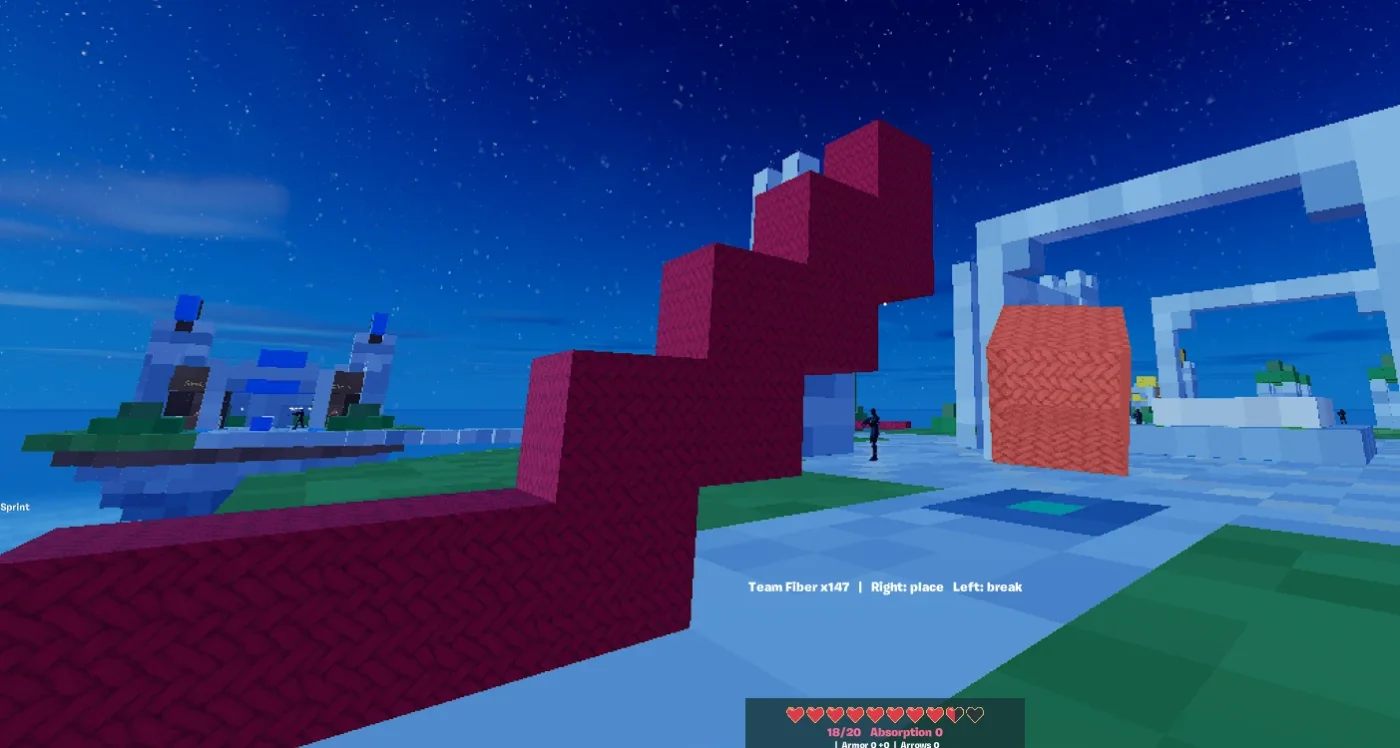
A night-time game view with a stair-like structure built from dark red wool blocks; Fortnite's Sprint state text is visible at the left edge. When jumping against blocks like these, the sprint's air acceleration carried the pawn over the block.
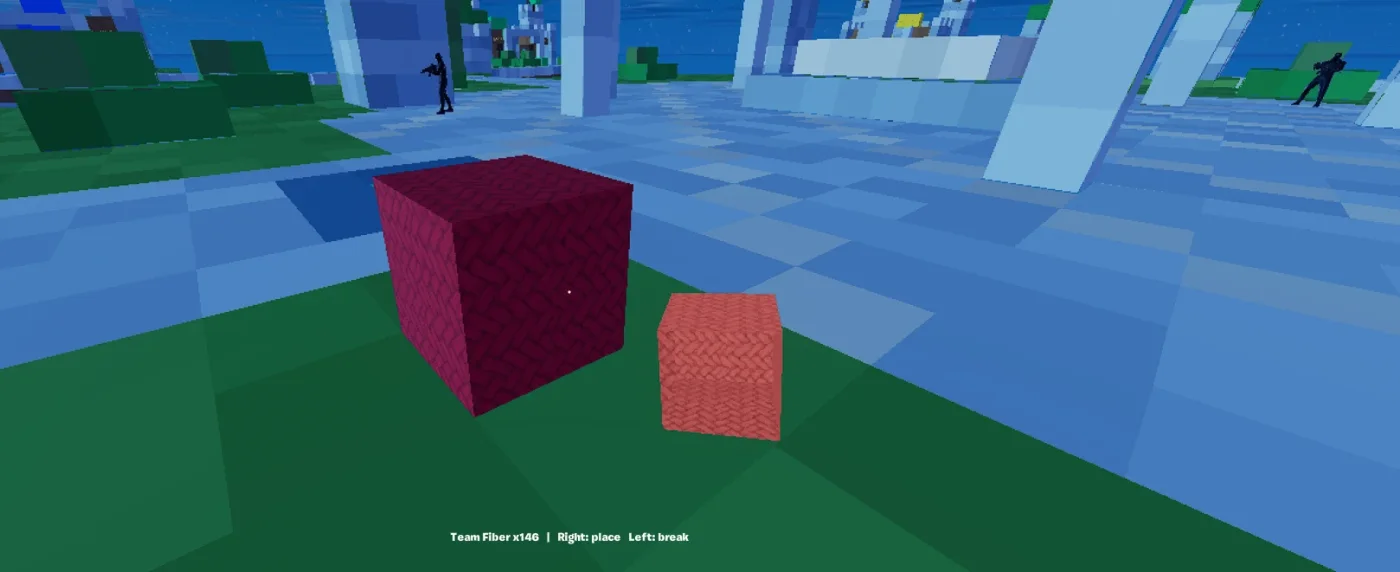
Two single wool blocks on grass. Staying on top of a single block with a sprint jump was the test case that led to the wall-step speed cap and the gravity change to −1950.

Running, acceleration and removing the sprint

Based on the logs, Fortnite's walking without sprint always accelerates at 7 m/s² and sprinting at 28.5 m/s², and neither can be changed from Verse or the island settings. Full walking speed was reached in the measurements in about 0.23–0.24 s. With the permanent speed effect 1.26, walking is about 4.4 m/s and native sprint about 6.9 m/s (measured peak 6.93 m/s); walking backwards is about 3.8 m/s. According to the calculation, staying on top of a block with a sprint jump would have required a sprint of about 3 m/s, which would have been slower than Minecraft walking, so no general slowdown was made.

Before release, on 21.10., the controls were tidied up. Fortnite's key hints shown on screen were removed from the Input Trigger devices, and sneaking was moved from the Sprint key to Fortnite's Crouch key (device BW_Mechanics_ShiftInput). The device consumes the key (consume Input), so Fortnite's own crouch does not trigger. The sneak slowdown delay was shortened from 0.35 s to 0.15 s, and according to the log the slowdown then began 0.13–0.15 s after the press instead of the earlier 0.33 s.

Fortnite's separate, faster sprint was to be removed. According to the log, the island setting Allow Sprinting = Off had no effect on this either: the measurements contained hundreds of samples in the native sprint state, average speed about 5.9–6.2 m/s. A working method turned out to be the swim key device BW_Water_SwimInput, which had been left unused (water had been removed from the game on 30.9.); it now listens to the Sprint key and consumes it. A Verse speed cap on all running was also briefly started, but it was cancelled, because the intention was only to remove Fortnite's separate sprint key; ordinary W running, about 6.2 m/s, and the sprint hit's extra push were left as they were. Players who have Fortnite's default sprint enabled can still run in the native sprint state.

The same evening, sneak getting stuck was fixed: the code read the device's button-held state, which stayed on if the release was lost during death or a menu. Sneaking is now based on its own press and release state, which is reset on death and when a menu opens. The actual residual cause was found in the Pillars project: with sliding turned off on the island, the Crouch key stayed held down during Fortnite's auto-run for as long as 8–26 seconds and slowed the pawn. The Allow Sliding setting was turned on on 2.11.; because the sneak device consumes the crouch key, no actual slide occurs. At the same time the 0.45 s backwards-walking sneak delay (BackwardSlowDelay) was brought over from Pillars for speed bridging. In the developer's playtest the movement was found acceptable after this.

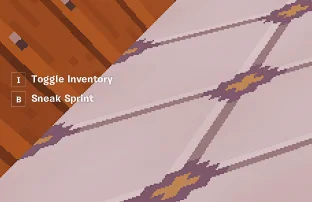
Close-up of the edge of the game view showing the Input Trigger devices' key hints Toggle Inventory (I) and Sneak Sprint (B). These texts were removed, and sneaking was moved from the Sprint key to the crouch key.

The first life after a push and the respawn desync

A long-recurring problem was that after every push (sending changes to a running test session) the first life was broken: the W key did not move the pawn, movement stuttered, and at the initial spawn the pawn moved on its own. Dying fixed the situation, and on 14.10. this was at first turned into a working practice: after a push, die once before testing. In the broken life, according to the log, the pawn stood still about 90% of the time.

The cause was found the same evening. After a push the server creates the pawn 5–20 seconds before the player's machine starts driving it; in the meantime the pawn hangs frozen. The waiting lobby's code teleported the pawn to the lobby immediately, and the lobby's rescue logic (which returns anyone who has fallen out of the room) teleported it again every 0.5 s, so the pawn bounced between the spawn pad (Z about 10218) and the lobby (Z about 35100). A server change like this before control is handed over leaves the physics pawn desynced, meaning the server and the player's machine disagree about the pawn's state for the entire life. As a fix, the PawnReady check in bedwars_lobby.verse waits before teleporting until the pawn has actually moved more than 2 cm, or for a 60 s timeout (PawnReadyTimeout). The first version used the grounded state, but the frozen pawn reported being on the ground and the problem recurred, so actual movement alone was left as the condition.

On 20.10. it was noticed that the first life of a match next to the bed was also slow, even though the speeds in the server log were normal; the cause was concluded to be a desync caused by the long teleport from the lobby to the base. Now the lobby asks the team's spawn pad (player_spawner_device) to create a fresh pawn for the player in the same way as on respawn, and the teleport was kept only as a fallback if no new pawn arrives within 3 seconds. This was confirmed to work in a playtest.

On 21.10., in a two-player game, the same symptom appeared after an ordinary respawn: the pawn slid, the jump rose only about 10 cm and snapped back, and the fault only went away after several falls into the void. The code showed that shift_sneak modified the new pawn as soon as it appeared: it set the speed effect and the movement settings device, moved the floor plates under the pawn, and at the one-second mark made a second effect swap. In the fix the new pawn is not touched until WatchPawnDriven detects the player's machine moving it (0.5–300 cm in 0.1 s, teleports not counted, at most 60 s). After that StartDrivenLife sets the movement settings, a single speed effect, the camera and the floor plates once, and the extra effect swap was removed. As a side effect the pawn moves at Fortnite's normal speed for about half a second after respawning. There was no time to confirm the fix in a playtest in the same session.

The start of joining belonged to the same series. The player was first spawned on the game island and only then flown to the lobby, because the teams' spawn pads were enabled during the wait and had the Use as Island Start setting; the pads were moved to the game phase and the setting was removed from them. When on 2.11. the pawn started bouncing at spawn again, the cause was the same principle: the lobby code modified the pawn before control was handed over, so it now waits for the PawnDriven or PawnReady state. The island's pre-game wait was shortened with the setting autoStart 5 → 1, so that going from arriving in the lobby to the first-person view took 0.3 s instead of the earlier 6.3 s, and a loading and timer text was added to the lobby until the pawn can be moved. The pawn was not frozen from the server, because it was precisely server changes before the control handover that had caused the desync.

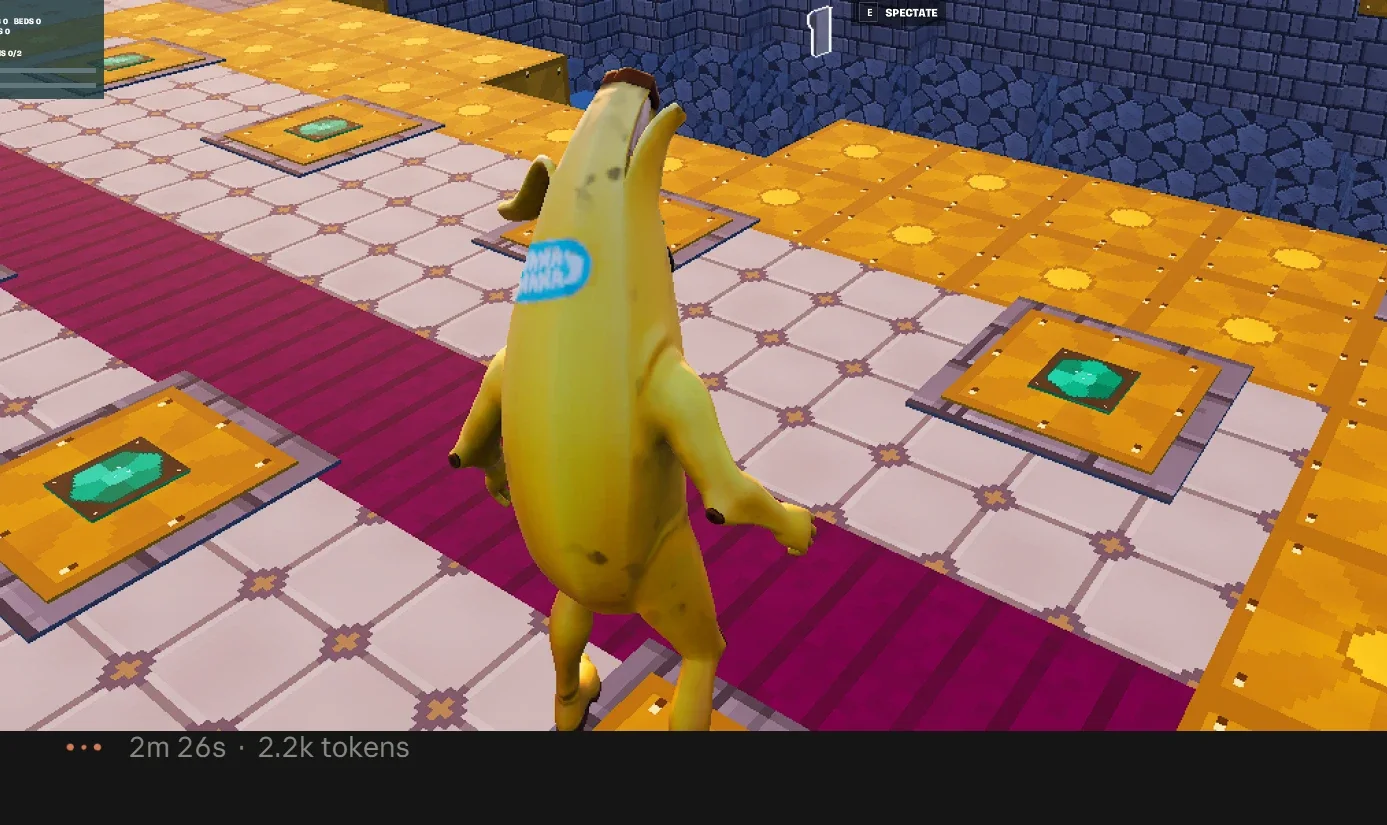
A banana-costumed player character on the waiting lobby's gold and pink floor among the spawn pads, with a SPECTATE button at the top. At the time, after joining the lobby it took about five seconds before the first-person view came on and the pawn could be moved; the delay was shortened by changing the island's pre-game setting.

Movement slowing down after the sky and fog change

On 11.10. a grey-blue fog named Storm Keep (Myrskylinna) and a sky were added below the islands with a single Day Sequence device covering the whole map, BW_Sky_StormKeep (fully opaque height fog in two layers, a grey sky gradient, a dimmer sun and 75% cloud cover), so that the saturated blue surface visible below the islands would not look like a safe sea. Right after this push a movement problem was noticed.

According to the log, sprinting on the ground usually stayed at about 3.1 m/s and at most 4.4 m/s, when before the push it had been 6.93 m/s; sneaking also slowed from about 0.9 to 0.7 m/s. Only the fog device had changed in the push, so it was suspected that the heavy clouds and fog dropped the player machine's frame rate and through it slowed the physics pawn's movement, or that the device had some other side effect. This could not be confirmed, because the player machine's log could not be read.

As an A/B test the fog device was disabled (enableDuringPhase = None) and pushed. The plan was to restore Storm Keep in a lighter form as fog only if movement recovered. The sources do not record the result of the test or any later re-enabling of the device, so the causal link remained unconfirmed. Notably, similar slow-running symptoms later also appeared in the post-push first-life desync (sprint at zero or about 4.4 m/s), so a push-induced desync is a possible alternative explanation.

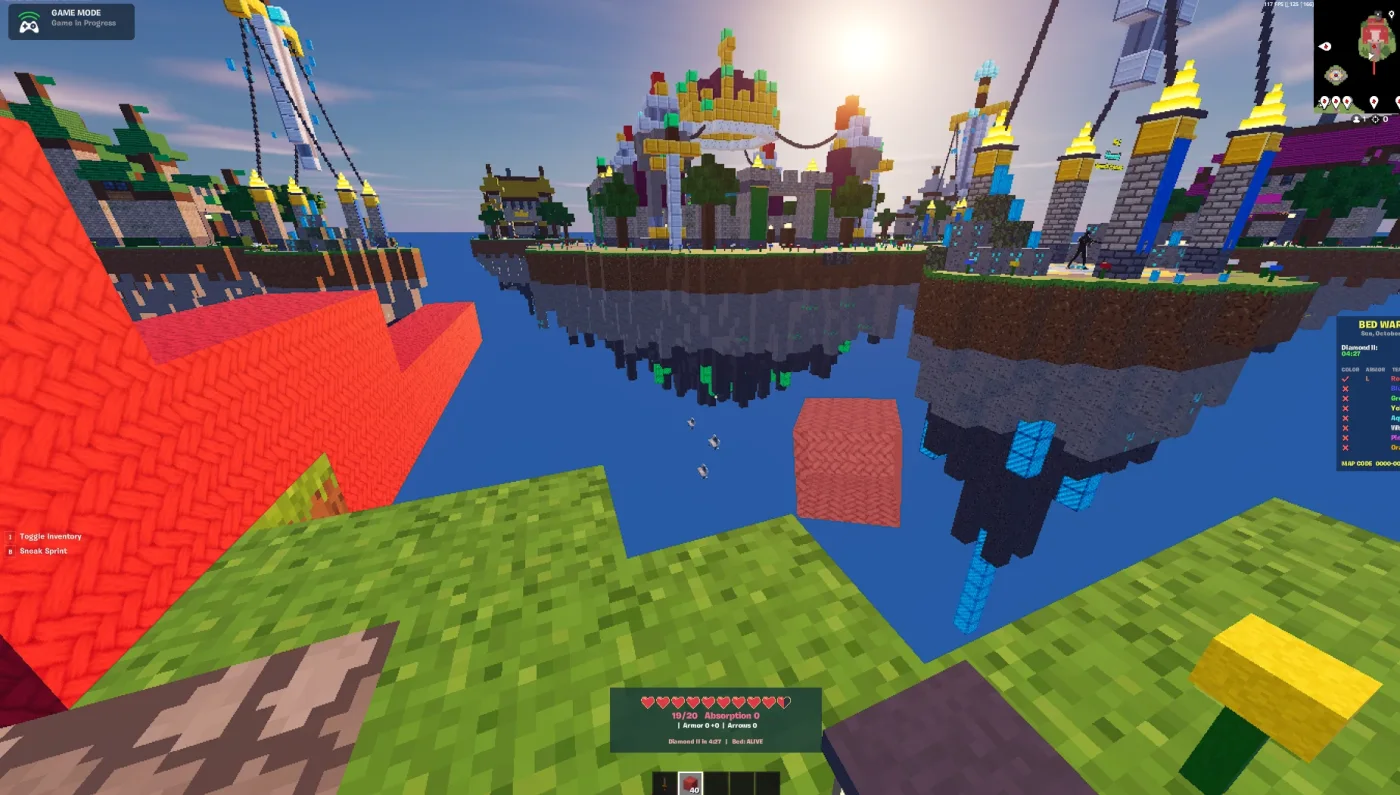
Game shot of the castle-style map before the fog change: a golden crown above the centre island, swords hanging from chains, and a flat, saturated blue floor below the islands. The Storm Keep fog added in place of this floor was the only change in the push after which running speed dropped in the logs.

Other movement-related observations

Your own body was occasionally visible in the first-person camera. The cause was at first thought to be camera switches: when an orbiting camera device is removed from the player, Fortnite makes the body visible again. The sneak camera switch was removed, and each life has a single camera, which is added only once the player's machine is driving the pawn and removed on death. On 20.10. it was finally established that the visible body was a test-session artefact caused by the editor push: in a fully restarted session the body stayed hidden, and the phenomenon does not affect the published game.

Knockback was implemented in the movement system as an involuntary jump. In measurements, a physics pawn on the ground only leaves the walking mode when the vertical velocity is at least about 9 m/s; weaker hits moved the pawn only 24.6–48.3 cm, because ground friction stopped it in about 0.2 seconds. Knockback is therefore written with a SetLinearVelocity call with a sufficient upward velocity. Fortnite's air control while sprinting is about three times Minecraft's (28.5 vs. about 8 m/s²), and there is no control for it in Verse; this is the biggest remaining difference in combat feel. For the guard bots, which do not obey physics, a teleport-based flight was made that uses the same 52.65 m/s² gravity.

Minecraft-style water was attempted with Fortnite's water devices, but they have a dead zone of about 50 cm (43 cm below the surface – 7 cm above) in which the player does not move, and a swim jump lifts only about 75 cm. Water was removed from the shop on 30.9. On a controller players usually reach an edge at full speed (walk 4.4 m/s, sprint 6.9 m/s), which was taken into account in the timing of the sneak edge guard.

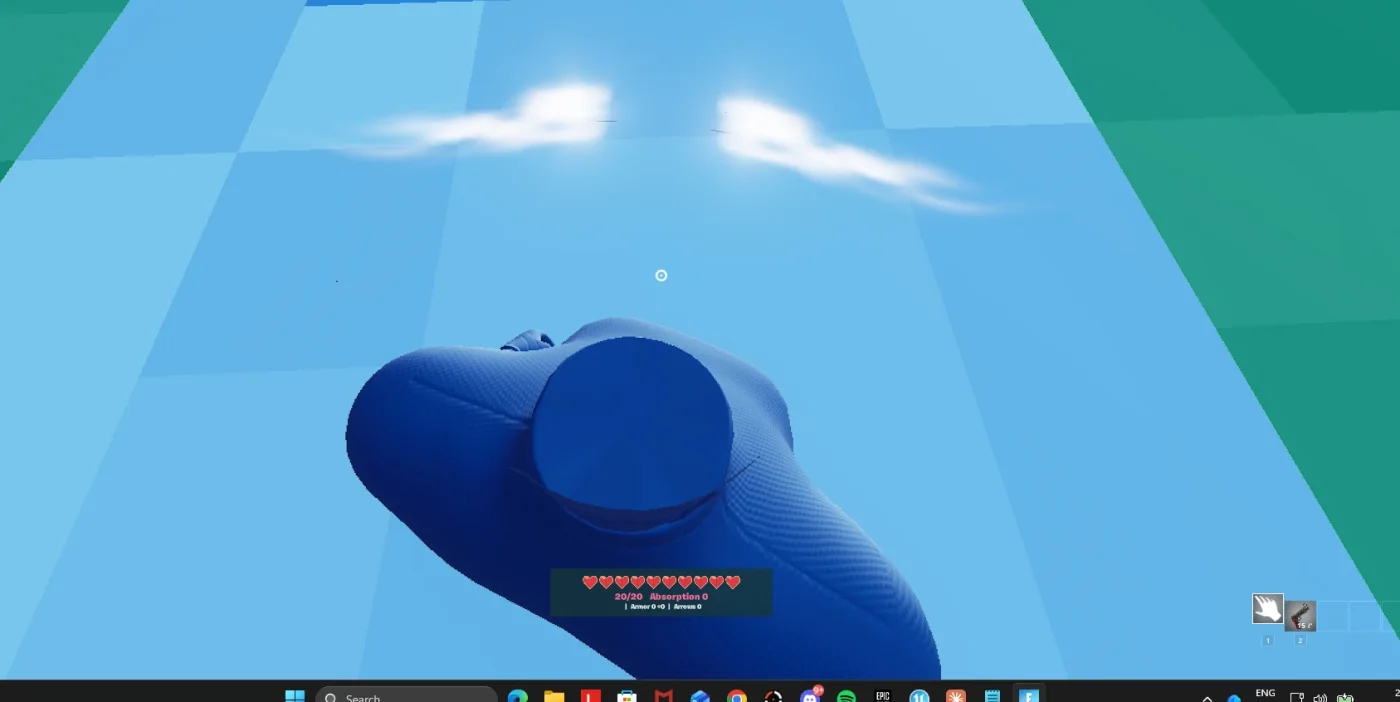
First-person view looking down: your own blue body is visible, with a round cut at the neck where the hidden head is. The visible body turned out to be caused by the editor's push function and did not affect the published game.

Key values

WhatValueWhat it affects
Island gravity-1950 cm/s² (the pawn feels about 52.65 m/s²)The only working jump height control. Peak about 1.25 m, air time about 0.45 s, a sprint jump clears a 3-block gap. Previously -1655 (peak about 1.47 m).
Native jump launch velocityabout 11.2 m/s (locked)The physics pawn does not obey the Player Movement Settings device, so the jump cannot be adjusted directly.
Jump peak formulav0² / (2 · 0.027 · |g|)How high the jump rises with island gravity g (cm/s²).
BaseSpeedMod1.26Permanent speed effect: walk about 4.4 m/s and sprint about 6.9 m/s (native 3.5 and 5.5 m/s).
Walk acceleration7 m/s²Fortnite's native value without sprint; not adjustable.
Sprint acceleration28.5 m/s²Also in the air; the cause of the sprint-jump boost over a block. The Minecraft equivalent is about 8 m/s².
BW_State_WallSpeedMod0.36 (sprint about 2 m/s)Speed cap when the pawn stands at under 0.5 m/s against a one-block step (WallStepSlow); stays on if the pawn rises faster than 0.3 m/s.
PadDrop1.5 cmInvisible floor plates below the block surface, so the pawn stands on the real block and not on a frictionless plate.
Lips on two-block wallsfrom 30 cm below the edge to 70 cm above, 5 × 5 cellsStop the capsule's rounded bottom from riding up on top of two blocks.
Map box collisionsabout 1,360 boxesReplaced the map meshes' triangle-mesh collision, which the capsule caught on.
PawnReady conditionmovement over 2 cm or 60 s (PawnReadyTimeout)The lobby does not teleport the pawn before the player's machine is driving it.
WatchPawnDriven0.5–300 cm / 0.1 s, at most 60 sOn respawn, movement settings, speed effect, camera and floor plates are set only once the player's machine is moving the pawn.
Sneak slowdown delay0.15 s (backwards 0.45 s)From pressing the crouch key to sneaking speed; shortened from 0.35 s on 21.10.
Island autoStart1Pre-game wait shortened from 5; from arriving in the lobby to moving 0.3 s instead of the earlier 6.3 s.
Movement presetCustom (not Current BR)The BR preset brought ledge grabbing and wall climbing.
Allow SlidingonWithout it the crouch key stayed held down during auto-run and slowed the pawn.

Final state

In the published game the jump is Fortnite's native jump, predicted on the player's machine, with its height determined by the island gravity of −1950 (peak about 1.25 m) and its length by the permanent speed effect 1.26; you cannot get on top of two blocks, a three-block gap can be cleared with a sprint jump, and a sprint jump against a block lands on top of the block. The map's collisions are boxes, the movement preset is Custom, sneaking is on the crouch key and Fortnite's separate sprint key is consumed. The pawn is not touched on respawn or in the lobby before the player's machine is driving it, and the first life of a match gets a fresh pawn from the spawn pad. Left open: the sprint's air acceleration cannot be adjusted, so a sprint jump made right on hitting a wall still gets a small boost; players using the default sprint run in the native sprint state; stepping up onto a block while walking is tight according to the calculation; confirmation of the respawn desync fix and the sneak-sticking fix was left partly to playtesting; the link between the Storm Keep fog and slow running remained unconfirmed; and the goal of making Bed Wars feel as smooth as the smaller Pillars map was left unmeasured.

Next chapter: Shift & bridging →