Bedwars: The Origin FI

Chapter

Placing and breaking blocks

Bed Wars is a team game in which each team protects its own bed and builds bridges and defences out of blocks from island to island. Fortnite has no built-in Minecraft-style one-metre block building, so it was made entirely from scratch in Verse code: a custom 100 cm grid, an aiming ray, placing and breaking blocks, a crack effect and blocks shown in the hand. This chapter explains why the system was built this way, which problems came up (double blocks, latency, pillaring stutter, building inside bases) and how they were solved.

Goal: Minecraft-feeling building in Fortnite

Bed Wars is a game mode familiar from Minecraft: eight teams start on their own islands, buy blocks and gear with resources and build bridges out of blocks to the opponents' islands. Once a team's bed has been broken, a player who dies no longer returns to the game. Without blocks a player cannot get anywhere from their island, and the protective shell built around the bed is the team's most important defence. Building and breaking therefore have to feel immediate and precise, or the whole game falls apart.

The game was made with UEFN (Unreal Editor for Fortnite), Epic's editor for making Fortnite islands. Game logic is written in the Verse programming language, and ready-made functionality is provided by devices, such as the Input Trigger device, which listens for the player's key presses. Fortnite's own building is based on walls and floors about five metres in size, and it cannot be scaled down to one-metre cubes. That is why Bed Wars blocks are custom 3D models that Verse places and removes during the game.

The foundation of building was made in the early phase of the project, before the sessions described in this account (according to the design documents, in mid-September 2026). That is when the grid, placing with the right mouse button, breaking with the left, the crack effect and six purchasable block types came into being. Polishing the gameplay started on 27.9.2026 and continued until release: almost every change started from a playtest observation and measurements in the game log.
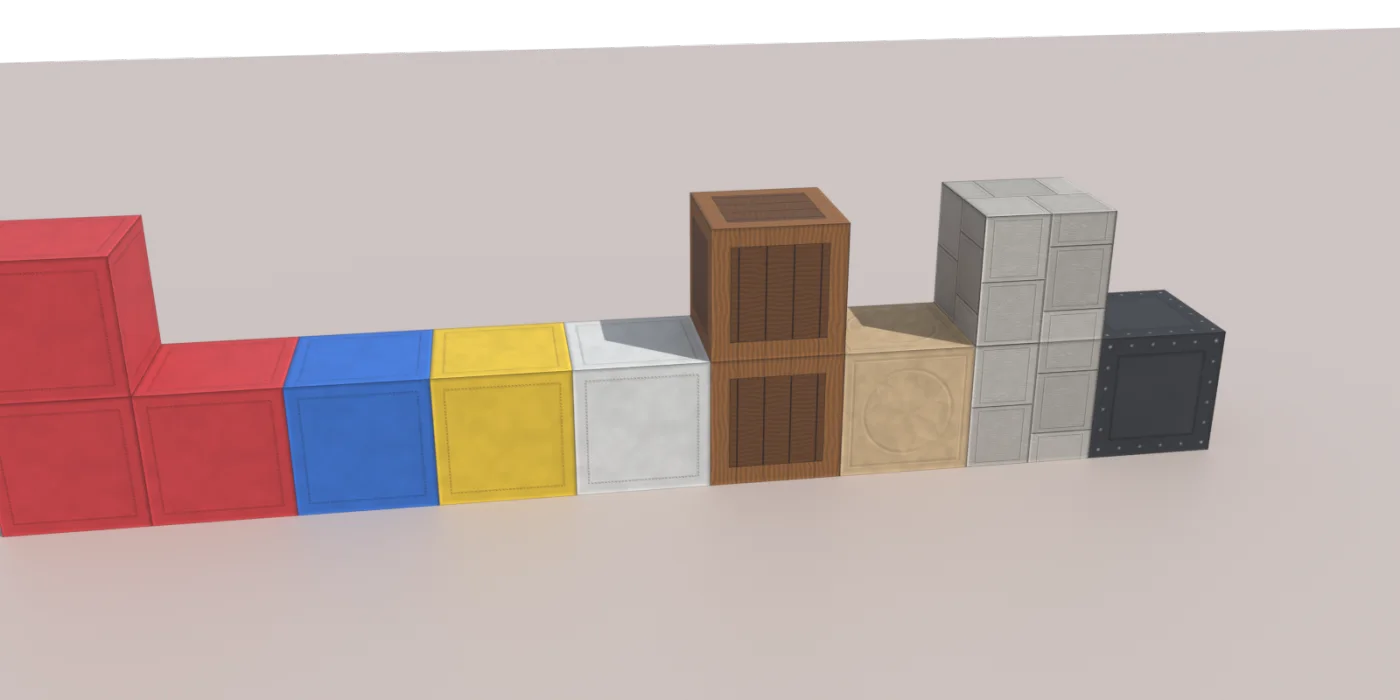
The second texture version of the purchasable blocks side by side: team-coloured felt (red, blue, yellow, white), wooden crate, sandstone, keep stone and riveted metal plate. All are 100 cm cubes of the same size that fit into one grid.

The 100 cm grid and the grid support file

All blocks in the game, both the map's prebuilt structures and those placed by players, sit in the same unrotated 100 cm world grid. The centre of cell (X, Y, Z) is at (50 + 100·X, 50 + 100·Y, 10050 + 100·Z) cm, so the base level of the grid is at a height of 10,000 cm. Verse handles cells as integers (bw_cell), and placed blocks are stored in a lookup map under a key computed from the cell's coordinates. The play area covers cells −96…96 in the X and Y directions and −24…48 vertically.

So that Verse knows where the map's solid blocks are, the map is written into a separate Verse file, bedwars_grid_support.verse. It is generated directly from the map's voxel data and is not edited by hand: for each Y row there is an array of integers in which each bit tells whether there is a solid cell at a given height (bit Z + 16). The function Contains(X, Y, Z) answers whether a cell is solid. The same data is used by the aiming ray, the building rules and the Minecraft-like sneak, i.e. the shift edge guard that prevents falling off the edge of a block while the sneak key is held.

The file must always be updated along with the map. The map's models are made with Blender scripts, and the same script produces both the models and the cell list (grid_v2_solid_cells.json) from which the Verse file is generated. There were initially 34,491 solid cells. The base redesign at the end of September raised the number to 35,179, removing the prebuilt bridges on 1.10. lowered it to 34,483, and the full map redesign on 11.10. (Sky Keep bases, new diamond islands and the central court) raised it step by step to 70,413. Merely moving a model in the editor does not update the file, so after every map change the generator was run along with a check in which the top surface of every cell column was tested with a ray. On 1.10. such a check found 514 columns with a missing collision surface, and they were fixed.

How a block is placed: the aiming ray and the target cell

When the player presses the build button (the right mouse button, listened to by an Input Trigger device), the server casts a ray from the player's eye in the direction of view for at most 500 cm. The ray traverses the grid one cell at a time (bedwars_voxels.verse, function Trace, a so-called DDA voxel traversal): it always steps along the axis whose cell boundary comes up first, and stops at the first solid cell. The new block goes next to this cell, in the cell the ray came from (Adjacent). Ties are always resolved in the same axis order, so a block never ends up floating between cells.

Before placing, the CanPlace check rejects the cell if it is outside the play area or already occupied, if the world already has 4096 placed blocks (MaxBlocks), if the cell is in a protected area or at a team chest or generator pile, if it contains a lit explosive, or if the cell would overlap a player. For a player, an 85 cm area horizontally and the span between feet and head are checked; when crouching the foot level is higher, so the next block of a bridge fits under the pawn. Spectators and players in the lobby do not block building. If the eye position is more than 2 m from the pawn (for example right after a teleport), the ray is not cast.

A successful block is also registered immediately with the sneak edge guard (RegisterCell), so the guard knows the new floor exists, and one is deducted from the player's block supply. There are six purchasable block types: team-coloured Banner Felt (4 iron / 16 pcs), Carved Sandstone (12 iron / 16), explosion-resistant Blast Glass (12 iron / 4), Keep Stone (24 iron / 12), Crate Wood (4 gold / 16) and Bastion Plate (4 emeralds / 4). They correspond to Minecraft's wool, clay, blast-proof glass, end stone, planks and obsidian, but the names and textures were replaced with original ones in October for copyright reasons.

Placing was also refined at the edge. In speed bridging, i.e. fast bridge building, the player backs up to the edge, holds sneak and places a block under their feet in the empty cell ahead. At the end of September it was noticed that a jerk at the sneak edge happened only on self-placed blocks. The cause was the blocks' collision shape: all 13 placeable block models had, in addition to an exact 100 cm box, an automatically generated, slightly larger hull, so there were two edges. The extra hull was removed, leaving a single exact box with the same collision settings as the map's blocks.

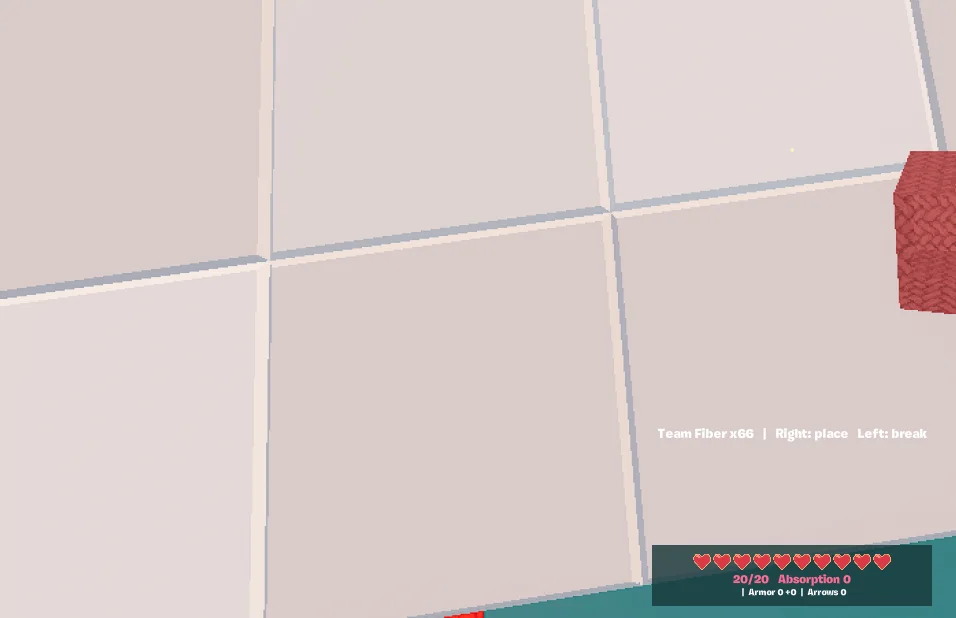
Game shot of light floor blocks with one red placed block at the edge. The building hint text (right button places, left breaks) and the block count are visible on screen. The image relates to the observation that the edge jerk happened only on self-placed blocks, which led to fixing the block models' collision shapes.

One click, one block, and placement latency

The first bug fixed (28.9.) was that a single click often placed two blocks. In the log the blocks came in pairs 50–95 ms apart in adjacent cells. The code repeated placement while the button was held as often as every 0.10 s, and an ordinary click often lasts longer, so the repeat had time to put a second block against the side of the one just placed. In the fix every separate press places a block immediately, and only a double press arriving in the same server tick is ignored (PlaceClickGap 0.03 s). A held button repeats a successful placement only after 0.2 s (PlaceRepeatDelay, Minecraft's 4 ticks), but if the aim hits nothing, the attempt is retried every frame, so building from an edge works as soon as the next cell comes into the aim.

In October the pawn occasionally fell on long bridges. The log showed that the fault was not in sneaking: the pawn stopped at the edge, but the next block did not appear. The most likely cause was aiming: from the edge the crosshair has to hit the side of the block below within a window of about 4 degrees (view angle about 80–84°). If the crosshair drifts onto the top of the block, the target cell becomes the cell the player is standing in, and placement is blocked without notice. The mechanics were not changed on a guess; instead a permanent log line, BEDWARS PLACE MISS, was added to the code, reporting the hit point, target cell and reason for every press that produced nothing. Later logs confirmed that the wasted clicks while bridging hit the top surface of the block, which is normal in Minecraft as well.

Around the same time placement felt laggy. The log showed that the server placed the block in the same frame the press arrived. The latency came from every block being created as a new Scene Graph entity (Verse's object model for game-world objects), which every player's machine first had to build. The solution was a block pool (functions TakeBlock and FillBlockPool): for each block variation 4 ready-made copies are kept deep under the map at a height of −12,000 cm, where a living player never goes, because the fall zone already kills at −10,000 cm. Placing just moves a ready block into the right cell, and a new one is made to replace the used one on the next frame. The network round-trip latency still remains: in Verse all code runs on the server, and the player's machine cannot show the block in advance as in Minecraft.

At the end of October a stuck build button was also fixed: if the button was released while the shop or inventory was open, the release did not arrive, and blocks started appearing on their own after the menu closed. Now the build button state is always reset while a menu is open. According to the sources, there was no time to test this fix in game before it was pushed to the session.

Building while jumping: the pillaring suck-in

Pillaring means building a tower under your own character: the player jumps and places a block under their feet, landing on top of the block one metre higher. In Minecraft this is smooth, but in tests on 14.10. the pawn felt like it sank into the block and popped up (a suck-in), and later also like it was thrown to the side and back. The jump is tuned so that gravity is −1950 cm/s² (the pawn experiences it as 52.65 m/s²) and the jump peak is about 1.25 blocks, which gives about 0.30 s of air time.

In the server log pillaring looked clean, so the first fix was to the sneak's invisible floor plate, which was moved under the landing pawn at every level. The suck-in remained, however, especially when the block was placed only just before landing. The log showed that late-placed blocks sank the pawn a few centimetres into the block even on the server: the block reached the server in time, but the player's machine too late. A rule was added to the code that computes from the pawn's height and vertical velocity how soon the feet will hit the top surface of the new block (function LandIn), and skips placing the block if there is too little time (PlaceLandLead). The threshold was tried at 0.12, 0.17, 0.22 and 0.20 s; according to the log, 0.15 s or more landed cleanly, while 0.13 s sank 5 cm.

The suck-in still happened at times, even though the ping was only about 40 ms. It was concluded that a Scene Graph block updates slowly on the player's machine. As an experiment, an identical-looking Creative prop, Fortnite's older object type that updates faster on the player's machine, was moved to the position of the pillaring block. 8 props per block variation are kept ready under the map. The prop removed the suck-in. A temporary on-screen readout (setting PillarReadout) showed how many milliseconds before landing the block arrived: blocks arriving about 100 ms before landing sank the server pawn 1–9 cm, while those arriving 150 ms or earlier were clean.

The developer also asked whether a 10 cm higher jump would help. According to the calculation it would have given only about 0.04 s of extra time and required changing gravity to about −1810, so the jump was left alone. In Minecraft the player's own machine places the block immediately and the server only verifies it. Fortnite's own building pieces are predicted on the player's machine, but they cannot be scaled down to block size. In UEFN's Verse API a Predicts module marked for Epic-internal use was found, and according to a reply on Epic's forum, Verse running on the player's machine (Predicts) is on the roadmap for the second quarter of 2027.

The final pillaring solution: prop blocks, a 0.25 s threshold and a click buffer

Next, a per-player threshold that learns from ping was tried, since Verse has no API for reading ping: sinking raised the threshold and clean landings lowered it. The threshold dropped too low, however, and late clicks at 105 and 132 ms sank the pawn again. Frames were extracted at 0.2 s intervals from a video recorded during a playtest, and they revealed the actual cause: with a late click the player's machine had already landed on the old block when the new block appeared inside the pawn and pushed it to the side. The server did not see this at all, so the learning threshold based on server observations had been computing the wrong thing. The threshold was set to a fixed 0.25 s for everyone.

At the same time the side effects of the prop blocks were fixed. When the prop was moved away from under a standing pawn after 0.8 s, the pawn was thrown to the side; now the prop stays in place for at least 0.8 s and until nobody is nearby (120 cm to the sides, 150 cm below and 300 cm above, at most 20 s). At the developer's suggestion a click buffer was added: if a block is attempted while still on the ground or early in the jump into the cell the player occupies, the click is remembered for 0.35 s (PillarClickBuffer) and the block is placed as soon as the feet rise above the block's level, which is the safest moment.

Tightening the threshold to 0.27 s and adding an exception for the early phase of the jump made things worse: the jump's launch velocity varied between 9–10.7 m/s, and on slower jumps no block appeared at all. At the same time a calculation error in the foot height was found (the pawn's root is 95 cm above the floor, not 77.15 cm), as well as the fact that the pillar rule rejected speed-bridging blocks, because a pawn standing on an edge plate is not always counted as grounded. At the developer's request the 0.25 s version with the original calculation was restored, because the threshold had been tuned with exactly that, and only the bridging exception was kept: a pawn standing still at block level is not subject to the rule.

The last fix was breaking on top of a pillar. The invisible prop of a broken block stayed under the feet, so the player stood on an invisible block and hacked at the block below. The prop was removed immediately when the block broke, but that caused a small jerk when falling. In the final version the prop is hidden in place, which also removes its collision, and it is moved away only when no player is nearby. The developer confirmed in a playtest that spam-clicking pillaring upwards worked without the suck-in and that the final version was smooth. According to the log, 294 of 302 blocks got a prop. A suspicion was also checked that the pistol-based item held in the hand would aim with the right button and slow the player down: the speed right after placing was 3.78–4.04 m/s, i.e. full backing-up speed, so there was no slowdown.

No building inside bases

An established Bed Wars rule is that you may not build in a base's inner court, where the spawn, the shopkeepers and the generator are, but you may block the entrance. In a playtest at the end of September it was noticed that a tall pillar could be built in the generator area. From the original base design it was established that the white arch is the entrance, the bed is outside the arch and the spawn is in the inner court.

The ban was added to the same check (Protected) used by blocks, TNT and, at the time, still water. The function InBase (bedwars_combat.verse) measures the cell's distance from the shopkeepers' centre point in the base's direction: the area extends 450 cm forward and 350 cm back and 550 cm to the sides, at full height upwards from the floor. In design cells this is 8 × 11 cells (88 cells at floor level), the same in all eight bases. The entrance arch row is left buildable so that it can be blocked, and building on top of the walls is allowed. When pressing in the banned area the player gets the message You can't place blocks here!

In addition there are 39 protected points (ProtectedPoints): the diamond and emerald generators and 16 shopkeepers. Around them a cell is rejected within a 125 cm horizontal radius and 220 cm of height. Building is also not possible in team chest cells or on top of generator piles. Previously the bases had old protection points around former generator locations, because of which in some spots building only worked from the sixth block upwards; they were removed. The inner court ban was compiled and pushed to the game on 30.9., but the sources make no separate mention of a playtest of it.

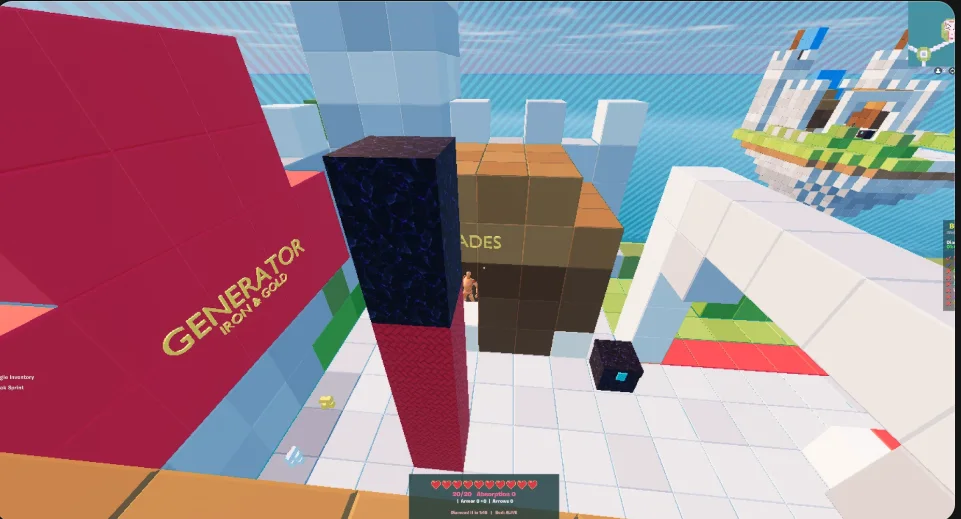
Game shot from inside the red base before the building ban: a dark and red block pillar has been built in the generator area next to the GENERATOR IRON & GOLD sign, with the upgrade booth in the background. The image showed that the inner court could be built in, although according to Bed Wars rules it should not be.
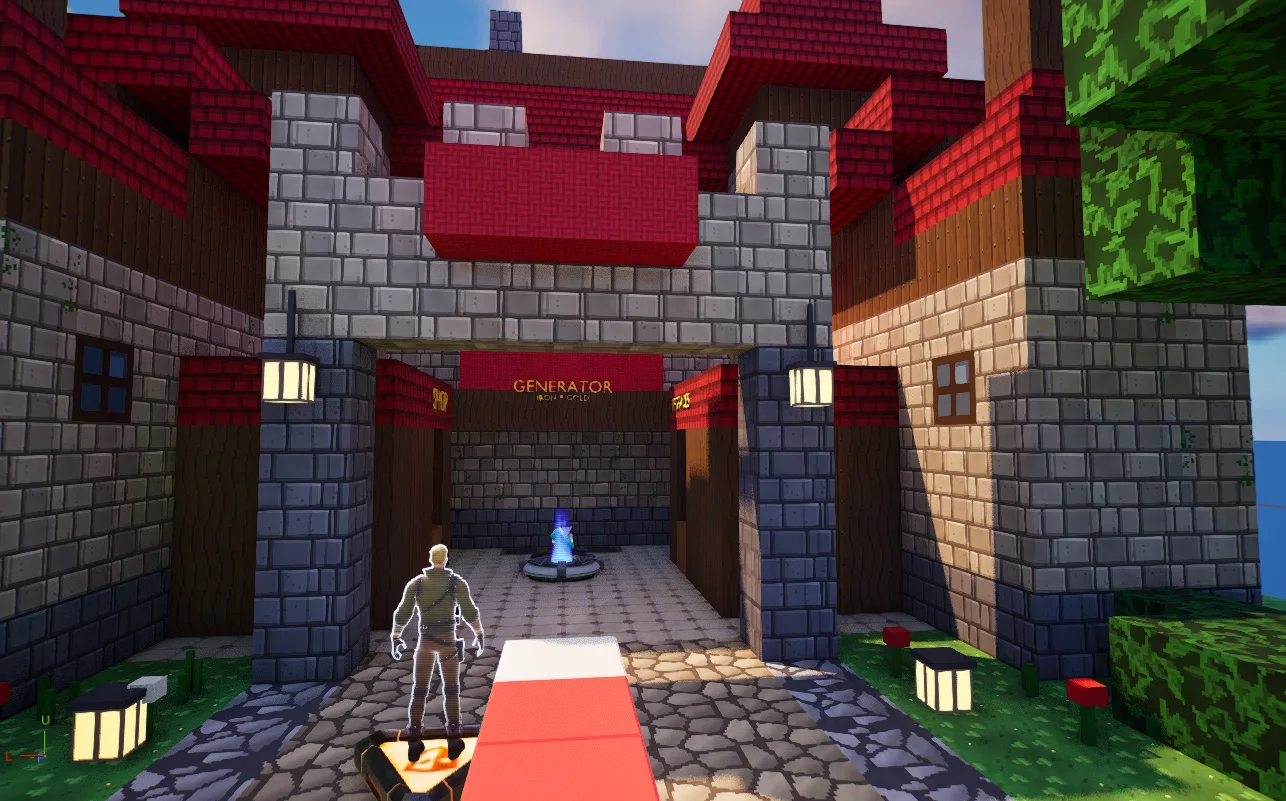
Editor shot of the entrance to the redesigned red base: behind the gate is the inner court, at the back of which the GENERATOR sign and the generator pile are visible. The entrance row is buildable, but the court behind it belongs to the no-build area.

Breaking blocks: mining times, tools and the crack effect

The left button breaks blocks placed by players and enemy beds; the map's solid structure does not break. Breaking is not a single click: the button is held, and progress grows every frame by the fraction elapsed time / required time. Progress is measured as a fraction, so if conditions change midway (the player jumps or the team buys a mining upgrade), only the rate changes, not the work already done. Changing target, releasing the button or opening a menu resets progress. If an enemy is in the crosshair, the hit goes to the player and not to the block behind them. Your own bed cannot be broken.

The base times are in the file bedwars_block_catalog.verse (MineSeconds). The tools are hand, pickaxe, axe and shears, and tools have three tiers: stone, iron and crystal. Banner Felt breaks in 0.8 s by hand and 0.25 s with shears. Carved Sandstone takes 1.25 / 0.8 / 0.35 s with a pickaxe (tiers 1–3) and 4 s otherwise. Blast Glass always breaks in 0.5 s. Keep Stone takes 2.2 / 1.4 / 0.6 s with a pickaxe and 12 s without. Crate Wood takes 1.4 / 0.9 / 0.4 s with an axe and 4 s without. Bastion Plate lasts 120 s unless the player has a crystal pickaxe, with which it breaks in 4.5 s. An enemy bed breaks in 0.3 s.

The base time is modified by multipliers (bedwars_rules.verse, Mining): the team's mining upgrade divides the time by 1.2 or 1.4, a mining-fatigue trap triples the time, and mining in the air multiplies it by five as in Minecraft. Being in the air is inferred from the pawn's position in the grid rather than from Fortnite's grounded flag alone, because that arrives about 0.1 s late. A broken block returns to the player's inventory. For explosives, each block also has a durability: Banner Felt 1, Carved Sandstone 2.5, Crate Wood 2, Keep Stone 6, and Blast Glass and Bastion Plate are immune to explosions.

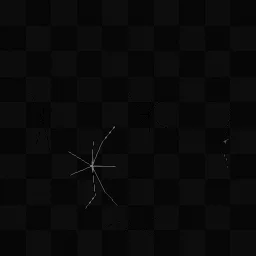
Breaking progress shows as cracks on the block's surface. The cracks are ten original, branching 3D models (SM_BW_Fracture_01…10) made with the Blender script build_break_fx.py, and they are not copies of Minecraft's images. The stage is chosen directly from progress (progress × 10), so the same ten-stage animation works for all materials and tools; only its speed varies. If several players hack at the same block, the stage of the player furthest along is shown, but the times do not add up. The cracks have no collision.

When a block breaks, eight small block-like fragments (scale 0.11) spawn in its place, fly outwards and fall under gravity for 12 animation steps at 0.04 s intervals while shrinking. The effect lasts less than half a second, and the fragments have no collision. There can be at most 16 simultaneous fragment groups, so that large explosions do not overload the game. The fragments are always removed, even if the game ends mid-effect.

The model for the second stage of the crack effect in UEFN: a thin, light crack pattern branching from a centre point on a dark background. Ten such stages cover the block's surface as breaking progresses.

Blocks shown in the hand

The player sees the selected block in their own hand, and other players see it in theirs. The views are made in two different ways. The own hand view (bedwars_viewmodel.verse) is a purely cosmetic model, visible only to its owner, that sways with walking, jumping and landing; every placed block triggers a short use animation (PulseUse). When a block is selected, a dedicated build camera is used in which the character's body is hidden, so aiming down at an angle is unobstructed.

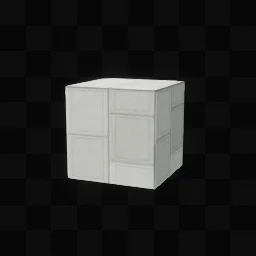
The block visible to others is a real Fortnite hotbar item. Giving Fortnite items to a player required a pistol template (pistol_template), but the pistol model was visible to other players even though it was removed on the server. The solution was a prefab made in the editor, BW_HandItem, from which the pistol model has been removed. From it an item is built for each block whose model is the block's own handheld version (SM_BW_Held_*), and the weapon's damage and sounds are disabled. The item is shown to everyone except the owner, who sees their own hand view.

The handheld model of the Keep Stone block in UEFN: a light stone cube with blocks of varying length on its surface. SM_BW_Held models like this are used for the blocks other players see in the builder's hand.

Final implementation

The core of building is in the file bedwars_building.verse (about 2700 lines). It listens to the place and mine buttons, runs a per-player loop every frame (placing, click buffer, mining, hits) and contains the rules CanPlace and Protected, the block pool (TakeBlock, FillBlockPool), the pillaring props (ShowPillarProp, FillPillarProps), the landing calculation (LandIn) and mining (Mine, RemoveBlock). The same file also contains the ClearGame function, which removes all placed blocks, props and pools at the end of a game so that the next game starts from a clean slate.

The file bedwars_voxels.verse defines the cell (bw_cell), the placed block (bw_placed), cell keys and coordinates, and the ray through the grid (Trace). bedwars_grid_support.verse contains the map's solid cells as a bitmap. bedwars_block_catalog.verse contains the blocks' names, prices, stack sizes, mining times, blast resistances, icons, and world and handheld models. bedwars_break_fx.verse does the cracks and fragments, bedwars_rules.verse the mining multipliers, bedwars_viewmodel.verse the own hand view and bedwars_inventory.verse the hotbar items visible to others. The sneak edge guard (shift_sneak.verse) receives information about every placed and broken block immediately.

From the player's point of view the result is Minecraft-like: the right button places a block in the cell the aim points to, each click makes one block and holding repeats every 0.2 s, the left button breaks a block in a time that depends on the tool, and the bases' inner courts are no-build zones. In pillaring, a click that comes too late is deliberately left without a block, because without prediction on the player's machine it would cause a jerk.

Key values

WhatValueWhat it affects
Block size100 cmAll map and player blocks sit in the same unrotated 100 cm world grid.
Grid base levelZ 10,000 cmThe centre of cell (X, Y, Z) is at (50 + 100X, 50 + 100Y, 10050 + 100Z) cm.
Map solid cells34,491 → 70,413Cell count of the bedwars_grid_support.verse file at the start and after the map's Sky Keep redesign.
Building reach500 cmMaximum length of the aiming ray from the eye in the direction of view.
MaxBlocks4096Maximum number of placed blocks in the world at the same time.
PlaceRepeatDelay0.2 sRepeat interval of a held build button (Minecraft's 4 ticks); 0.10 s produced double blocks.
PlaceClickGap0.03 sOnly a second press arriving closer than this is ignored as a same-tick double.
BlockPoolSize4 per variation, Z −12,000 cmPre-created blocks under the map; placing only moves them into position.
PlaceLandLead0.25 sIn pillaring, a block is not placed if the feet would hit its top surface sooner than this; can rise to at most 0.30 s if the server detects sinking.
PillarFallExtra+0.04 sExtra time added to the threshold when the pawn is already falling.
PillarClickBuffer0.35 sHow long a too-early pillar click is remembered; the block is placed when the feet rise above the block's level.
Number of pillar props8 per variation, at least 0.8 sCreative prop blocks, which update quickly on the player's machine, at the position of the pillar block.
Gravity−1950 cm/s² (52.65 m/s²)Gravity used in the pillaring landing calculation.
Base building ban8 × 11 cellsInner court from the shopkeepers' centre point 450 cm forward, 350 cm back and 550 cm to the sides, at full height; arch row free.
Protected point radius125 cm / 220 cmAround generators and shopkeepers, horizontally and vertically.
Mining times0.25–120 sE.g. Banner Felt by hand 0.8 s, with shears 0.25 s; Keep Stone with a crystal pickaxe 0.6 s; Bastion Plate without a crystal pickaxe 120 s, with one 4.5 s; bed 0.3 s.
Mining multipliers÷1.2 / ÷1.4, ×3, ×5Team mining upgrade tiers 1–2, mining-fatigue trap, mining in the air.
Crack stages10Original branching crack models, stage = progress × 10.
Fragments8 pcs, 12 × 0.04 s, at most 16 groupsBreak effect duration under 0.5 s and the cap on simultaneous effects.

Final state

In the published game (6.11.2026) blocks are placed and broken by a custom Verse system on a 100 cm grid. One click makes one block, ready-made block pools shorten placement latency, and pillaring works with prop blocks, a fixed 0.25 s threshold and a 0.35 s click buffer; the developer confirmed pillaring and breaking on top of a pillar to be smooth. Mining times depend on the block, the tool and its tier, and breaking shows as ten crack stages and fragments. The bases' inner courts, generators, shopkeepers and chests are no-build zones. Left open: late pillaring clicks do not produce a block, and players with higher ping may get jerks more often; the prop and the real block overlap for a moment, which may flicker. Prediction on the player's machine (Verse Predicts, on Epic's roadmap for the second quarter of 2027) would allow building to be reimplemented without these workarounds. The sources contain no separate playtest confirmation of the block pool's effect on feel, the stuck build button fix or the inner court building ban.

Next chapter: Combat →