Bedwars: The Origin FI

Chapter

Visuals: map, blocks, icons, sky and an original visual identity

This chapter describes how the map and graphics of Bedwars: The Origin went from flat-coloured cubes to an original castle style in which every model and texture is generated by code. The visuals directly affected gameplay, because the collision of every surface had to match the block grid. They also affected whether the island could be published: Epic's review can reject an island that looks too much like Minecraft, so in the final phase every recognisable block, name and icon was replaced with original ones.

Starting point: Stone Ruins and Grid V2

Bed Wars is a team game in which each team has its own island and a bed. As long as the bed stands, a dead player respawns. Players build bridges of blocks between the islands, and generators produce iron, gold, diamonds and emeralds as shop currency. The game was made with Fortnite's UEFN editor (Unreal Editor for Fortnite). The game logic is written in Fortnite's Verse programming language, and an AI agent drove the editor through an MCP connection (Model Context Protocol).

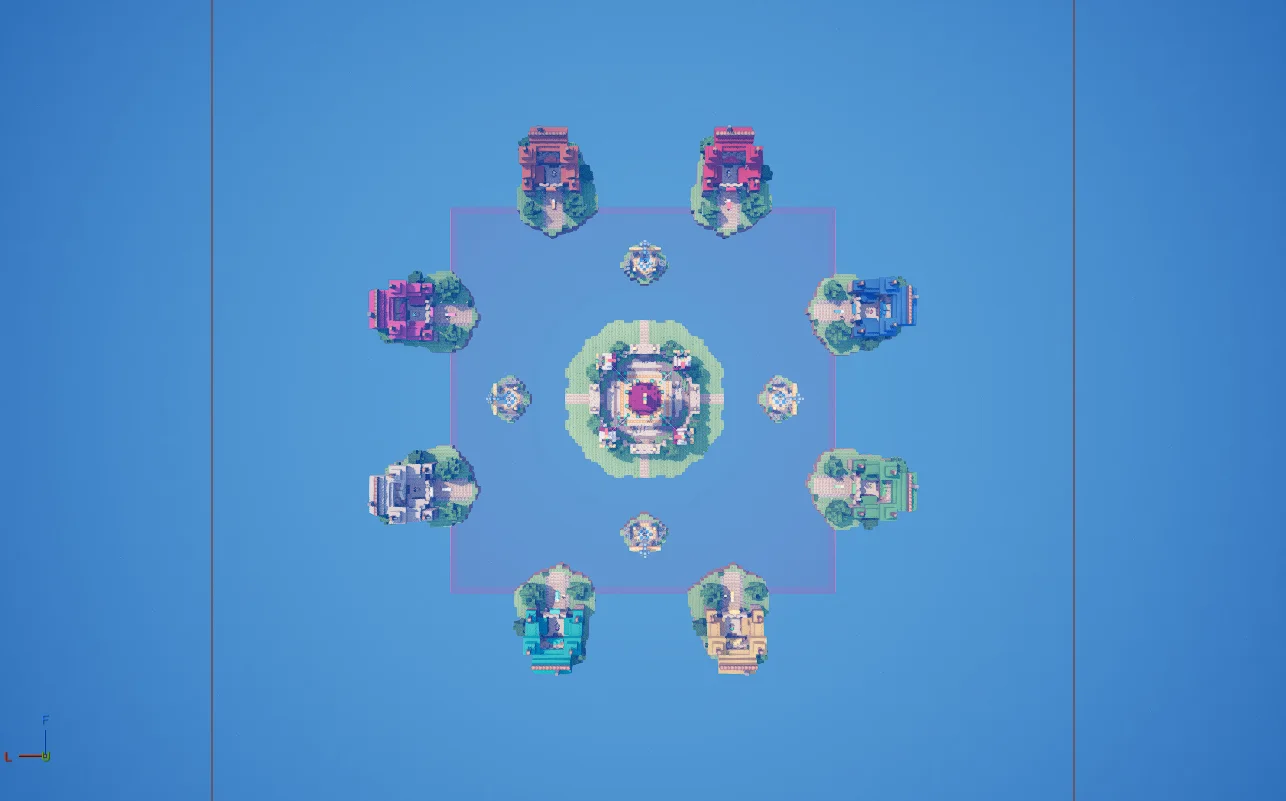
The first map, Stone Ruins, was finished on 15.9.2026, before the Claude sessions covered in this account. It had eight identical bases, marked with different colours, on the perimeter of an octagon. Each had a spawn, a bed, an Item Shop and an Upgrades character, and an iron and a gold generator. Four diamond islands sat at a radius of 42 metres from the centre, each serving the two neighbouring bases. The centre island was about 51 × 51 m and had three emerald generators. The islands were connected by prebuilt stone paths three blocks wide, whose diagonal sections stepped in one-metre increments. A player falling into the void died about 60 m below the island floor. The blocks were one-metre cubes with their own materials and bevelled edges. No Minecraft textures were used.

The next version, Grid V2, moved everything onto the same 100 cm world grid. The map was assembled from 30 merged structural pieces, each with rotation (0,0,0), scale 1 and a location that is a multiple of a hundred centimetres. The bridge model had 696 cells. In play it turned out that UEFN's automatic LOD levels (simplified models used at a distance) distorted the block surfaces into large triangles. All 15 grid models were given a single full geometry level. The models are in the Bedwars/GridV2 folder. They are no longer visible in the game, but the same block grid is still the foundation of the game.

In the first Claude session (27.9.) it emerged that the player character stuttered and snagged on the map's prebuilt structures, such as the green stairs next to the shop and the pillars of the centre island, even though walls made of player-built blocks behaved normally. The cause was that the GridV2 models (SM_BWG_*) used triangle-mesh collision, and the capsule of Fortnite's physics character caught on the seams between triangles. About 1,360 merged box collisions were computed from the map's block data (bedwars_grid_support), with floors as large slabs. The original meshes were backed up, and the surface height at every point was checked to be unchanged. After that, walls behaved normally in a playtest.
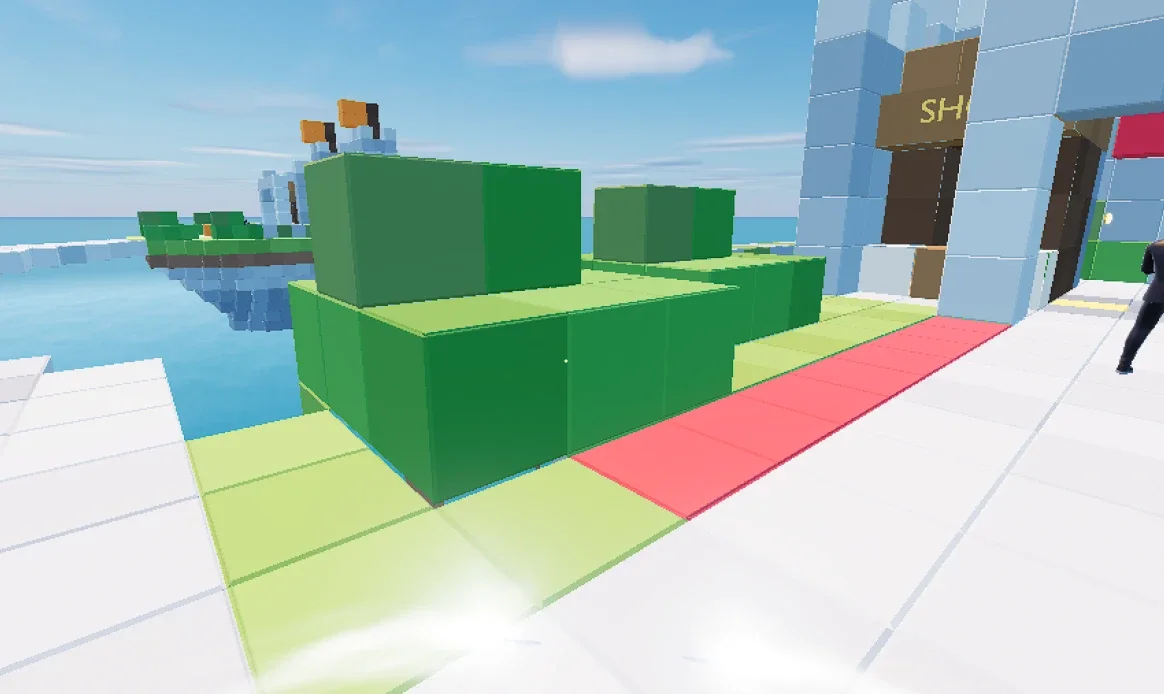
A Grid V2 base at the end of September: flat-coloured green block stairs, a red path, a white tiled floor and a light-blue castle with SHOP signs. On these merged structures the player stuttered against walls until the triangle-mesh collision was replaced with boxes.
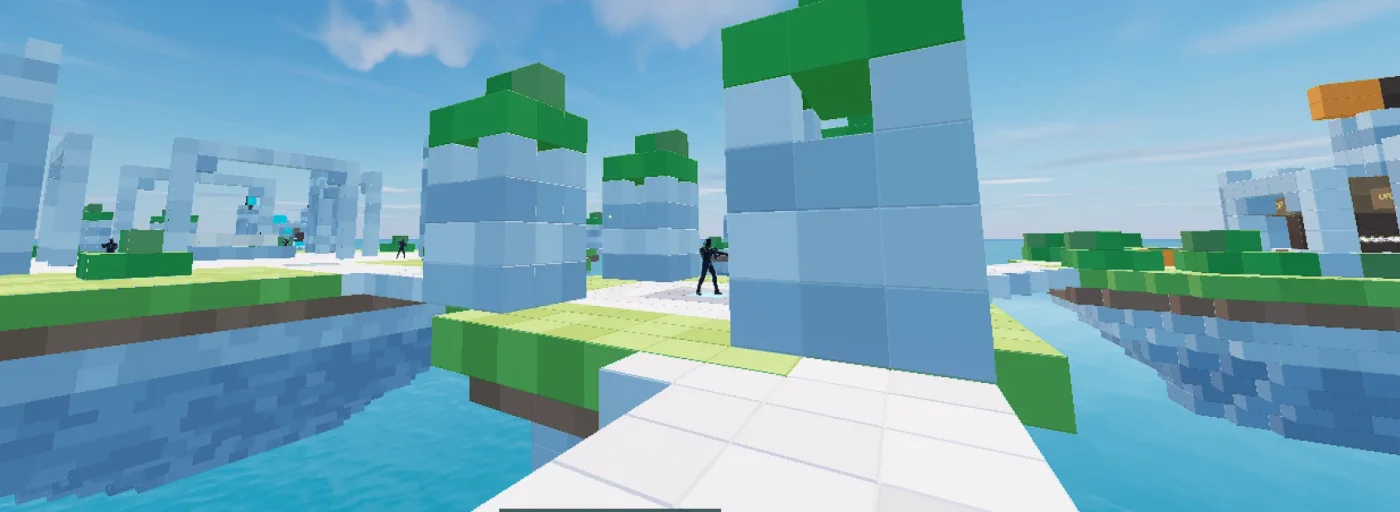
The old centre island: light-blue pillars topped with green blocks, a white bridge and islands floating above the sea. The image shows the untextured look of the Grid V2 era.

A code-driven asset pipeline: from Blender to UEFN

All of the game's own models and textures were made with code. Nothing in the game was modelled by hand, and no third-party assets were used. The sources are Python scripts in the folder Documents\ChatGPT\Blocks. They are run with Blender 5.1 in background mode (blender -b --factory-startup --python ...). A script produces FBX models, PNG textures and preview images, and the developer chooses the direction from those. The most important scripts are build_keep_v3.py (bases), build_diamond_v3.py (diamond islands), build_center_v3.py (centre island), build_lobby_v3.py (waiting lobby), build_keep_tiles_v4.py (map tiles), build_block_textures_v2.py (building blocks), build_shop_icons_v2.py (icons), build_item_meshes_v2.py (3D items) and build_bed_v4.py (bed). The machine has no separate Python install, so the helper scripts are also run with Blender's bundled Python.

Importing into UEFN was done with the MCP tools StaticMeshTools.import_file and TextureTools.import_file, and they had many pitfalls. First, the importer rotates an FBX model by 90° compared with the old import: variant n in the new version corresponds to variant n−1 in the old one, so the team in quarter turn q uses variant (q+1) mod 4. Alternatively, the model is pre-rotated in Blender. Second, the importer adds three automatic LOD levels (50 % and 25 %) and a Nanite fallback mesh to every model. On devices without Nanite, the blocks therefore looked melted. This happened on the developer's PC but not on PlayStation. So after every import remove_lods is run and the Nanite fallback percentage is set to 100 %. The centre island's fallback mesh had already shrunk from 80,100 triangles to 13,110.

The list of collision boxes is first set to empty and then set again in full, because set_properties cannot grow an existing array. The values must also be passed as JSON text rather than as a dictionary, otherwise the call silently returns false. import_file does not replace an existing asset, so every new version got a new name (AtlasV2…V8, T_UI2/3/4, SM_VM3/4/5). A new content folder is an internal module from Verse's point of view, so the assets used by Verse were moved to the Bedwars/Building folder. Assets and actors are saved before the Verse build (BuildAll), because otherwise the editor waits on a modal Save Content dialog that only a human can click.

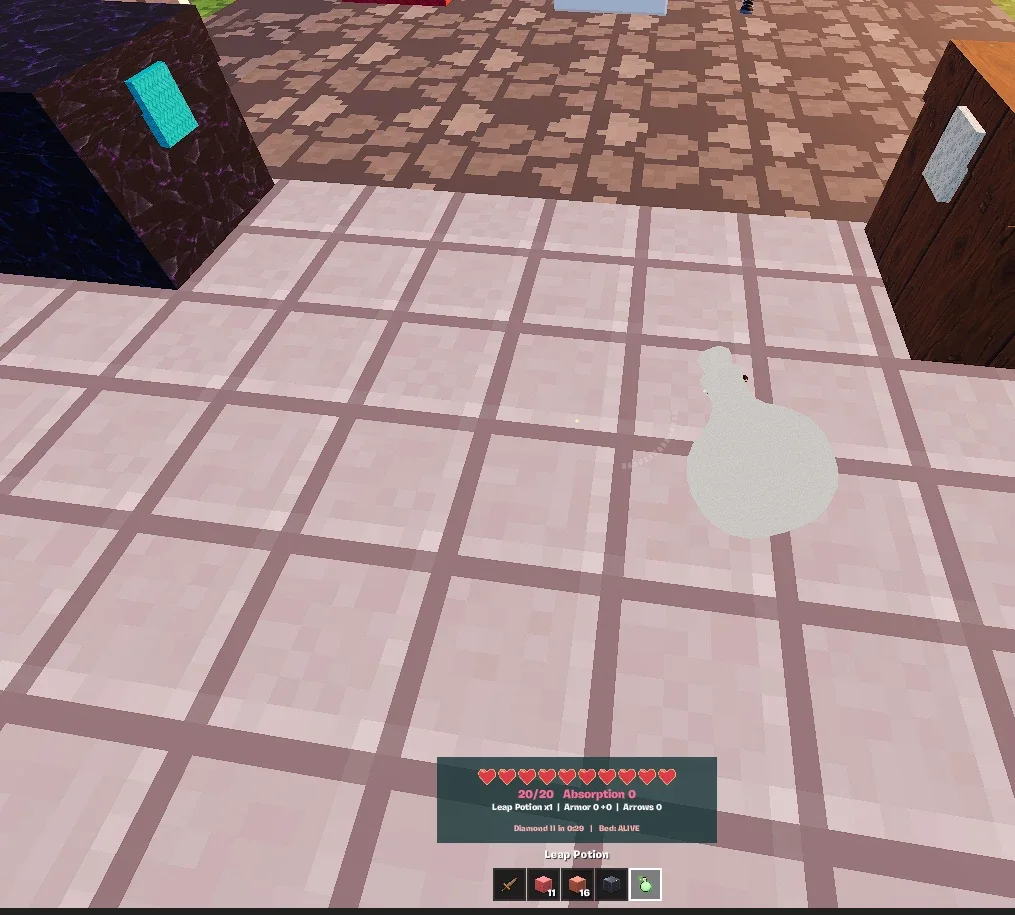
Two later traps concerned surfaces and colours. The MCP import uses the legacy FBX importer, whose VertexColorImportOption defaults to Ignore. That is why the first-person models came in grey until the setting was changed to Replace. The setting reverts to the default every time the editor is restarted. In hand-built bmesh models, mirroring on the Y axis flips the winding order of the faces, and UEFN renders only the front side of faces, so the model appeared inside out in the game. The faces are flipped in the script, and the preview is rendered with back-face culling, just as in the game.

Plan v2: bridges removed, a deeper void and a collision-gap audit

At the beginning of October a launch plan was drawn up. Its layout decisions were: the prebuilt bridges are removed entirely so that everyone has to build their own; the void is made deep enough that a falling player has time to save themselves with a throwable pearl; the waiting lobby stays above the map but cannot be seen from below; and the backdrop is calmer. The 696 bridge cells were recomputed from the original build script and removed from the building grid, so that no one can build against an invisible bridge. The bridge actor was removed from the map. The kill height was turned into a tunable setting, VoidKillZ = −10000 cm, about 200 m below the island floor (Z 10000), so that a fall lasts about 4 s.

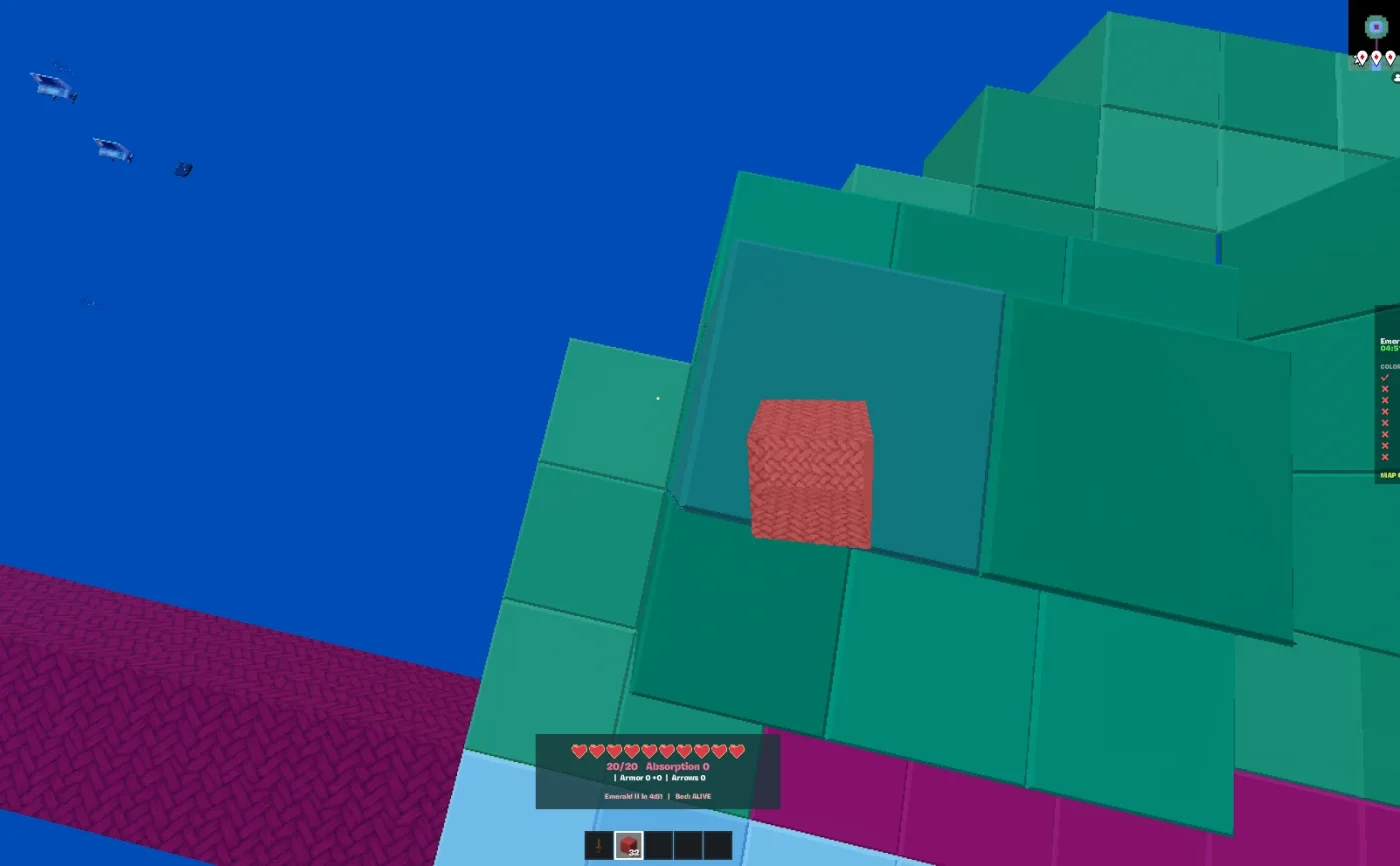
Once the bridges were gone, a playtest showed players falling through blocks at the edges of the green base and the diamond islands. The agent ray-traced all 5,937 grid columns from top to bottom and compared each hit with the expected surface height. A collision surface was missing in 514 columns: 112 on each of the four diamond islands (the island's boxes skipped the local height 0–100 entirely) and 11 at the front edge of the three base models. Previously the bridges had covered these spots. The missing 100 cm boxes were added, and the re-trace found 0 gaps. The same trace test was later run after every model change.
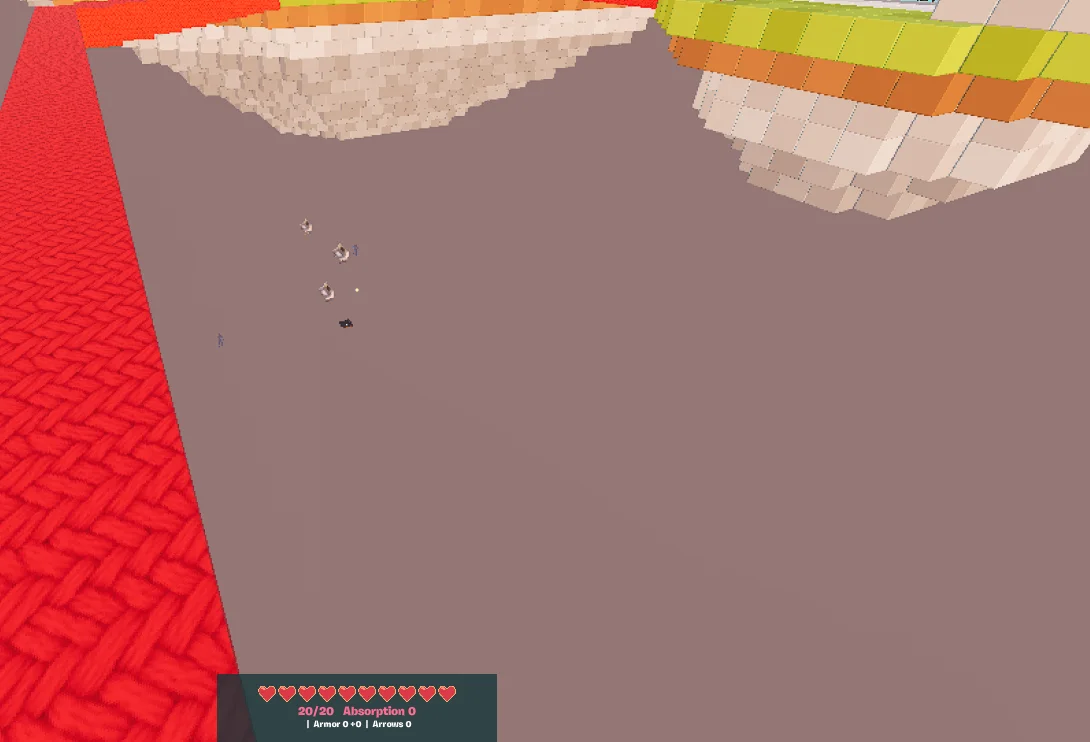
The deeper void exposed clutter that had been hidden below the islands. 16 grid floor slabs, the sea, 96 old water devices and a stray cube were removed from the map. Payment buttons, audio and VFX devices, and 15 orbit and first-person camera devices were moved to a depth of about one kilometre. For the backdrop, a Skydome device BW_Sky_Sunset was tried first, but it tinted everything blue and the void brown. It was replaced with a sunset locked at 19:00 in the island settings, because the brightness had to stay the same throughout the match.

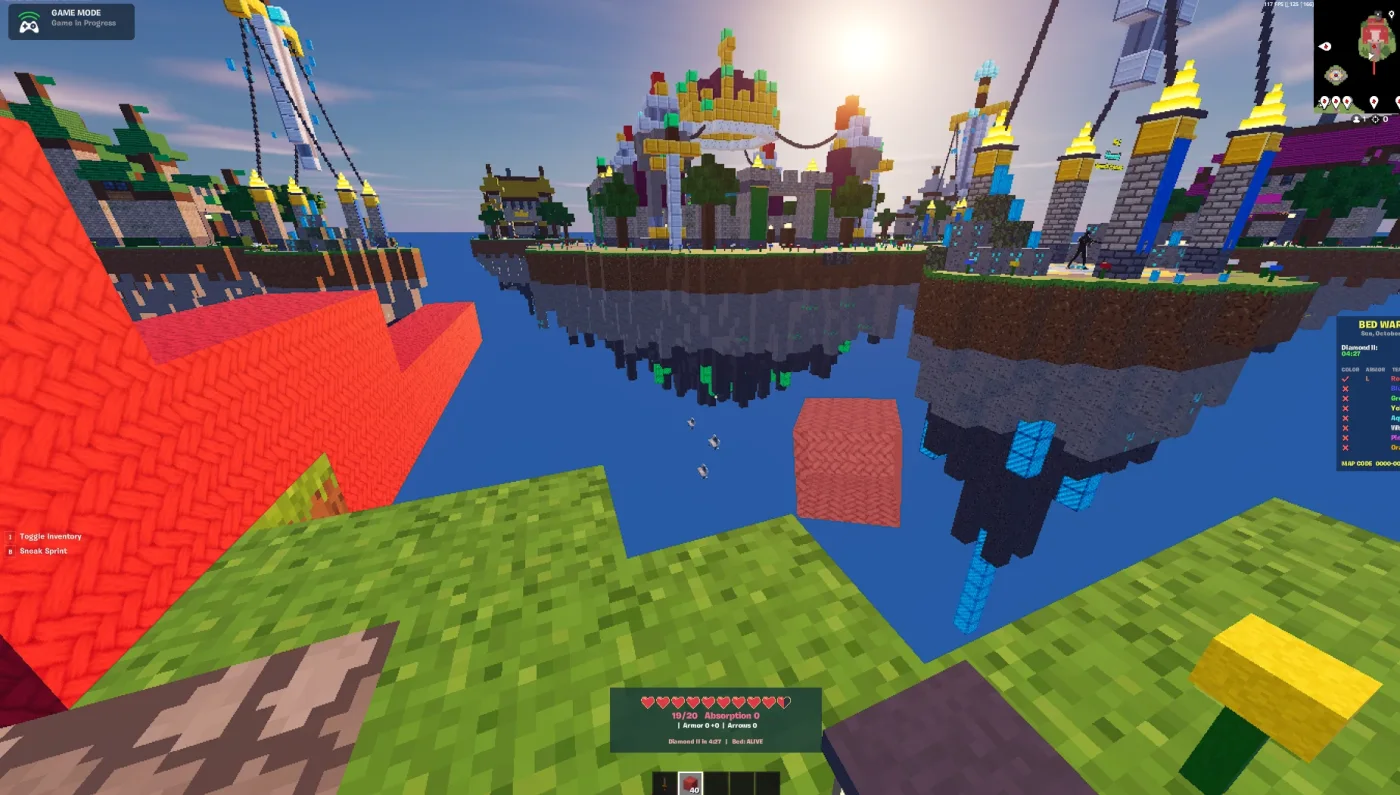
Gameplay shot from the turquoise edge of an island: a wool block has been placed where the collision surface was missing, with the deep blue void in the background. Spots like this were later found systematically by ray-tracing every grid column.
A view below the islands into a brownish-grey void with small devices floating in it. The image shows both the backdrop tinted by the Skydome device and the clutter revealed by the deeper void.

Keep v3: Sky Keep bases

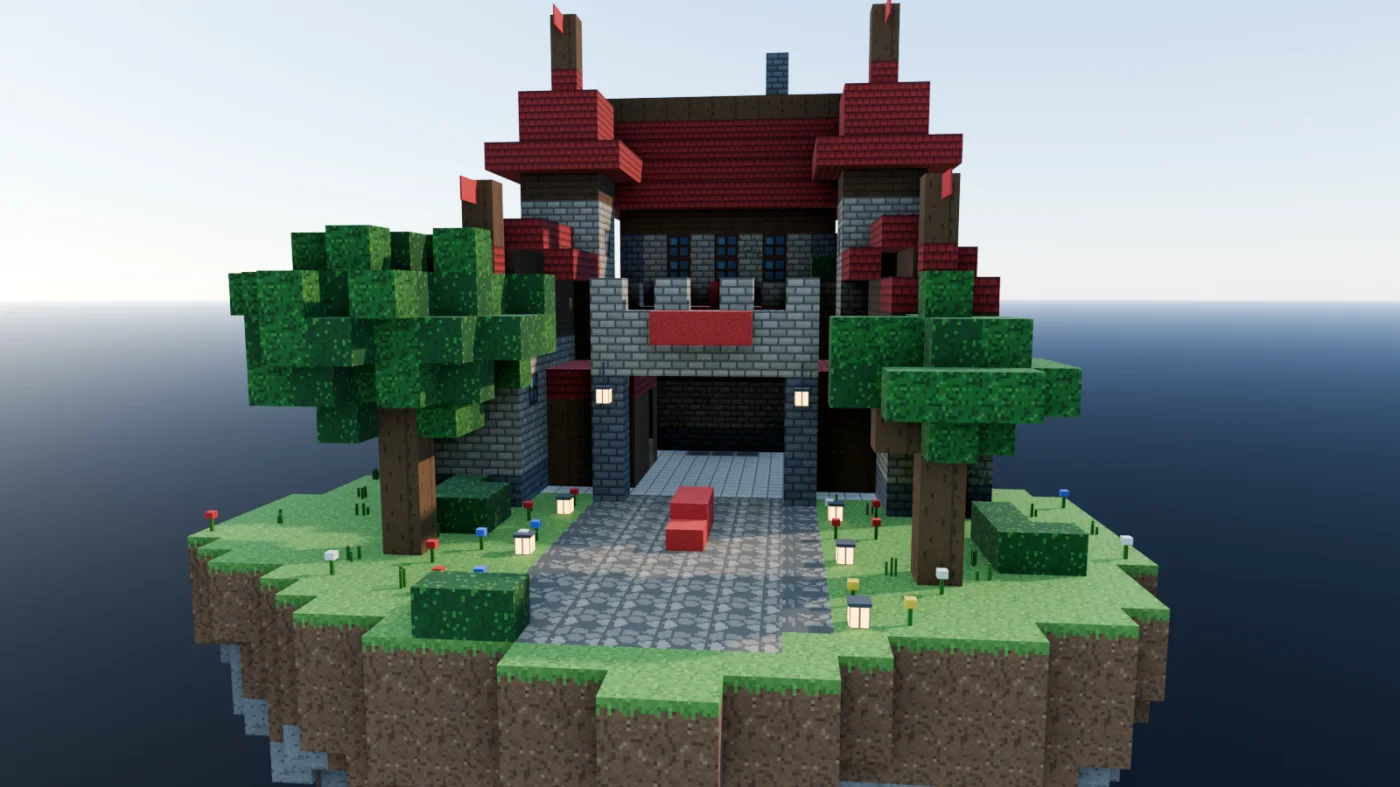
On 11 October it was noted that the bases looked poor. According to the analysis the blocks had no texture, the bushes were bright lime-green piles of cubes, the underside of the island was thin and flat, the courtyard was empty, the team colour showed only on the towers and carpets, a flat sea was visible below and the lighting was flat. A new base concept, Sky Keep, was built in Blender with the script build_keep_v3.py. It has a gatehouse with a banner and lanterns, four towers with pointed roofs and pennants, wooden lofts above the shops and a tall main keep behind the generator. The green piles were replaced with four trees and dark bushes. The underside of the island tapers to a spike in layers: grass, dirt, stone and deepslate, with roots hanging from the edges.

Each block type got its own 16 px pixel texture drawn by code: stone brick, mossy brick, cobblestone, planks, log, foliage, grass and dirt. They were all combined into a single 256 px atlas (one image in which every pattern is a tile) T_BWK_Atlas. Each tile sits in a 32 px cell with an 8 px border around it. The atlas alpha channel serves as the glow mask for the lanterns. The atlas is used by one master material, M_BWK_Atlas, with the parameters Tex, Tint, Glow and Roughness. The team colour comes from material instances MI_BWK_Team_<colour>, so the same model works for all eight teams and the colour shows on roofs, pennants and banners. The texture uses Nearest filtering, so the pixels stay sharp. A base is drawn with three pieces: SM_BWK_Base (collision), SM_BWK_Team (team colour) and SM_BWK_Decor (decorations without collision). Nanite is off and there is a single LOD level.

The gameplay cells stayed in place: the courtyard, the no-build zone, the generator lane, the shop booths with their vendors, the bed and the entrance arch row. The front edge of the island (13.5 cells) was kept shorter than the back edge (16) so that the distance to the diamond island did not shrink. 556 merged collision boxes were computed for the keep and saved in the cells.json file produced by the script, together with the solid cells and bed cells. The building grid bedwars_grid_support.verse was regenerated with the script grid_gen_v3.py. The trace test on the red base gave 562/563 correct, and the only deviation was the practice guard. The next day the waiting lobby was built as a castle with the same atlas (SM_BWK_Lobby, 829 collision boxes) at height Z 35000. Its draw distance is limited to 150 metres so that the lobby cannot be seen from the map 250 m below.

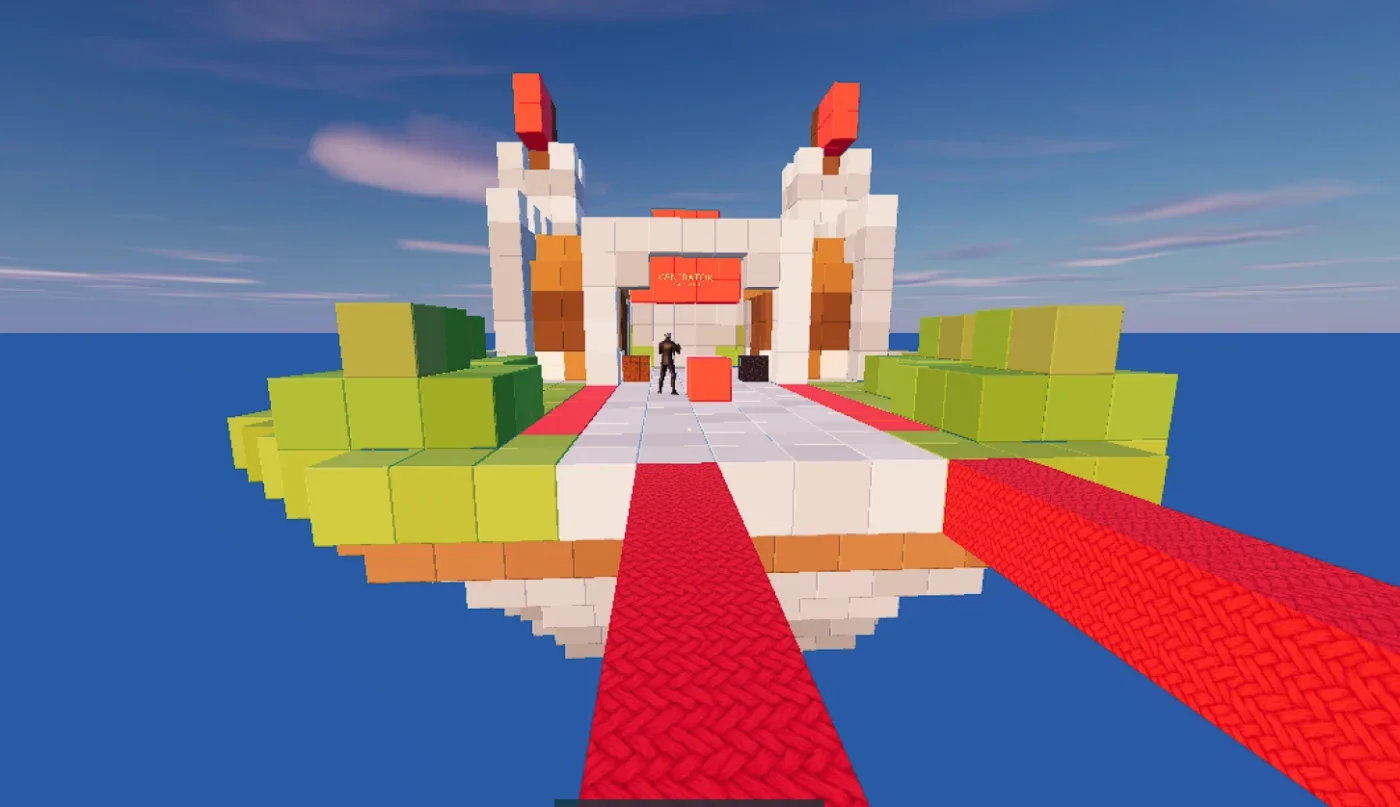
The old red team base in game before the redesign: a flat white castle, a GENERATOR sign, lime-green piles of cubes and red wool bridges above the sea. This is where the Keep v3 redesign started.
Blender preview of the Sky Keep base: a grey stone castle with red roofs and pennants, a gatehouse with a banner and lanterns, trees, bushes and a cobblestone courtyard. The team colour shows on the roofs and banner, so the same model works for every team.
The same base from below: the underside of the island tapers from grass and dirt to stone and dark deepslate. This replaced the old thin, flat underside.

Chained Sword diamond islands and Coronation Court

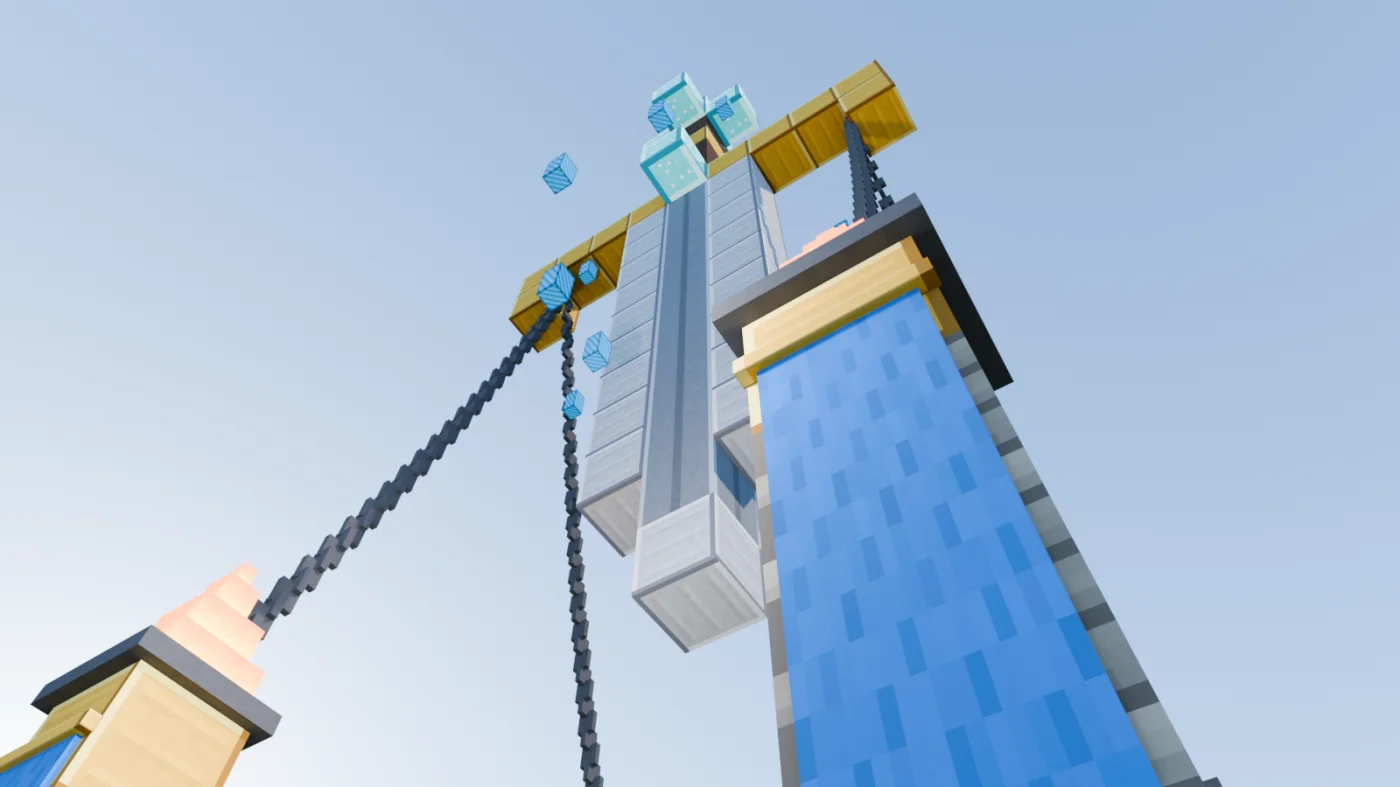
For the diamond island, a creative replacement for the old four pillars was sought. The script build_diamond_v3.py produced concepts A–I, which are still kept in the file. The first three were Crystal Cave, Ruined Shrine and Diamond Mine. They did not fit the castle theme, so next came D, Diamond Watch, a castle-style building with diamond-blue roofs. The developer set the guideline that the generator must be the focal point of the composition and a medieval stage for the island, not a building. That led to H, Chained Sword: a giant sword, point down, floats above the generator, held by four chains on four brick pillars.

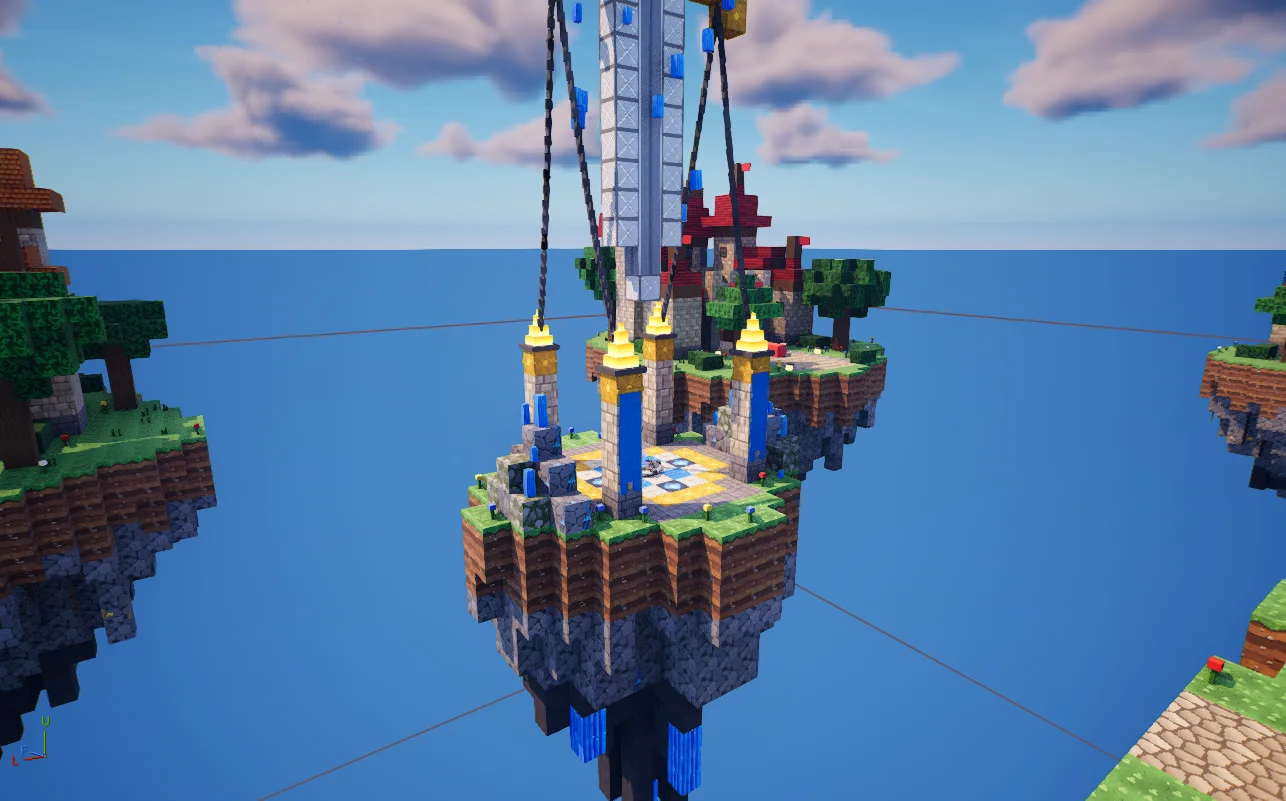
Version H was analysed and improved into I. The blade tapers to a point and has a fuller, the crossguard is curved and golden with a diamond gem, the grip is leather and the pommel is diamond. The island also got iron braziers with a new flame texture, swallowtail pennants, floating crystal shards and a golden ritual circle in the floor. The sword's tip had at first disappeared, because the generator's clearance volume cut it off. The clearance was limited to a height of 7 metres, and the tip now sits at about 8 metres, above the holograms (3–5.5 m). The island is mirror-symmetric, so it is fair to both teams that use it. The model's pivot is at the centre of the generator cell. The island has 113 collision boxes, and the trace test gave 127/127 correct.

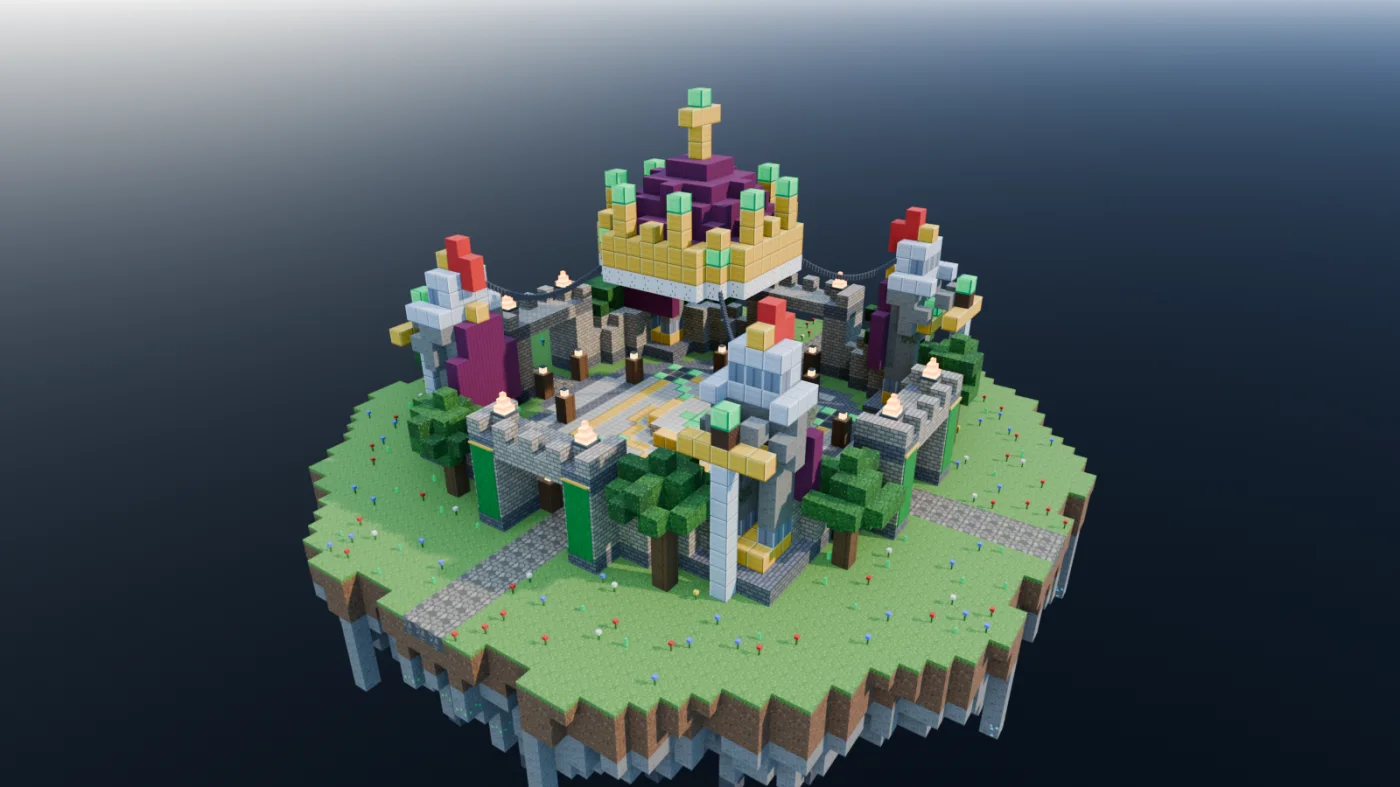
The centre island was made in the same chained-treasure theme under the name Coronation Court (build_center_v3.py). A golden crown with an ermine band, a velvet cap and eight emerald points floats at a height of 13 m above the coronation dais. Chains run from it to the helmets of four stone knight statues on the diagonals (±11, ±11). Around it are a ruined ring wall with gate towers and gardens. The four emerald generators form a square (±7, ±7) so that the distance is the same for every team, and a golden floor frame runs through them. The island was widened at the statues from about 24 to 26.5 cells so that players can walk around the wall. Along the axes the size stayed the same, so the distance to the diamond islands did not change.

The collision trace of the centre island covered 1,969 columns. Only 12 hit the emerald holograms, as expected. The centre island added 21,413 new cells to the building grid, bringing the whole map to 70,413. Adding new tiles became a rule: tiles may only be appended to the end of the atlas, so that earlier cells do not shift. By the end of the day the whole map was in the new style: eight Sky Keep bases, four Chained Sword islands and Coronation Court. The developer approved the concepts from preview images, but a full playthrough on the new map was not done that same day.

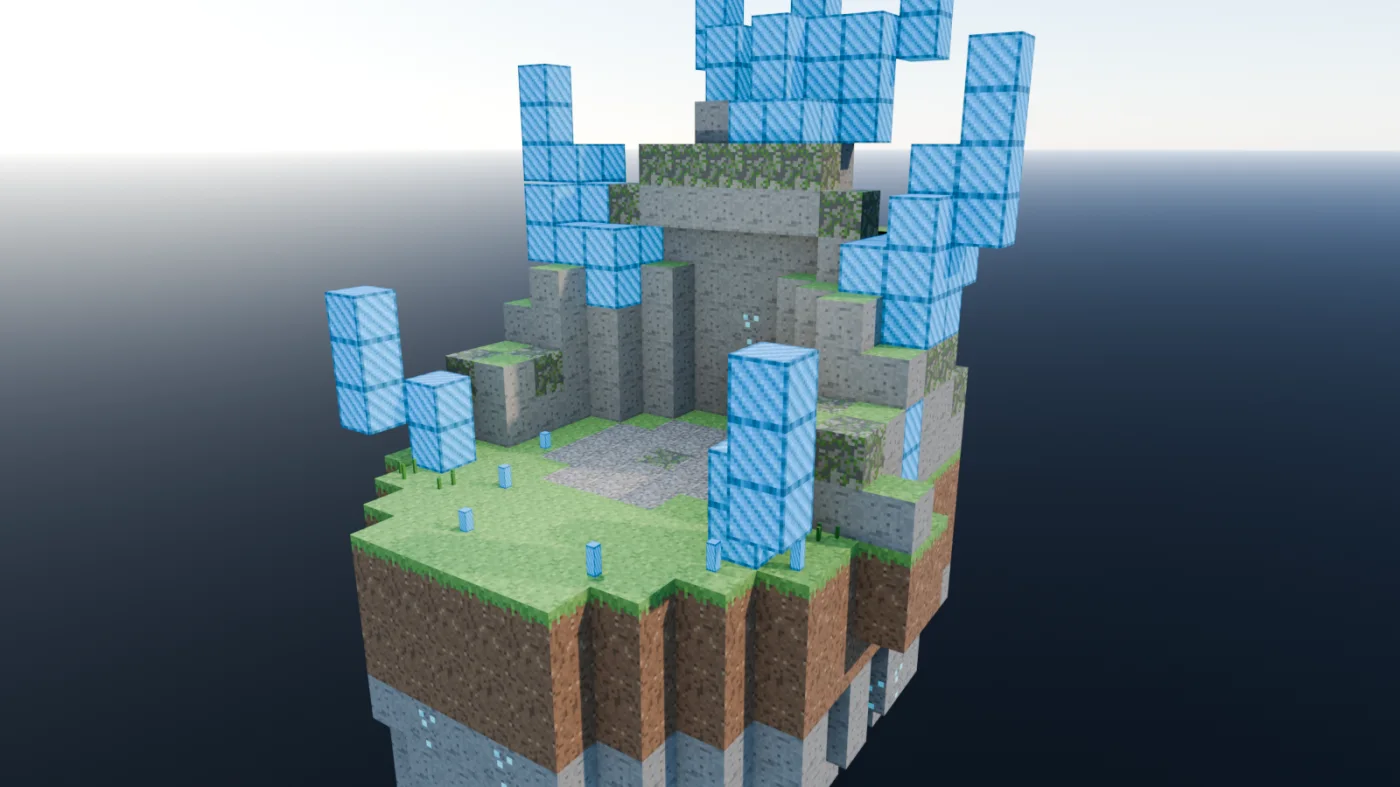
Diamond island concept A, Crystal Cave: mossy stone mounds and slanted blue crystal columns on a grassy island. The concept was rejected because it did not fit the castle theme.
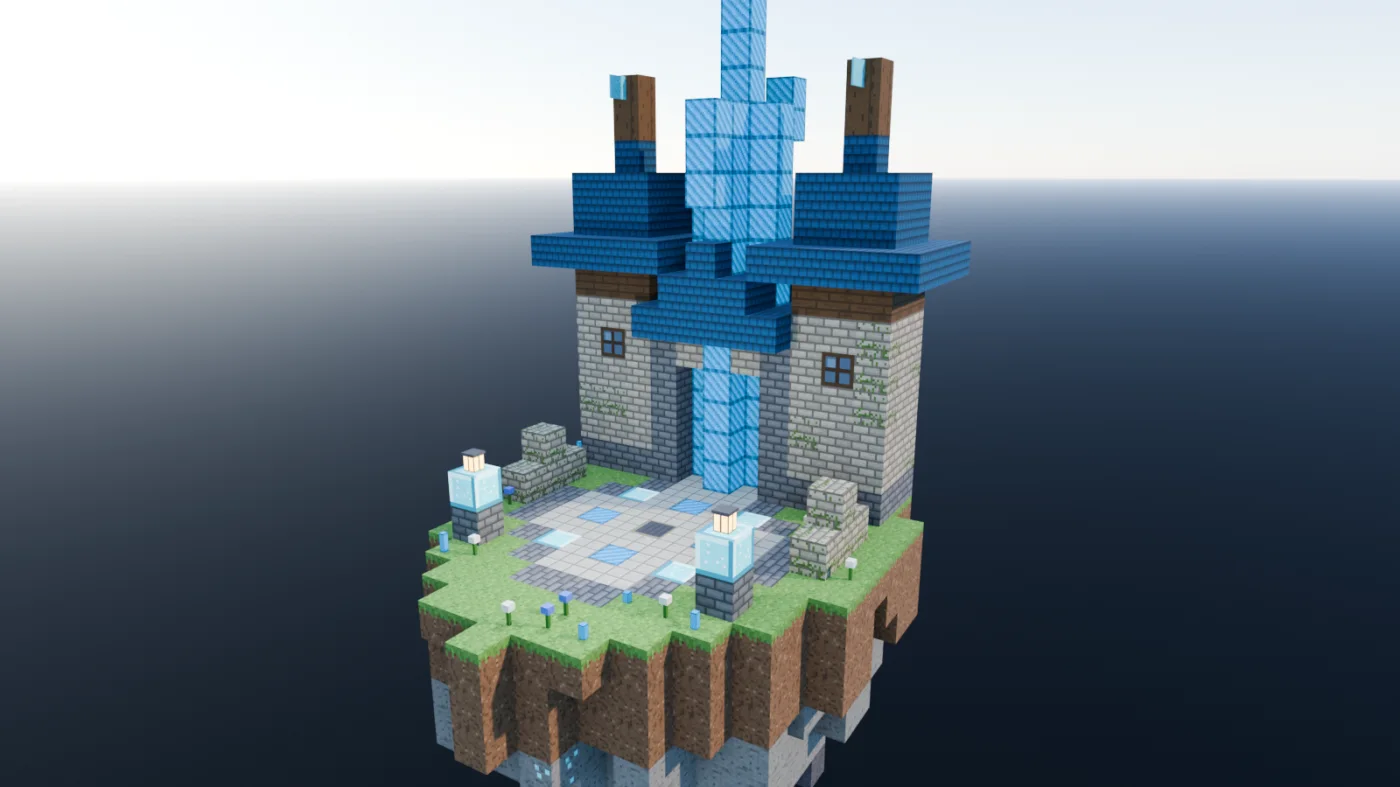
Concept D, Diamond Watch: a brick guardhouse with diamond-blue roofs and a crystal vein rising in the middle. It fit the theme, but the generator was not the focal point of the composition.
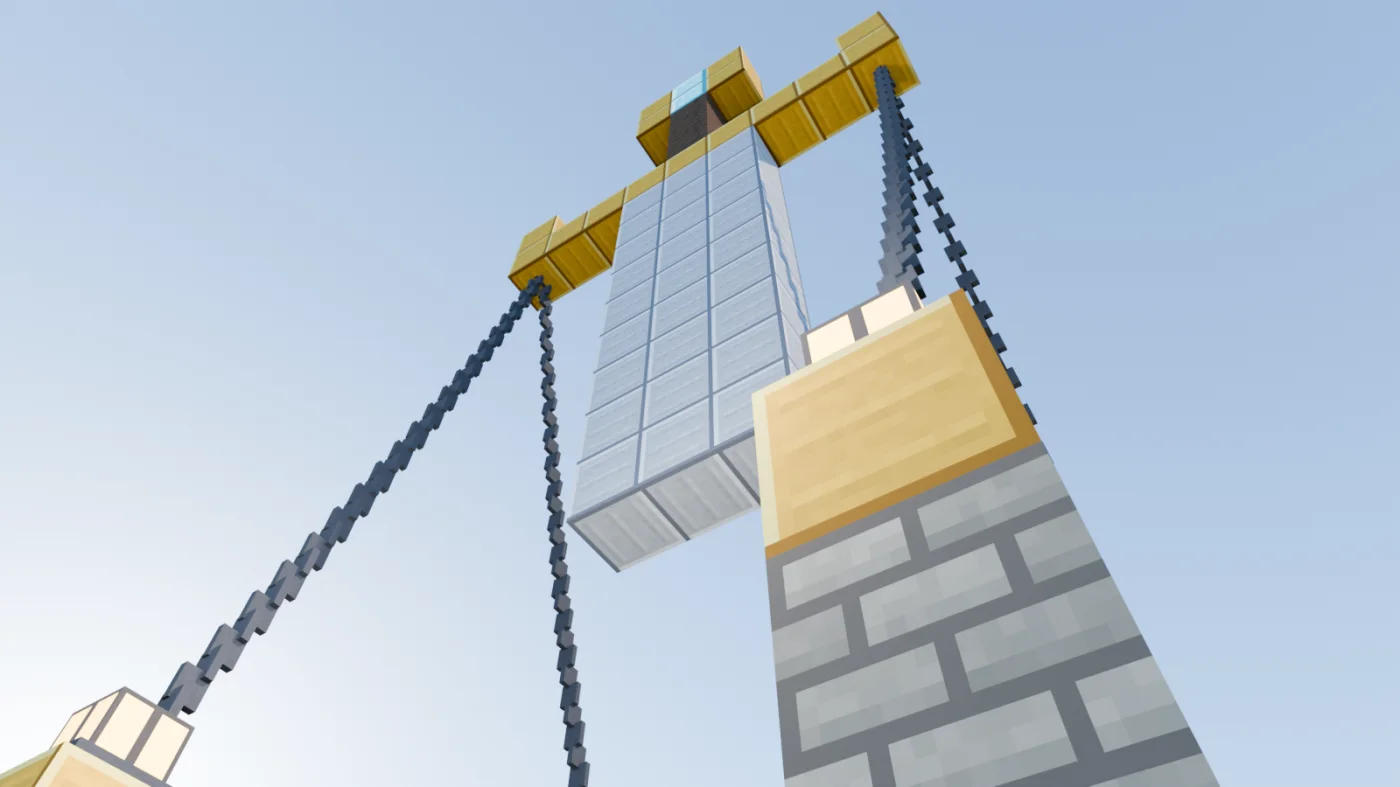
Concept H from below: a straight blade and a golden crossguard hanging on chains between brick pillars. This was developed into the improved version I.
The final version I, Chained Sword: a fullered blade, a diamond pommel, floating crystal shards and pillars decorated with blue pennants and braziers.
Editor shot of the finished diamond island on the map: the sword hangs on four chains above the generator, the pillars have golden flames and blue pennants, and there is a golden pattern in the floor. A neighbouring base is visible in the background.
Preview of Coronation Court: a floating golden crown with emerald points, stone knight statues with chains, the ring wall and a grass ring with walking paths.
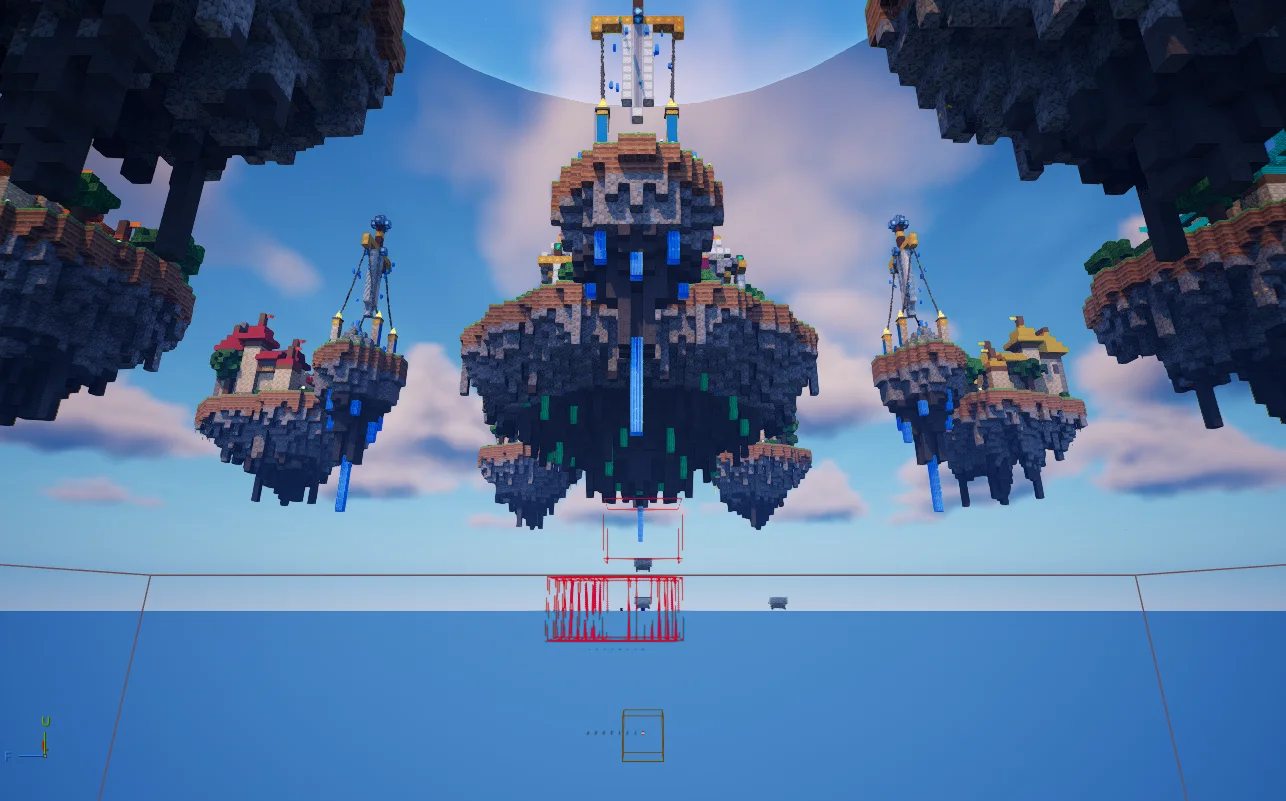
The whole map from directly above: eight team castles on the perimeter in their own colours, four diamond islands between them and Coronation Court in the middle. The image shows the symmetry of the layout.
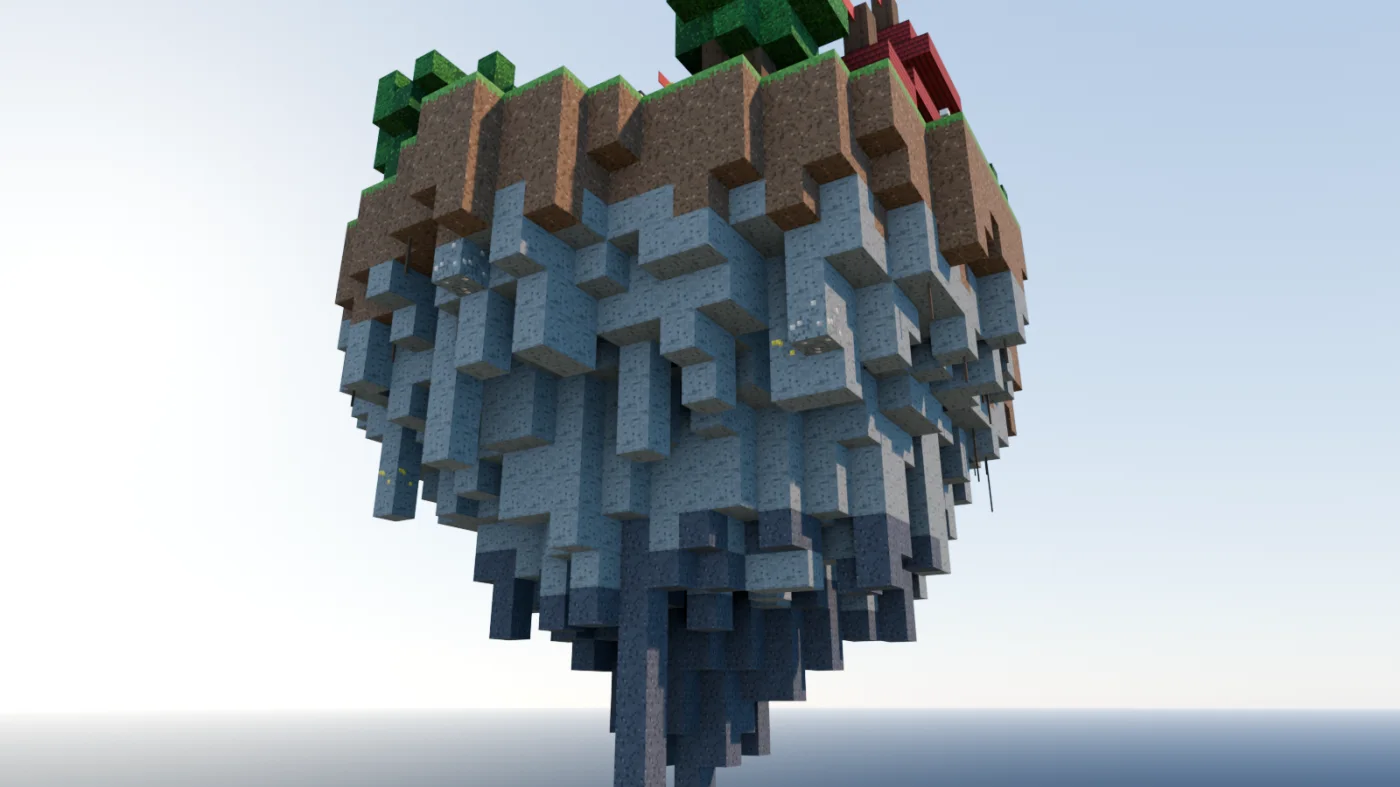
The islands seen from below, from the void: undersides tapering to spikes, blue crystals and the dark base of the centre island. The underside is an important view, because players see it when they fall off a bridge.

Sky and atmosphere: from sunset to Storm Keep

After the new map, a flat, saturated blue surface was still visible below the islands. The level had no fog, no Day Sequence device (the Fortnite device that controls sky, light and fog) and no post-processing. According to the analysis, the blue floor was a problem for three reasons. It looked like a safe sea even though the void kills. Its hue was the same as the Blue and Aqua teams', so their blocks blended into the background. And it lacked depth. The proposed solution was height fog: base 20–30 m below the islands, full opacity and a colour matching the horizon.

The options were first shown as images. A Python script edited a gameplay screenshot into five mock-ups in which the blue floor was replaced with fog and aerial perspective was added to the distant islands: Sea of Clouds, Golden Hour, Morning Mist, Violet Dusk and Storm Keep. The agent recommended Sea of Clouds and considered the last two too dark for a whole match. The developer chose Storm Keep. It was implemented as a single map-wide Day Sequence device BW_Sky_StormKeep (priority 2000, always on). The time of day is locked to 13:00, and the grey-blue fog has density 0.06, falloff 0.35 and maximum opacity 1.0, plus a second, denser layer lower down. The sky is a grey gradient, the sun cooler and dimmer (10 → 6), lens flare off and cloud coverage 75 %. The values were a first guess, because Fortnite's fog cannot be previewed in the editor.

Right after the push, movement felt slow in game. According to the log, running on the ground typically topped out at 3.1 m/s and at most 4.4 m/s, compared with 6.93 m/s before. Sneaking also slowed from about 0.9 to 0.7 m/s. Only the fog device had changed in the push. The suspicion was that the heavy clouds and fog dropped the frame rate and thereby slowed the physics-based character. This could not be confirmed, because the client log could not be read. As an A/B test the device was switched off (enableDuringPhase = None). The sources contain nothing showing that Storm Keep was switched back on later. In gameplay screenshots taken on 20.10. the sky and void are blue with no grey fog. However, fog was switched off in the zone wall material that same day, because it was thought to hide the wall.

Gameplay shot of the new castle map: a golden crown above the centre island, swords and towers hanging on chains, and a flat, saturated blue floor below the islands. This view started the sky and fog design.
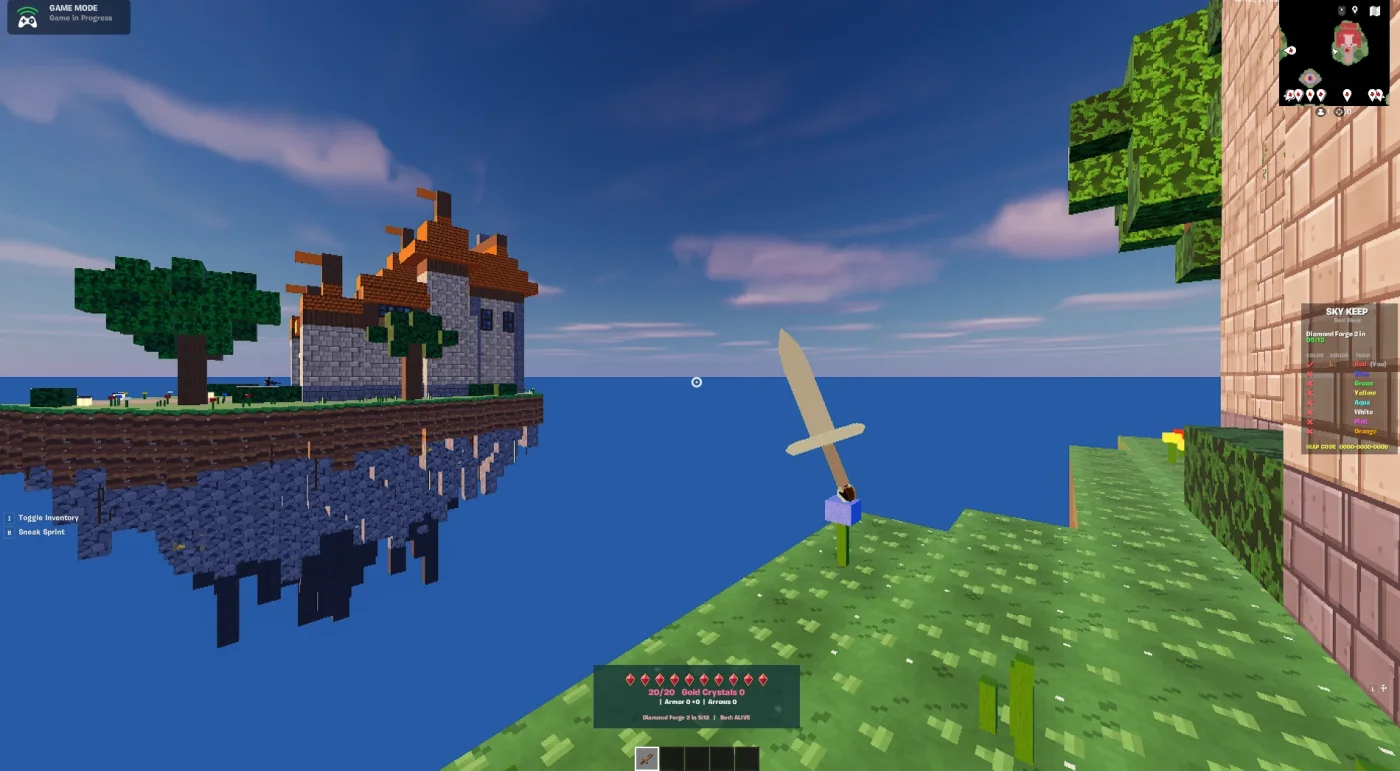
Gameplay shot on 20.10.: a neighbouring island's castle, a bright blue sky and a blue void below the island, plus the SKY KEEP sidebar and life crystals in the HUD. No grey Storm Keep fog is visible.

Shop icons v2, 3D items and first-person models

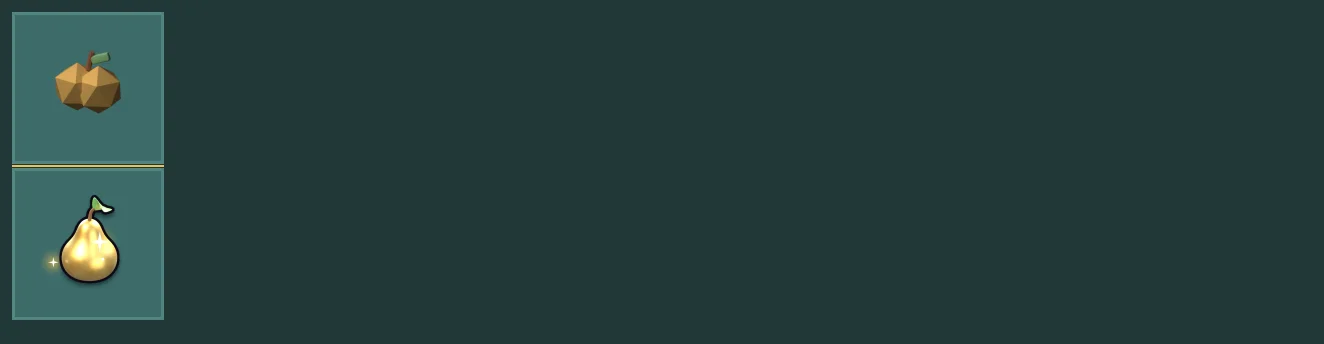
The old shop icons were assembled in Blender (build_shop_icons.py) from primitive shapes and rendered at 256 px with a single light and no outline. At small sizes they were unclear, and Golden Fruit, for example, looked like an angular potato. The new script build_shop_icons_v2.py builds rounded shapes, lights them with four area lights (Standard view transform), and numpy post-processing adds a dark outline from the alpha, a glow from GLOW objects and a soft shadow. The size is 512 px. Detached parts such as sparks and wind streaks get the glow but not the outline. Iron needed metallic 0.75 and a neutral world light, otherwise it looked brown. After a before/after comparison of four icons, the style was approved. All 31 shop icons plus 13 blocks and 4 currencies were rendered and imported under the names T_UI2_*.

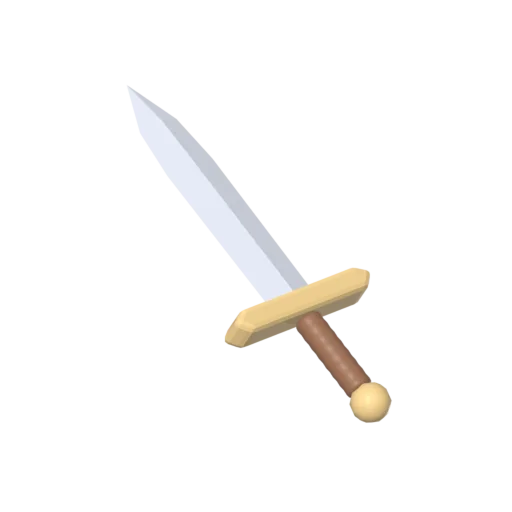
In game it was noticed that only blocks could be picked up from the ground. Fortnite's Pick up prompt requires the player's view to hit the model, and the item models had no collision shape. All 37 SM_BW_Item_* models and the wooden sword got a single convex collision hull (generate_convex_collisions). After that, 32 new 3D items (SM_BW_Item2_*) with 47 colour materials were built from the icon modelling. The scales are: swords 0.42 (about 62 cm, previously 36 cm), tools 0.38 (about 50 cm), bows 0.32 and others 0.28. The models are rotated −90° around the Z axis in the script before the 55° X tilt, because the importer rotates them by 90°.

The first-person models (viewmodels, the model visible in the player's own hand) were made from the same script with the --vm switch. They use the old pose, scale 0.25 × 0.85, vertex colours and pre-baked shading in a single VM_Surface material slot. The first import came in grey because the legacy FBX importer skipped the vertex colours. After the setting was changed, the models were reimported as SM_VM3_*. When all 32 models were imported at once with a playtest running, UEFN crashed after running out of GPU memory, so imports were done in batches of at most eight models. Two exceptions remained: the bows are still the old rigged models (build_bow_rework.py), because the draw animation requires full-draw offsets stored in the UV1/UV2 channels; and the fireball flames, which the own-hand shader lightened almost to white, were coloured separately (SM_VM4_Fireball). In game it was confirmed that the own-hand colours, the bow draw and the orange fireball work.

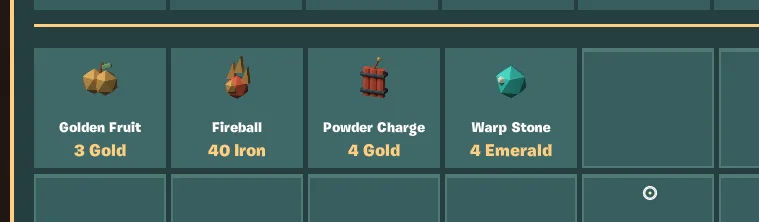
Special shop items with the old icons: Golden Fruit, Fireball, Powder Charge and Warp Stone as small angular shapes without outlines. This is where the icon redesign started.
Before/after comparison: at the top the old angular golden fruit, at the bottom the new round, glossy, outlined golden pear that later replaced Golden Fruit.
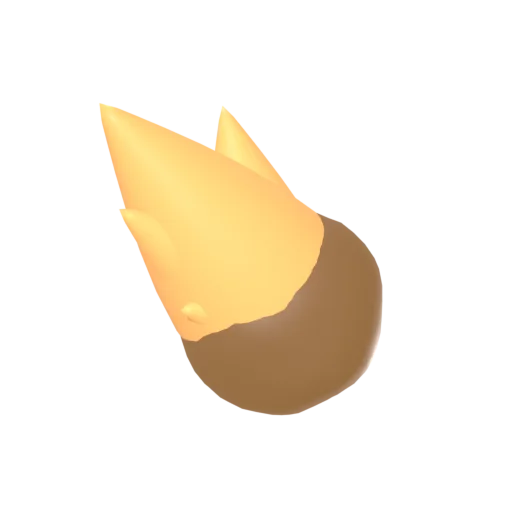
The Fireball icon in the new style: a cracked lava ball, orange flames, glow, sparks and a dark outline.
The 3D item built from the same modelling, visible when dropped on the ground and in another player's hand. The icon and the item share the same shape.
3D model of the iron sword: a rounded blade, golden crossguard, leather grip and pommel. Swords were scaled to about 62 cm long so that other players can see them.
Gameplay shot with the Leap Potion selected and the bottle in the player's own hand completely grey. The cause was the legacy FBX importer, which skipped the model's vertex colours.

Building blocks v2: sharp cubes and numbered variant sheets

The new icons appeared in the shop and inventory, but placed, held and dropped blocks were still the old ones. Bevelled blocks were tried first but rejected immediately. Real bevel geometry had earlier caused see-through gaps between blocks and edges that players could jump over. This became a permanent rule: blocks are sharp cubes that merge into one another. Next came brighter colours and glow, raising the resolution from about 156 px to 627 px with soft filtering and mipmaps, and wool tones matched to the icons. Colour and resolution tweaks alone did not produce the desired look. The new own-hand block models (with atlas UVs) did not show up in game at all, so instead the atlas texture is always swapped.

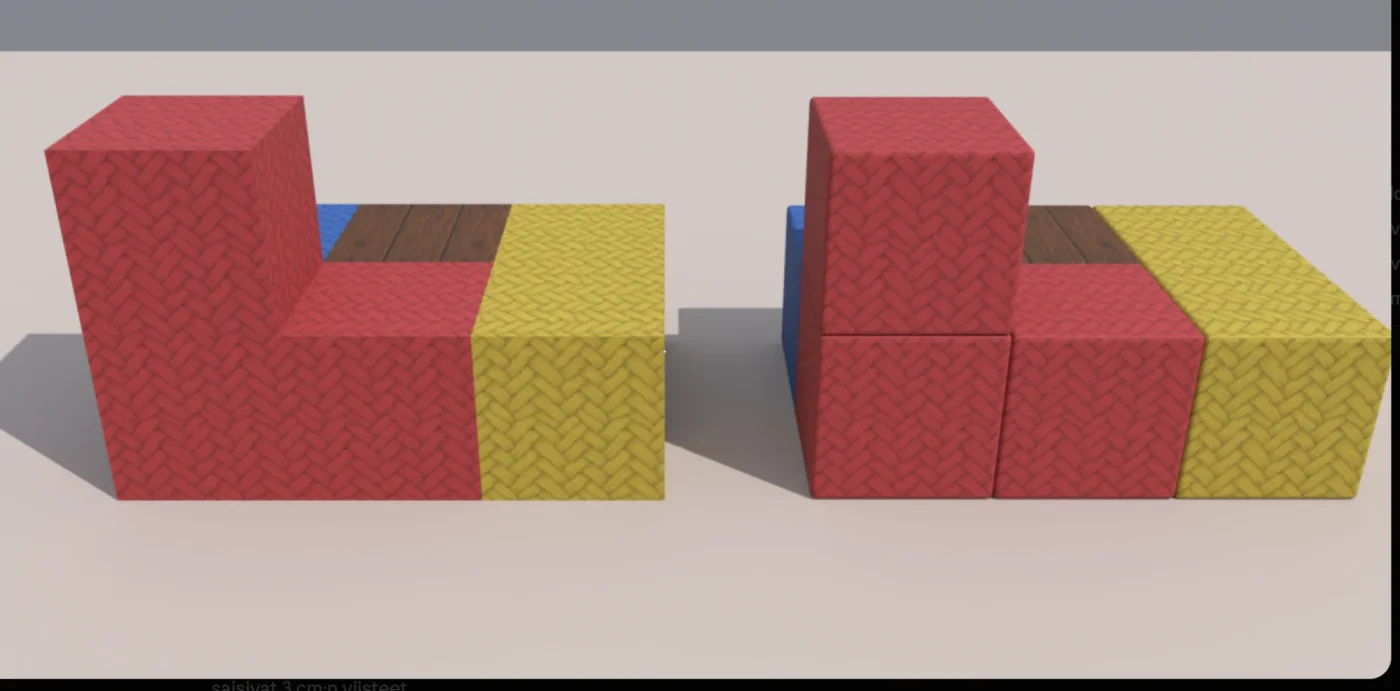
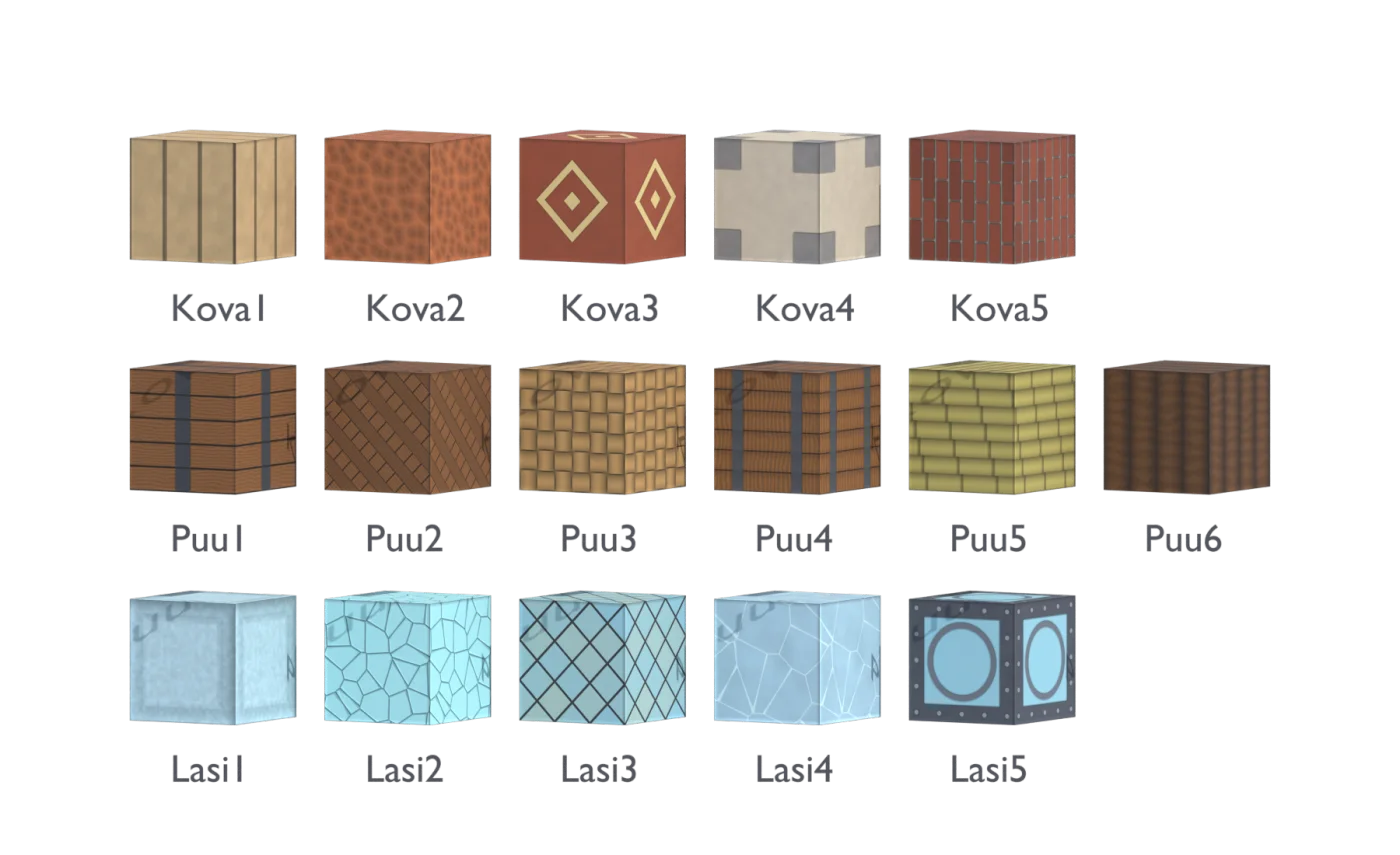
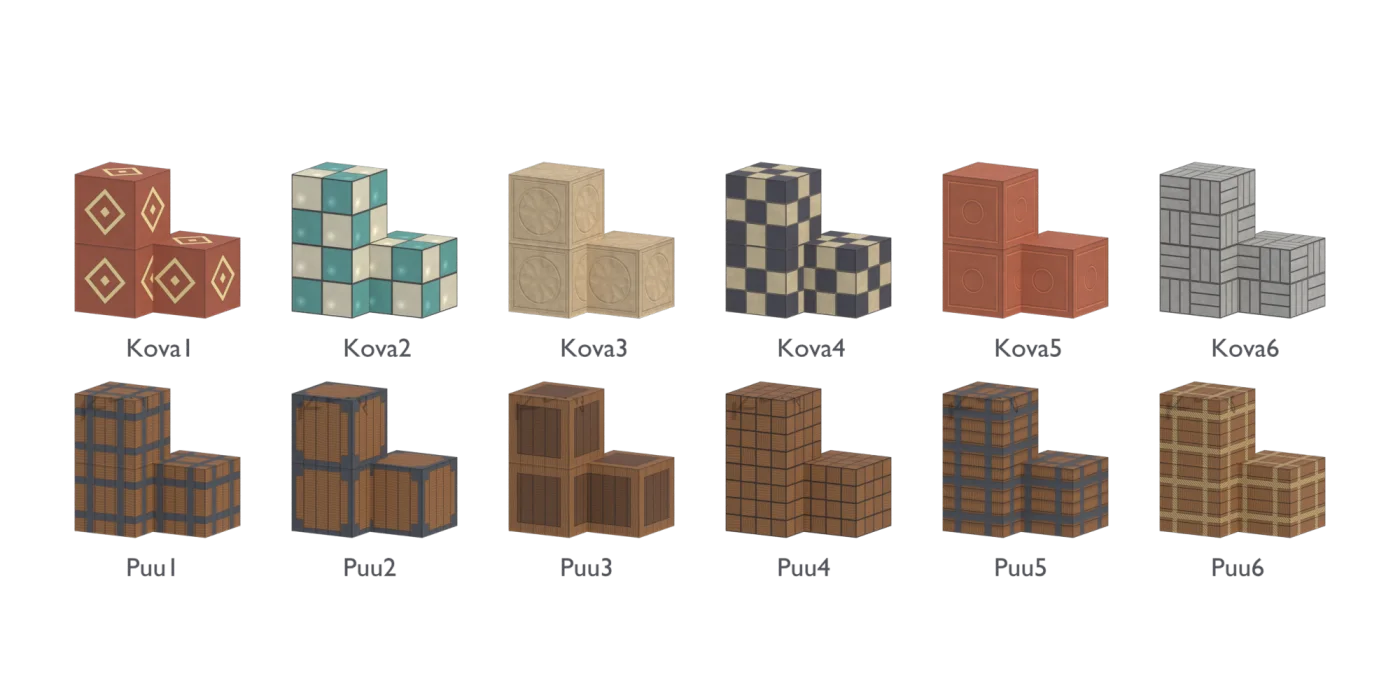
A bevel effect done purely with a normal map on top of a straight cube was also previewed, but the final choice was fully original, stylised textures with the edge bevel painted in (build_block_textures_v2.py, 1024 px). From the first set, an orange tile, X-patterned wood and glass were rejected. After that, the workflow was numbered variant sheets (build_block_variants.py, build_block_variants2.py, build_wool_variants.py), from which the developer picked by number. The wood lines had to continue over the corner, so the patterns were made symmetric in the u and v directions and shown as L-shaped clusters of three blocks in which the seams are visible.

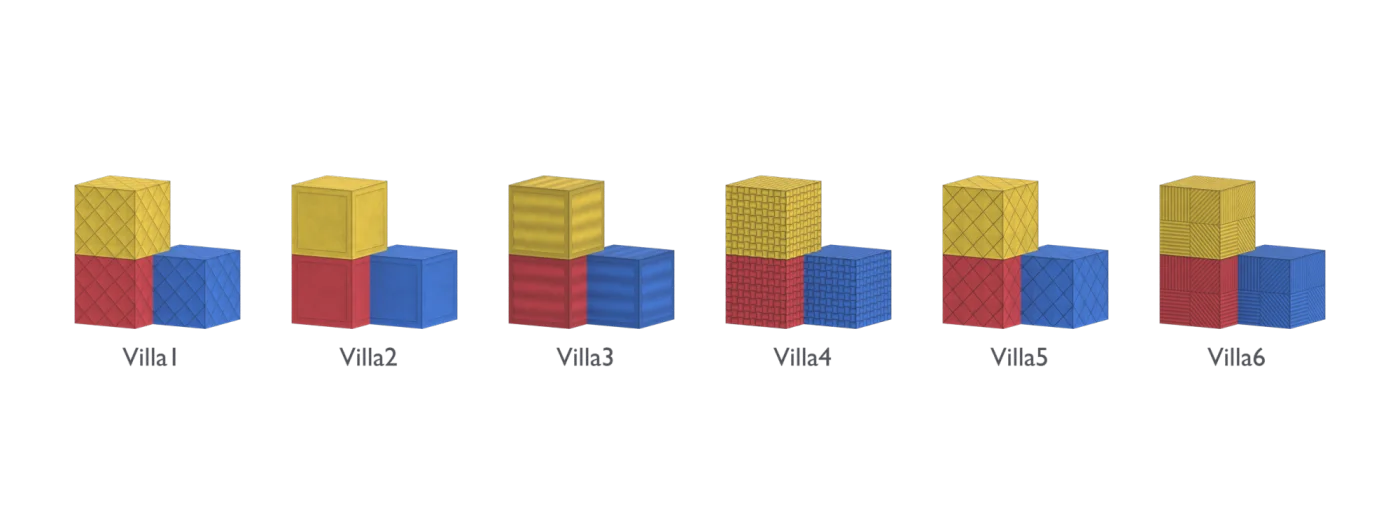
The picks were Kova3 (sandstone with a rosette), Puu3 (a wooden crate with edge beams), Villa2 (a felt panel) and glass unchanged. At the same time the blocks got their own names: Banner Felt (the team wool block, formerly Team Fiber), Carved Sandstone (formerly Terracotta), Keep Stone (formerly Ruins Stone), Crate Wood (formerly Wood Planks), Bastion Plate (formerly Nightstone) and Blast Glass. Bastion Plate is a dark armour plate with no purple tint or blue seams. The T_BW2_* textures were assigned to the M_BW_* materials (1024 px, default filtering, mipmaps, original wool tones, no glow). The first-person blocks got the same look through the T_VM_Atlas2 atlas, and the block icons were re-rendered under the names T_UI3_*. The new blocks were judged to look good in game.

Preview of wool blocks: on the left sharp cubes that merge seamlessly, on the right bevelled separate blocks. Bevelled geometry was rejected because it had earlier created gaps and jump ramps.
The first numbered variant sheet: hard blocks Kova1–5, woods Puu1–6 and glasses Lasi1–5 as separate cubes.
The second sheet as L-shaped clusters of three blocks, to show whether the patterns continue over the corners. Kova3 (rosette-patterned sandstone) and Puu3 (wooden crate with edge beams) were chosen.
Wool block options Villa1–6 in yellow, red and blue. Villa2, a felt panel with edge seams, was chosen as the team block Banner Felt.
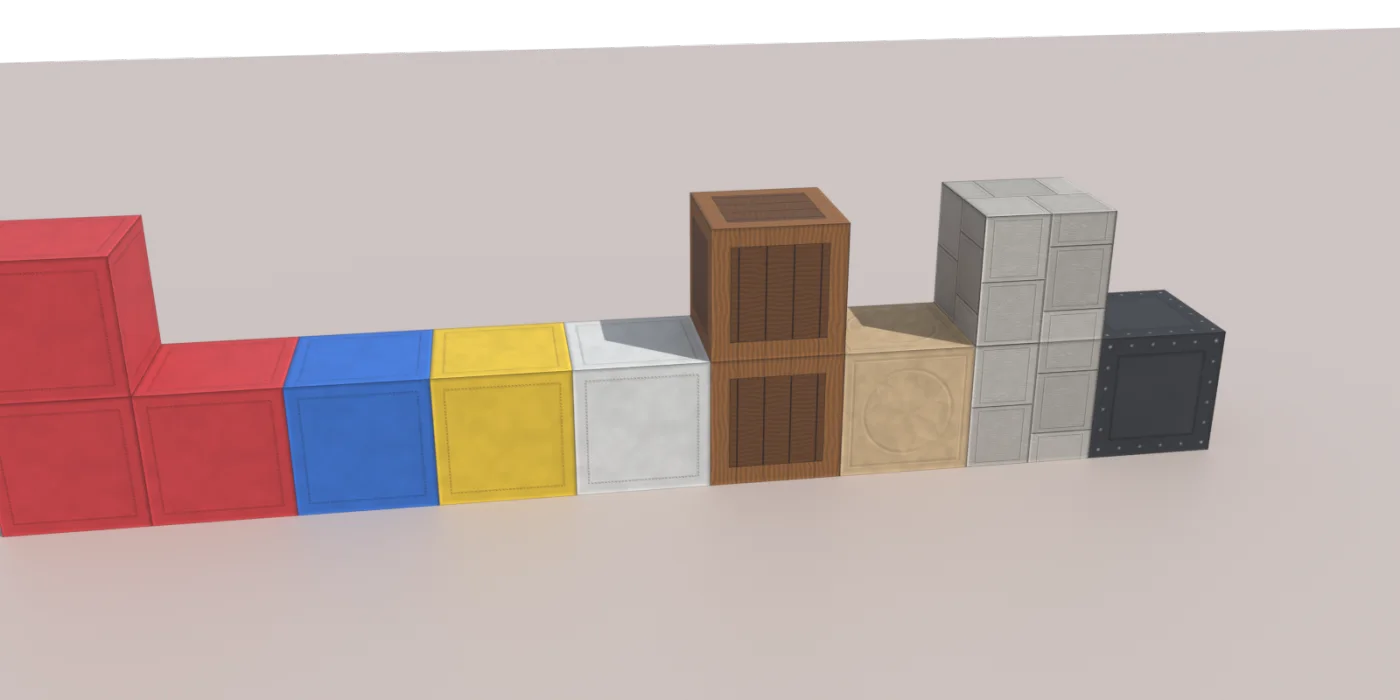
The final set side by side: Banner Felt in four team colours, Crate Wood, Carved Sandstone, Keep Stone and Bastion Plate. The patterns are painted into the texture, and the cubes stay sharp.
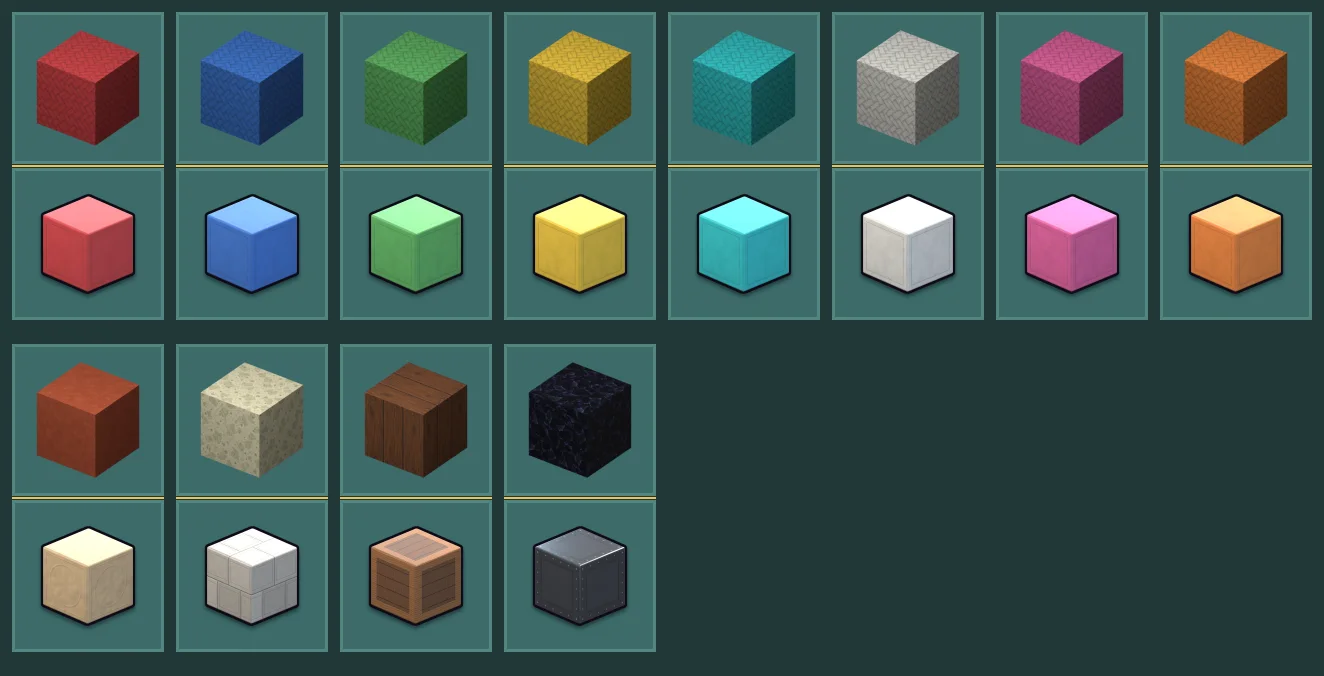
Block icon comparison: at the top the old dark pixel icons, at the bottom the new light, outlined T_UI3 icons that match the new textures.

Copyright I: map atlas V4 → V8

On 20 October the map blocks were checked for resemblance to Minecraft. A style, such as a cube-shaped grass block, is not protected, but Mojang's own texture is. Epic's review can also reject an island on recognisable appearance alone. All the map blocks came from a 16 px atlas that the code had drawn itself, so nothing had been copied. Even so, 30 tiles imitated Minecraft block concepts one-to-one: grass, dirt, ores, and gold, diamond and emerald blocks.

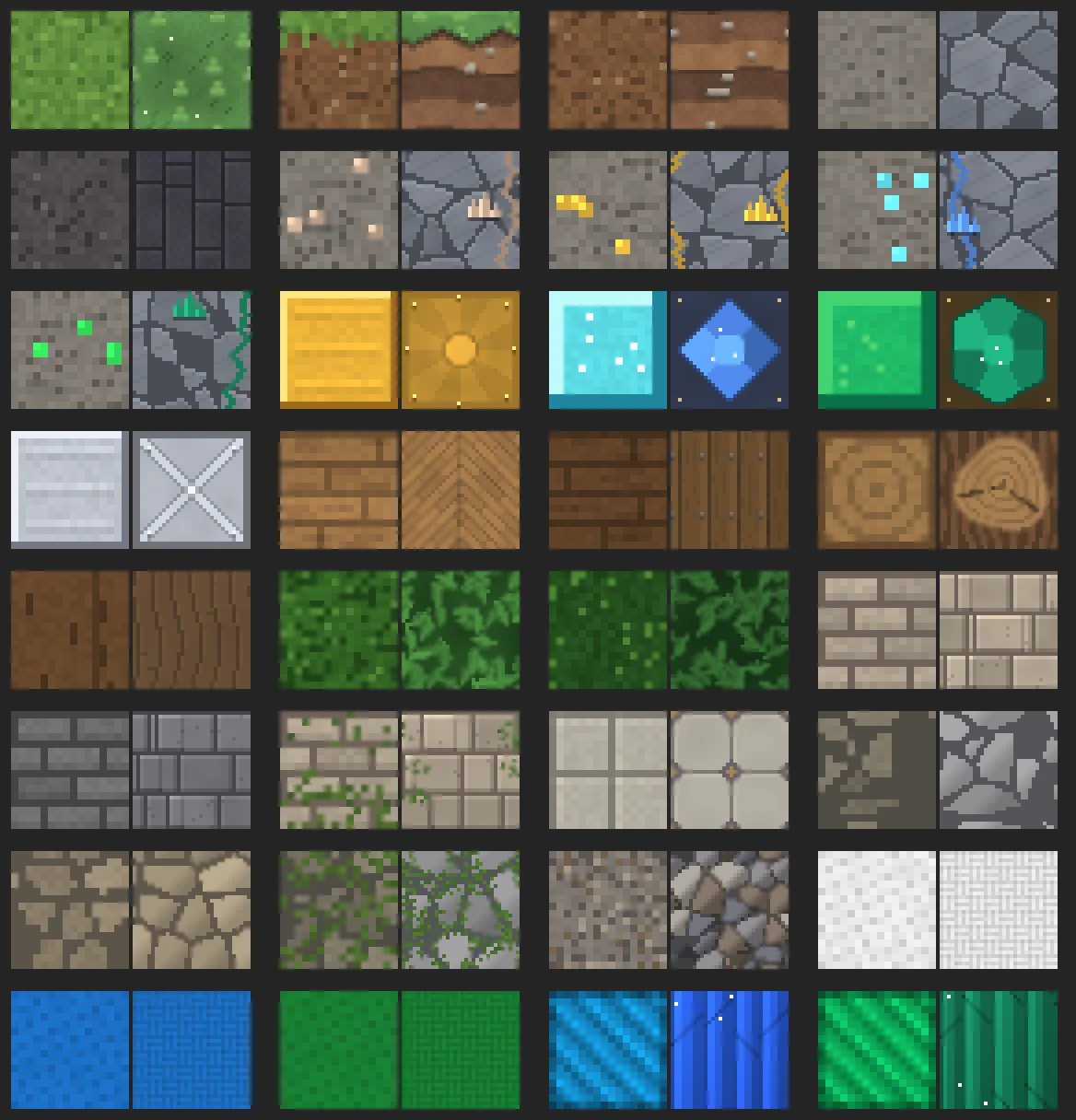
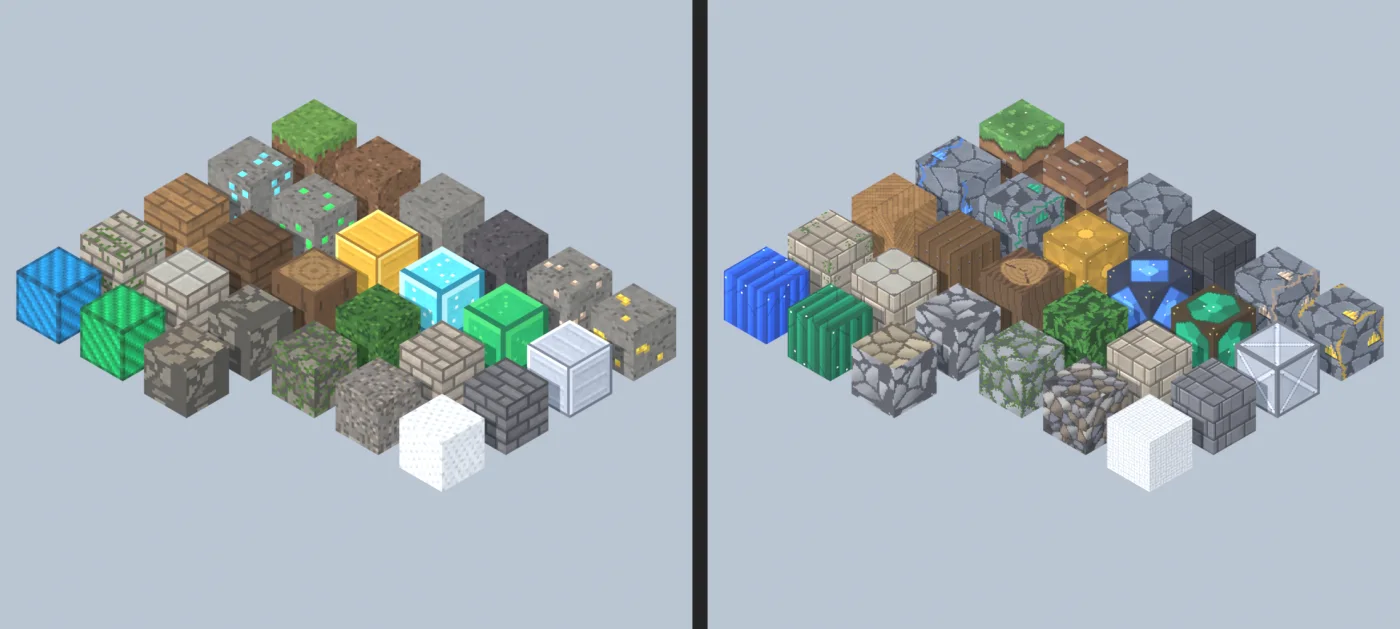
The script build_keep_tiles_v4.py redrew the 30 tiles at 32 px. The new atlas is 512 px, and each 32 px tile has a 16 px border around it (a 64 px cell). The normalised UV coordinates stayed the same, so the models did not need to be re-exported. Untouched tiles are copies doubled with nearest-neighbour scaling, and the glow alpha was preserved. The new motifs were a moss cover with clover and a wavy moss edge (no dripping grass), dirt as clay layers, slate, basalt, crystal-veined ores, a golden sun tile, diamond as a rhombus gem panel, emerald as a hexagon panel, steel as a cross-braced plate, herringbone parquet, a sawn log end, stone blocks of varying length, inlay floor tiles, river stones and woven wool.

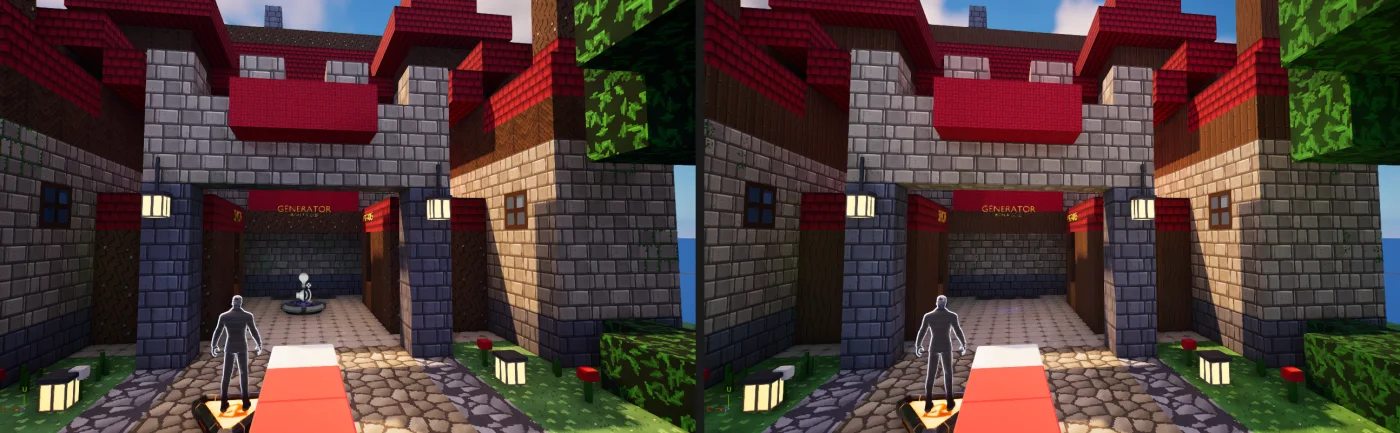
The atlas went through three more rounds. For these an editor capture tool, mcp_capture.py, was made; it takes shots of buildings in the UEFN editor from a list of cameras. Round 2 calmed patterns that looked busy on large surfaces: bark without lichen spots, a dark wall of vertical boards, a subtler herringbone, moss as patches instead of in the seams, softer leaves, straight dirt layers, fuller grass and a more restrained gold floor. Round 3 replaced the noisy blue and green crystal blocks on the island undersides with vertical cut prisms. A stone and cobblestone overhaul tried at the same time was reverted. Round 4 moved the gem tones away from Minecraft's palette while keeping the same hues so the currencies stay recognisable: diamond to a deep sapphire and emerald to a dark jade. Amber and brass were tried for gold, but the original gold stayed.

Because import_file does not replace the old asset, every round was imported as a new texture, and the final one is T_BWK_AtlasV8 (Nearest filtering, TC_EditorIcon, SimpleAverage mipmaps, NeverStream). It is set as the Tex parameter of the M_BWK_Atlas material. V3 was kept at first as a rollback version, but later the old atlases V1–V7 were deleted as unused.

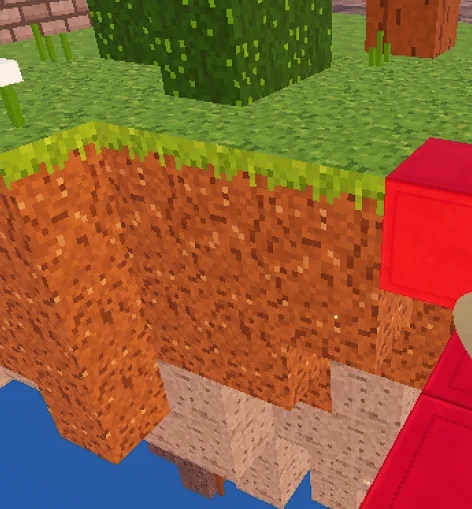
The old grass block at an island edge: orange-brown speckled dirt and green drips running from the top edge. This very texture, resembling Minecraft's grass block, triggered the review.
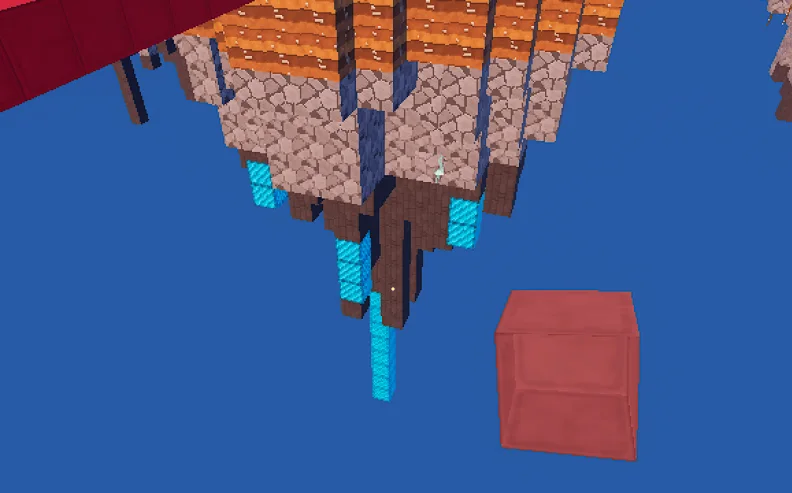
An island underside after the first redesign: new brown stone blocks, but the bright cyan noisy crystal blocks are still the old ones. They were replaced with vertical prisms in round 3.
Tile-by-tile comparison: on the left the old 16 px tile, on the right the new 32 px tile. For example, grass became clover moss, the gold block a sun tile, diamond a rhombus gem, emerald a hexagon panel and planks herringbone parquet.
The same map blocks as cubes: on the left the old atlas, on the right the new one. The shapes and hues were kept, but the patterns are original.
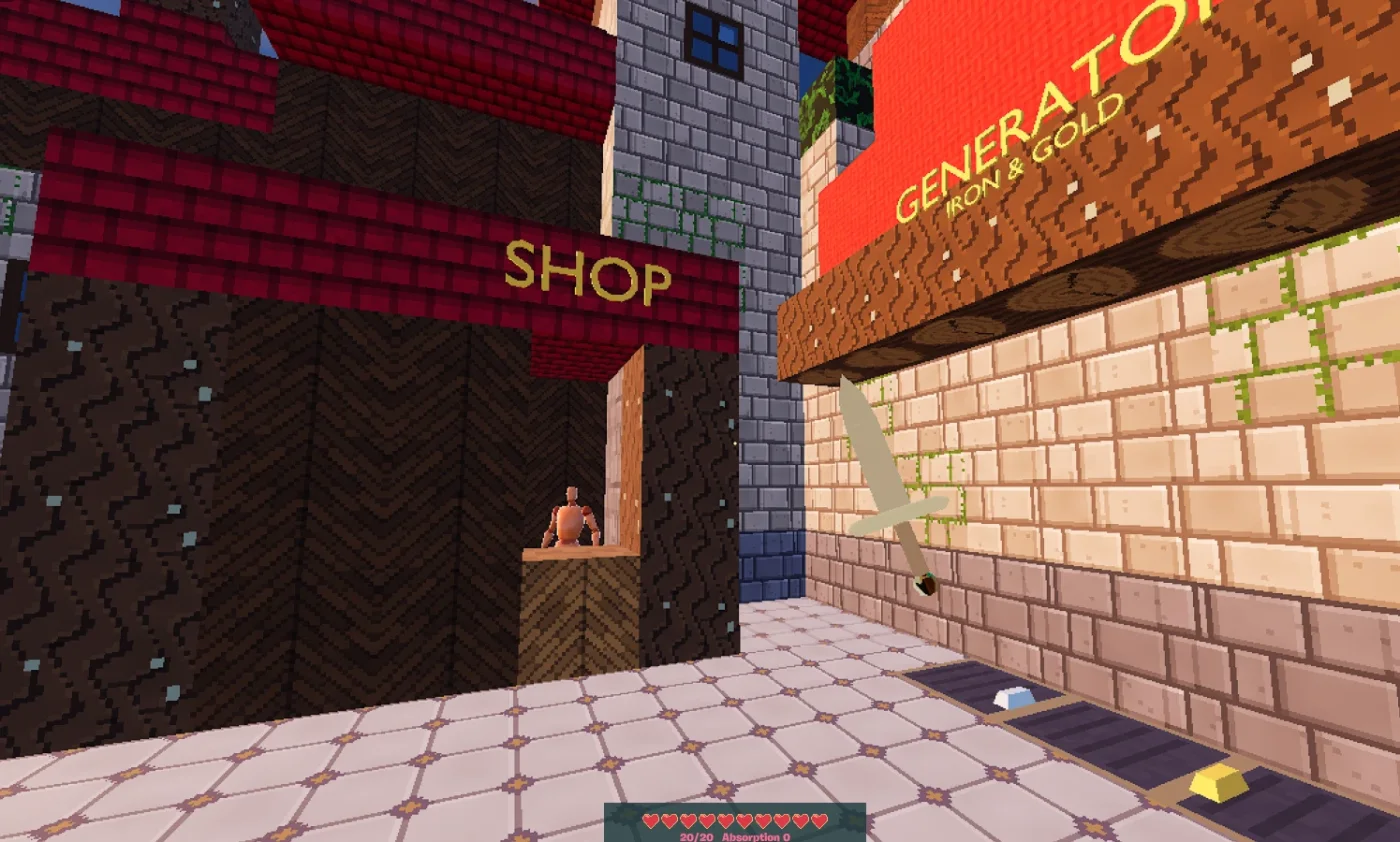
Gameplay shot of the first new atlas: a SHOP booth on dark herringbone parquet, a GENERATOR beam with zigzag bark and a moss-striped brick wall. On large surfaces the patterns looked busy, and they were calmed in round 2.
The red base's gate passage in the editor before and after round 2: on the right the bark, boards and moss are calmer.
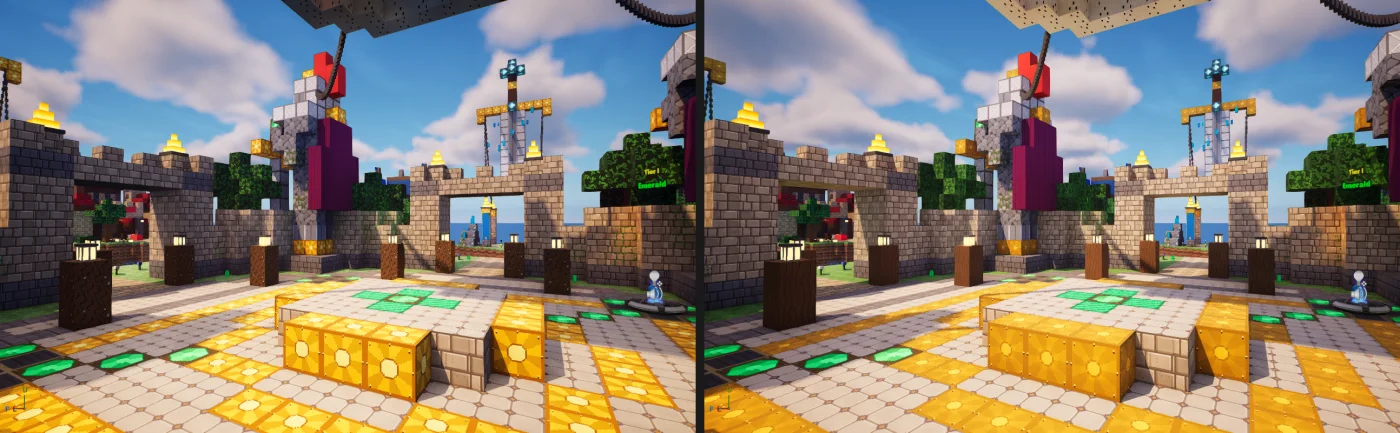
The Coronation Court floor before and after: on the left the strongly patterned sun tile, on the right the more restrained gold floor.

Copyright II: names, currencies, HUD, glass and an original bed

For names, the guideline was that common words (emerald, diamond, iron, gold, wool) and the genre name Bed Wars are allowed, but Minecraft's proper names and recognisable combinations are not. Already at the end of September the rank name NETHERITE had been changed to MAGMA, and the shop already had original names such as Warp Stone and Powder Charge. On 20.10. the effects were renamed: Speed II → Swift II, Jump Boost → Leap, Invisibility → Veiled, Regeneration → Mending, Haste → Mining Haste, and the traps' Mining Fatigue, Blindness and Slowness → Weary Hands, Shadowed, Slowed. Enchantment names were removed from descriptions (replaced with Armor Plating I–IV). Golden Fruit (a golden apple) was changed to the Golden Pear. Hypixel server phrasing was changed in the holograms and sidebar, for example to Diamond Forge / Forge level 2 / Next gem in 7s, and the sidebar title became SKY KEEP. The OBSIDIAN rank was changed from purple to black glass and DRAGON to crimson with gold.

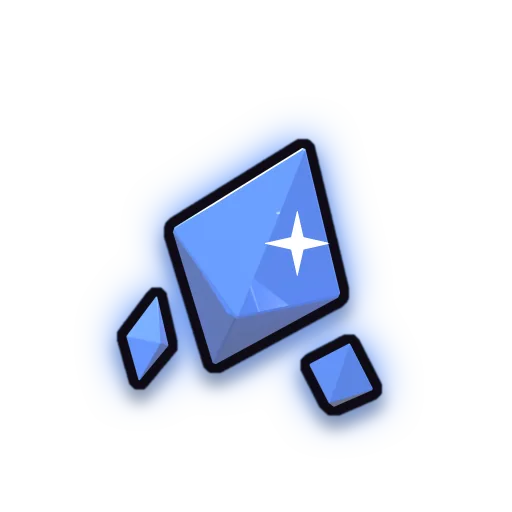
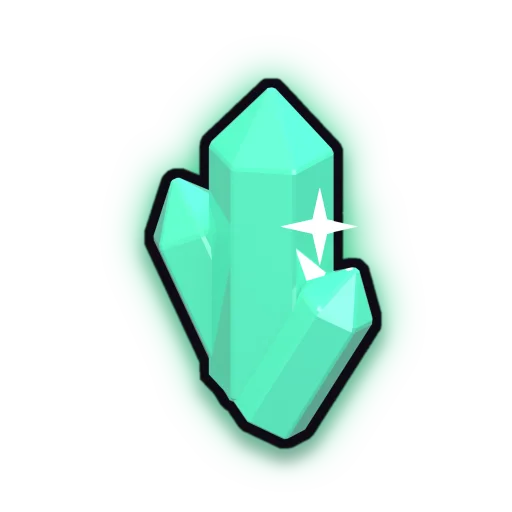
The old currency icons, a hexagonal emerald and a cut diamond, resembled Minecraft's items in silhouette. So they were turned into raw crystals, and on 20.10. they were tinted sapphire and jade (T_UI4_Diamond, T_UI4_Emerald). Iron and gold stayed as ingots. The generator pile materials and the Crystal gear (sword, armour, pickaxe, axe) were changed from turquoise to sapphire in the icons, on the ground, in models held by other players and in the player's own hand (SM_VM5_*). The HUD hearts were replaced with original life crystals: a ruby-red rhombus with a gold border in full, half, empty and golden versions (T_UI_Life*, drawn as SVG with the build_hud_life.js script). Golden hearts became Gold Crystals. The glass was made into an original leaded window that is actually see-through, because opacity now comes from the texture alpha. Previously the whole block was a uniform 38 % opaque.

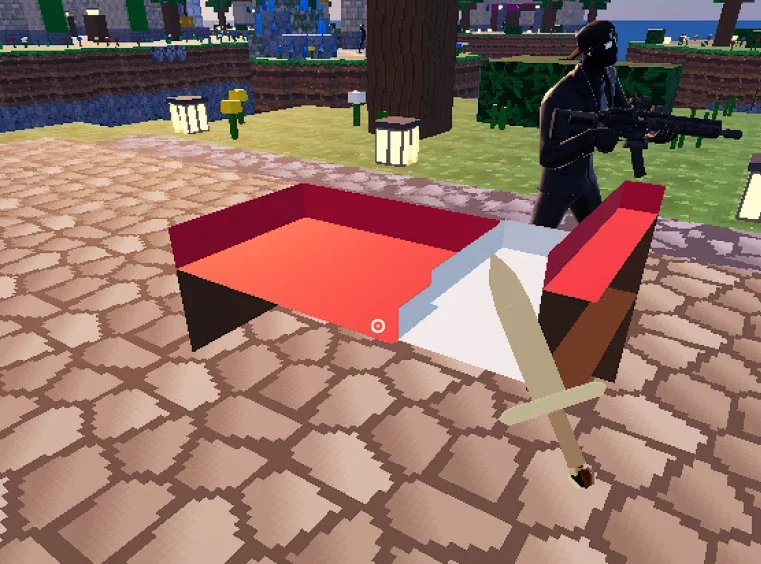
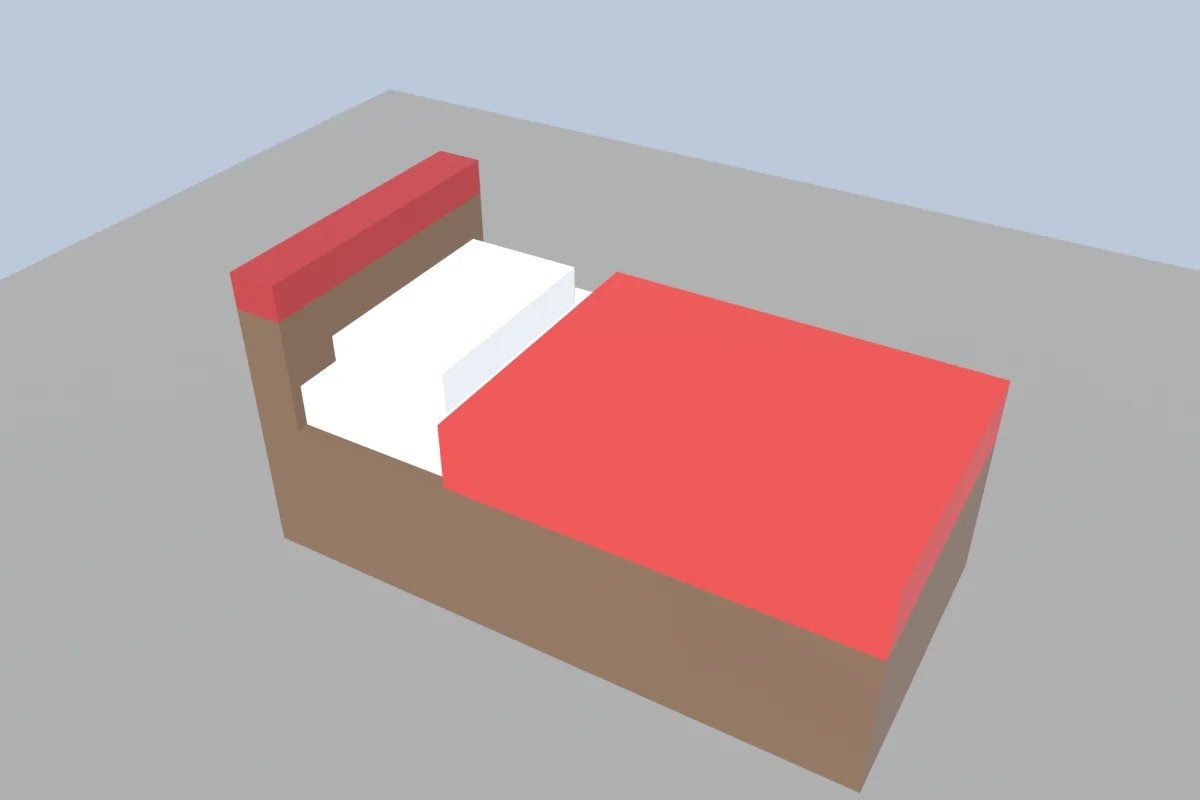
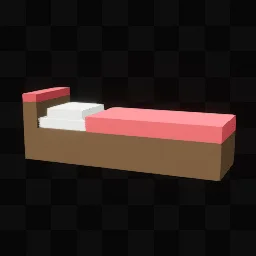
The biggest single finding was the bed: a white pillow and a team-coloured blanket two blocks long form the same silhouette as in Minecraft. The hard constraint was that the bed must fill exactly a 2 × 1 × 1 block space so that players can build around it. A canopy bed was rejected because it looked like a bunk bed. The next box bed appeared in game as skewed triangles and flickered. Three causes were found one after another: the automatic LOD levels added by the importer, coplanar faces (z-fighting) and faces flipped inside out by the Y mirroring. Thin trim strips also flickered and looked ugly. The final bed (build_bed_v4.py, version 7 and its face-fixed version 8, asset SM_BW_Bed8_*) consists of five thick parts: a wooden frame 2 × 1 × 0.5, a headboard with a team-coloured top edge, a mattress, a pillow and a full-width team-coloured blanket. The faces were flipped the right way round, and a check counts the number of inward-facing faces (0). The collision was copied from the old bed (one box), and in game the bed was confirmed to be correct.

Finally the whole project was cleaned up, because UEFN's version control uploads the project folder to Epic's servers and the review may look at the folders. The words Minecraft, MC, Hypixel and 1.8.9 were removed from Verse identifiers, comments and debug output (replaced with classic). For example, the files became bw_pvp_manager.verse and pvp_rules.verse. 32 assets were renamed: EndStone → KeepStone, Obsidian → Bastion, Bedbug → Mite, Golem → Guardian, PowerBow → ReinforcedBow and PunchBow → WindBow. Backups were moved outside the project to the folder MyProjectF_ClaudeArchive. After a reference check, 82 unused old assets were deleted, such as atlases V1–V7, the old hearts and old signs. The Discord ad in the lobby was removed, because Epic's rules forbid directing players outside Fortnite. A final search found no forbidden words in text or in binaries. All that remained was the internal import data of the renamed assets, which cannot be changed through MCP, and old versions in the history of Epic's version control.

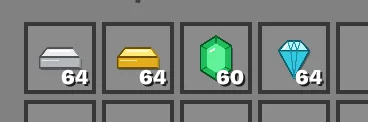
The old currency icons in the inventory: an iron ingot, a gold ingot, a green hexagonal emerald and a blue cut diamond. The silhouettes of the last two were almost identical to Minecraft's items.
The final diamond icon: a deep sapphire-blue raw crystal with shards, an outline and a glow.
The final emerald icon: a jade-green crystal cluster. The hue stayed green so that the currency remains recognisable.
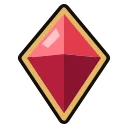
The original life crystal for the HUD: a ruby-red rhombus with a gold border. It replaced the Minecraft-style hearts.
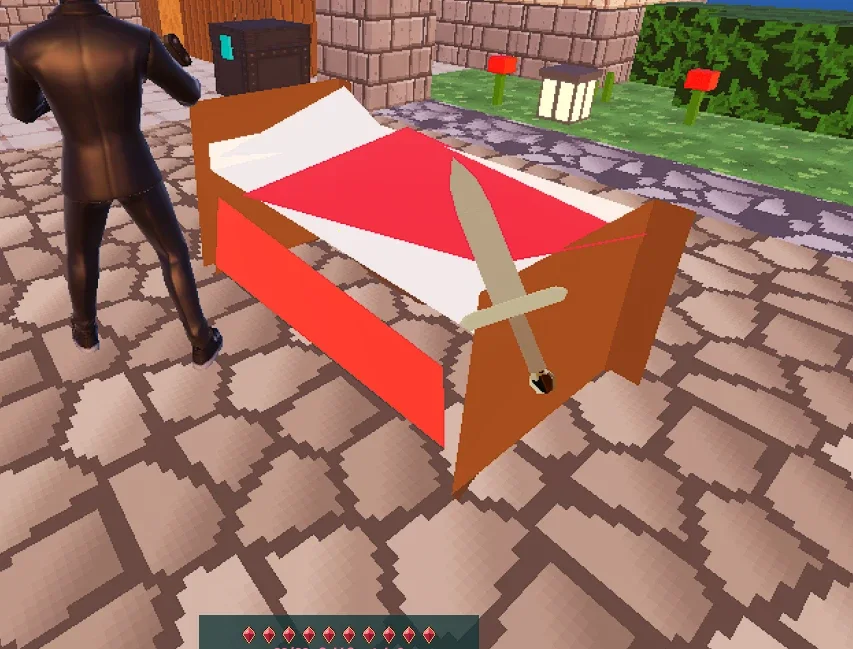
The new bed in game before the fixes: the faces are skewed triangles and the shape is distorted, because the importer's automatic LOD levels collapsed it.
A simplified bed in game: some faces are missing and the far walls are seen from the inside, because the Y mirroring had flipped the face winding order.
Blender preview of the final bed: a brown frame, a headboard with a red top edge, a white mattress and pillow and a red blanket as five thick parts on a 2 × 1 block footprint.
The bed model used in game, SM_BW_Bed8_0, in the UEFN preview. The faces are the right way round, and the team colour comes from the material.

Key values

WhatValueWhat it affects
Block grid100 cmAll map parts and player blocks share the same one-metre grid (from Grid V2 onwards).
Island floorZ 10000 cm (100 m)Floor level of the bases, diamond islands and centre island.
VoidKillZ−10000 cmKill height about 200 m below the floor, so a fall lasts about 4 s and there is time to save yourself with a throwable pearl (bedwars_building.verse).
Waiting lobbyZ 35000 cm, draw distance 150 mThe castle lobby is 250 m above the map and is not visible to players below.
Bridge removal696 cellsThe cells of the prebuilt bridges were removed from the building grid on 1.10.
Collision gaps514 → 0Ray-traced columns without a collision surface (5,937 checked) before and after the fix.
Grid V2 box collisionabout 1,360 boxesReplaced the triangle-mesh collision that the physics capsule snagged on.
Keep v3 collision boxes556 / 113 / 1698 / 829Base, diamond island, centre island and waiting lobby; decorations have no collision.
Building grid70,413 cellsbedwars_grid_support.verse after the centre island was added; generated with the script grid_gen_v3.py.
Sword tip / crown8 m / 13 mHeight of the floating centrepieces above the generator holograms (3–5.5 m).
Emerald generators(±7, ±7) cellsA square around the centre of the centre island, so that the distance is the same for every team.
Atlas v3256 px, 16 px tiles, 32 px cells, 8 px borderKeep v3's first map atlas, T_BWK_Atlas.
Atlas V4–V8512 px, 32 px tiles, 64 px cells, 16 px border30 original tiles; final T_BWK_AtlasV8, Nearest filtering.
Building block textures1024 pxT_BW2_* (Banner Felt, Carved Sandstone, Keep Stone, Crate Wood, Bastion Plate); bevel painted in, geometry a sharp cube.
Icons v2512 px31 shop icons plus blocks and currencies; outline, glow and shadow.
3D item scaleswords 0.42, tools 0.38, bows 0.32, others 0.28Sword about 62 cm (previously 36 cm), so that the item is visible to other players.
Viewmodel importat most 8 models at a timeImporting 32 models at once crashed UEFN after it ran out of GPU memory.
Storm Keep fogdensity 0.06, falloff 0.35, opacity 1.0, 13:00First values of the BW_Sky_StormKeep device; the device was switched off because of the movement slowdown.
Bed2 × 1 × 1 blocksThe bed must fill exactly this space so that players can build around it.

Final state

In the released game the whole map is in the Keep v3 style: eight Sky Keep bases in their team colours, four Chained Sword diamond islands and the Coronation Court centre island. The waiting lobby is a castle above the map. All map blocks come from the T_BWK_AtlasV8 atlas, which has original 32 px tiles and sapphire- and jade-toned gems. The building blocks are the original v2 set (Banner Felt, Carved Sandstone, Keep Stone, Crate Wood, Bastion Plate, Blast Glass) as sharp cubes. Icons, 3D items and first-person models are in the new style, except the bows, which are still the old rigged models. The bed is an original five-part model, the HUD uses life crystals, and the project files contain no Minecraft or Hypixel names. All models and textures are generated by the Blender scripts in the Blocks folder, so they can be regenerated. Open or uncertain: the Storm Keep sky device was switched off because of the movement slowdown, and the sources do not show whether it was later re-enabled. In gameplay screenshots the sky appears blue. The size of the larger items in another player's hand and the first-person colours of the sapphire Crystal gear were not separately checked in game. The internal import data of the renamed assets and the history of Epic's version control still contain old names. The map also has hidden old voxel bed objects that are not visible in game.

Next chapter: Workflow & release →